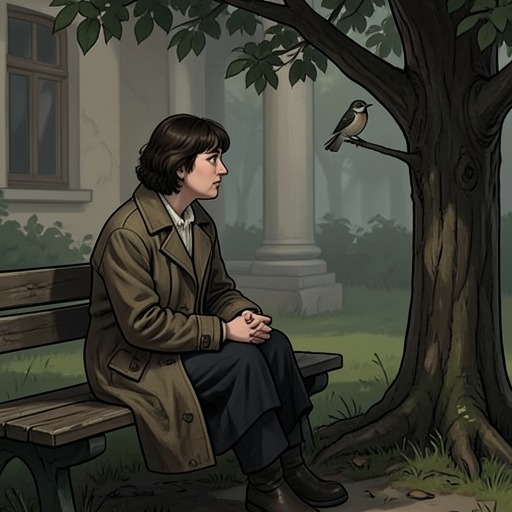
Helen Macdonald and her father
H is for HawkHelen Macdonald and her father are connected by a lifelong practice of looking: first together for sparrowhawks, later through his photojournalism and her own intense attention to a goshawk. His death changes the meaning of that inheritance. Patience, photographs, and small objects that once belonged to ordinary days become ways to register what has vanished—and to keep it in view.
Learning to wait together
When Helen was nine, she and her father watched for sparrowhawks nesting near the pines. The hoped-for signs were fleeting: a ripple through the treetops, a yellow eye, a barred chest among moving needles, or a silhouette against the Surrey sky. Helen fidgeted at the fence, bored by the long interval in which nothing seemed to happen. Her father explained that seeing a hawk required staying still and remembering how much she wanted to see it. His work as a newspaper photographer had taught him the same discipline: sometimes he had to remain in a car for hours, without getting up, until the picture came. At the time Helen heard a lecture rather than advice; the lesson acquired its force only later.
Years afterward, waiting patiently brought the hawks into view. Helen picked up a small clump of reindeer moss, a pale, branching lichen able to survive by becoming dormant when conditions are harsh. She kept the light object on a shelf near the telephone. Three weeks later, when her mother called with news of her father's death, Helen was looking at it. The moss became joined in memory to the last day she saw the hawks and the first moment she understood that her father was gone: an almost weightless keepsake acquired during one kind of waiting, present at the beginning of another.
Their shared attention extended beyond birds. Her father devised a project to photograph every bridge over the River Thames, and Helen sometimes joined him on Saturday mornings. They followed the river from its grassy source near Cirencester, consulted maps, crossed muddy ground, trespassed to photograph planks over streams, and endured complaints from farmers and the presence of cattle. The project took a year. Its completion left a photographic record, preserved among his slides at her mother's house, of ways to cross the river from source to sea. Helen remembers this undertaking not simply as an assignment but as a joint adventure: her father was also her friend and partner in eccentric quests.
A photographer's way of seeing
Her father's professional habits offered Helen a model for looking and also a warning about its limits. He described dangerous assignments, including working from a helicopter after a safety harness had snapped and taking a photograph from a precarious rung high on Salisbury Cathedral. Looking through the camera's viewfinder helped him get through such situations: the frame and the technical decisions occupied his attention, separating him from the fear of bodily danger. The camera also shielded him from the tragic scenes he photographed, among them accidents, train crashes, and the aftermath of bombings. He worried that this way of seeing had become habitual, a lens standing between him and other people's lives.
Yet photography also worked against loss. The thousands of images he made recorded that events had happened and prevented them from disappearing entirely from memory. His pictures ranged from a baby placing a small hand in an elderly person's palm to a fox crossing a woodland path, from wrecks and plane crashes to a comet across the morning sky. Helen understands his photographic life as a resistance to erasure, even as the camera could distance him from what he witnessed. The tension matters: his lens was both a barrier and a means of preserving contact with the world.
One winter day, after walking through a London park, he returned disheartened because a boy had shown no interest in the extraordinary sky above them. A 22-degree halo, a circumzenithal arc, and an upper tangent arc formed a pattern of light refracted through ice and air. Her father had asked the boy to look and remember, knowing that the sight would not recur in precisely the same way. Helen and the rest of the family teased him about the boy's lack of interest, but his sadness stayed with her. After his death, she began to understand that these brief natural spectacles made mortality visible: the world offered wonders that might be seen once or never again. The family albums held such moments alongside pictures of relatives—hoarfrost, blossom, storms, lightning, comets, and eclipses—making his attention a record of both intimate life and a world larger than any one life.
Death and the objects left behind
The news arrived in an ordinary interruption. Helen was about to leave the house when her mother said she had received a call from St Thomas' Hospital. Helen understood from that first sentence that her father had died. She collapsed to the carpet with the telephone against her ear, looking at the reindeer moss on the shelf while her mother explained that nothing could be done because of his heart. Her mother urged her not to make the long drive that night; in the shock, neither of them knew what should be done. Helen's brother was also part of the family left trying to grasp a world that had already changed.
Helen insisted on going to a restaurant with Christina because they had booked a table. She ordered food but could not eat it. In the days that followed, memories did not arrange themselves into a coherent sequence. On one walk from Waterloo toward the hospital, her mother carried his carefully folded glasses and other belongings; after leaving with a plastic bag containing them, they looked from Waterloo Bridge at the River Thames. Helen smiled, partly because the water's movement toward the sea still made sense and partly because it recalled the bridge project she had shared with her father. The smile arose from a physical fact and a remembered collaboration, while the rest of the day remained difficult to comprehend.
Another episode made bereavement collide with the practical residue of his life. Her father had left his blue Peugeot near Battersea Bridge and never returned for it. Helen and her family searched for hours before realizing it must have been towed. When she called the compound, she had to explain that the car's owner could not collect it because he was dead. His press pass was still tucked into the sun visor and his cameras were in the boot. The family took his death certificate to avoid the towing fee. The official document solved the immediate problem, but neither the explanation nor the paperwork could make the loss comprehensible.
What his attention leaves with Helen
After her father's death, preparing falconry equipment brought his presence back into the room. Helen cut and worked leather to make jesses, the straps connecting her to the goshawk she was about to acquire. The task recalled her twin brother, who had died soon after birth, a loss that had not been spoken of in the family and that Helen learned about only years later. She wondered, without claiming certainty, whether that early absence had shaped her attachment to birds or her sense that something was missing. Now the jesses seemed to her to join what might otherwise be separated: hawk and handler, and the living with the lost. While working, she remembered her father deliberately calling technical equipment by the wrong names, such as calling hoods hats and creances pieces of string. She had thought he was teasing her. She later understood that he knew the correct terms and was acknowledging her expertise in his own understated way; in his professional world, photographs were simply snaps and cameras were kit. The memory turns a familiar joke into a belated recognition of affection.
Manning the hawk gave Helen purpose during the months after the death. Sitting in a darkened room with the bird, she recalled that her father used the camera as protection from danger and painful involvement. She wondered whether she, too, had learned to become a watcher by observing him, but could not comfortably settle that question. Instead, she returned to what his photographs had done: each one testified that something had occurred and could not be made not to have occurred. Watching the hawk and thinking of her father's pictures therefore meet at a difficult point. Attention can create distance, but it can also preserve the reality of what is passing.
Helen's close observation of the goshawk develops into a bodily effort to read the bird's smallest changes in posture and expression. The memoir connects this vigilance to the practice of watching that began with her father, without making the two relationships identical. The hawk remains an animal with her own moods and actions, not merely a symbol of bereavement: she plays, responds to people, and makes choices Helen must learn to interpret. When Mabel first eats from Helen's hand in Christina's presence, the long-awaited moment arrives in circumstances Helen had not planned. Elsewhere, playing catch with the hawk offers companionship but does not supply the human closeness Helen misses. Her father's example thus persists less as a solution to grief than as a discipline of attention: to wait, to notice, and to keep a record of what might otherwise disappear.