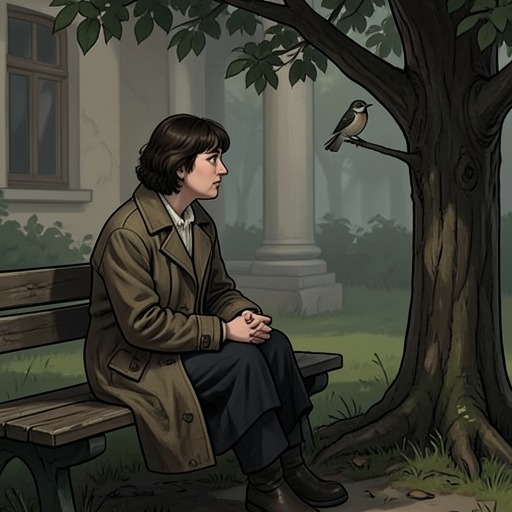
Helen and her father
H is for HawkHelen and her father share a way of looking: alert to what might vanish, attentive to the world’s small and extraordinary details, and aware that seeing can become a form of keeping. His death makes that inheritance newly legible. Photographs, plane-spotting notebooks, a misplaced key, and the memory of his hand holding hers become more than traces of a life; they give shape to a grief that eventually changes into love.
A childhood of watching
As a child, Helen hid for hours in bushes and trees with binoculars. Her father delighted in teasing her that she must be a spy, a possibility he treated as only partly a joke. He understood the appeal of secrecy because his own work involved patience, detection, subterfuge, and making a record. He once showed her a miniature silver camera that took special film, an object that condensed the likeness between their interests: both could involve looking closely, staying hidden, and noticing what others missed. He had also arranged infrared beams to photograph wildlife at night, watched the private lives of cabinet ministers, and followed nuclear waste on secret trains. To him, the methods of historians seemed more mysterious than those of spies.
The joke also gave Helen a way of seeing her father as an interpreter of her habits. She insisted that she taught English and the history of science, worked in libraries, and conducted research; he continued to imagine the more secret life suggested by her childhood concealment. In adulthood, that playful mismatch returns with painful force. At a summer lunch, surrounded by people watching the hawk, Helen feels that she has become neither the historian she had described to him nor quite herself, but the hawk woman. The remembered exchange makes the change feel like a loss of identity as well as a transformation of work: her father had known her through the hidden watcher she once was, while grief and falconry have made that watching visible to others.
The camera and the ethics of attention
Helen’s father described dangerous assignments as white-knuckle jobs. He could photograph from a helicopter after its safety harness had snapped or work high above the ground on a frail iron rung. He explained that looking through the camera helped him get through such moments: the viewfinder turned the world into a composition and filled his attention with technical decisions about exposure, depth of field, and the image he hoped to make. The lens provided distance from danger, but it could also distance him from the suffering he photographed, including accidents, train crashes, and the aftermath of bombing. He worried that the camera had become something between him and ordinary life.
Helen wonders whether she learned to be a watcher from him, and whether her own attention began as an imitation of his professional way of coping. She cannot settle the question; thinking that it might be true is harder than simply denying it. Instead, she considers what his photographs accomplished. Each image fixed an occurrence that could not be made not to have happened: a baby’s hand in an elderly person’s palm, a fox crossing a woodland path as a man raises a gun, wreckage, a comet, or a politician wiping his brow. His pictures were not simply an escape from experience. They made a public record against forgetting, giving events a memory beyond his own.
That commitment to noticing also shaped his life outside work. One winter evening he came home saddened because a boy in a London park had ignored a striking display of ice and sunlight in the sky. His father had urged the child to look and remember, and the child’s indifference stayed with him. After his death, Helen understands more fully the sadness behind that moment: remarkable sights arrive and disappear, and attention cannot guarantee that anyone else will share them. The family photographs on her mother’s shelves preserve not only people but also fleeting weather, blossom, birds, and celestial events. In this inheritance, looking is both an appetite for the world and a response to its impermanence.
Death and its belated recognition
Helen’s father died after going out to photograph storm-damaged buildings in Battersea, when his heart failed. His death enters the narrative not as an abstract fact but through the moment Helen understands its permanence. On a train with her mother and brother, she is travelling to look for his car. She remembers clutching the coarse upholstery and noticing the passing details of the journey. Only after they reach the unfamiliar platform at Queenstown Road railway station does she realise, fully, that she will never see him again. She stops and cries out for him; the word no gives way to a long, collapsing howl. Her mother and brother hold her, and the family clings together in shared grief.
The scene makes the loss bodily and relational. Helen recalls the quiet man in a suit with a camera on his shoulder, a person whose working life had been spent recording the movement of streets, storms, stars, and public figures. The camera he had taken on his final assignment still held his photographs when it was handed to her mother at the hospital. Helen saw the last image once: an empty London street, blurred and taken from too low an angle, with a damaged wall receding beneath a stormy sky. She cannot stop seeing it, though she does not want to see it again. The photograph records the scene without explaining the death; its persistence in memory is part of the wound.
At the hospital, Helen initially cannot accept the body as her father. He seems to her like a waxwork dressed in pyjamas, until she notices the cut on his arm that would not heal. She struggles to speak, then tells him that she loves and misses him and will always miss him. She explains things she can no longer remember, waits in the hope that an answer might come, and finally takes his hand and squeezes it in goodbye. This farewell gives her speech a destination even though no reply is possible. The scene’s silence does not resolve the loss; it marks the moment when she recognises that the conversation has ended.
Shared grief, refracted through the hawk
After her father’s death, Helen returns to her parents’ house while preparing to move. The rooms are full of ordinary reminders: the chairs he should occupy, cups he used, and his careful handwriting on a note by the back door. His absence makes familiar domestic objects difficult to bear. In her old room, Helen finds the animal books of her childhood, many of them ending in the deaths of their animal characters. She remembers having expected those endings as the pages dwindled, but now that she has trained a hawk, loss is no longer confined to the foreknowledge supplied by books.
That change alters how she reads T. H. White’s experience of losing Gos. As a child, Helen had felt a strong kinship with White through his imagined communion with the vanished past at Chapel Green, but she had not understood the full force of his bereavement. After her own father’s death, she can feel the blankness that White describes when Gos is lost. The comparison does not make their losses identical; it gives Helen a language for a scale of pain she had previously known only as narrative. The hawk and the account of White’s loss become part of the way she approaches her own grief.
Falconry also brings Helen into repeated contact with her father’s memory. While waiting for Mabel to feed, she recalls how he used the camera as a way to manage danger and asks whether her own habit of watching came from him. His example gives her a possible inheritance, but not a simple answer: observing can protect a person from involvement, while photographs can also testify that a life and its events were present. The tension between distance and witness runs through Helen’s understanding of both her father’s work and her own attention to the hawk.
Objects that preserve and change meaning
Later, Helen finds six cloth-spined plane-spotting diaries at the bottom of her father’s bookshelves. One is from 1956, when he was sixteen. Its ruled columns record the time, number and type of aircraft, remarks, and registration numbers. On successive days in April, he watched for more than nine hours and then twelve hours. The notebooks contain hundreds of pages and thousands of aircraft, entered with the detailed precision Helen remembers from her own childhood fascination with hawks. A glued-in photograph and his note identifying a Soviet aircraft as a likely civil conversion reveal the same fierce exactness. Reading the diaries makes her father feel close: his patience and sustained looking are present in the marks he left on the page.
A scrap of cardboard tucked between the notebooks holds a silver key under clear tape. Her father had sent it so she could stay at his London flat; after Helen lost it, he had promised to have another cut, but never did. The key returns her to an earlier memory of standing with him among the stones at Stonehenge, her small hand in his, asking whether the ancient structure was a house. Its attachment to the cardboard makes an unfinished practical matter into a physical remnant of their shared past. Helen can feel the cut edge and, for the first time, understand the size of her grief.
The diaries and key do not restore the person they record. Instead, they make remembrance tangible without pretending that it can reverse death. Helen recognises that time has worked on her grief while she waited, much as patience had been part of her father’s way of looking. The change is not forgetting but a shift in what the remembered objects hold: the loss remains, yet it is no longer only absence. She puts the key back on the shelf and answers, in a whisper, the love her father had written on the card. Their relationship therefore persists not as a reunion but as an inheritance of attention, affection, and material traces through which Helen can continue to address him.