Helen's father
H is for HawkHelen's father is remembered as a newspaper photographer whose patient attention to the world became part of his daughter's inheritance. He taught Helen to wait for hawks, shared with her a taste for ambitious small quests, and made photographs that preserved passing moments. After his sudden death, these habits and memories acquire a new weight: they show her a man who used the camera both to face difficult work and to resist forgetting.## Identity and Early Habits Helen's father grew up during the war. For the first four years of his life, his family lived beneath aircraft passing overhead; as a boy, he learned to identify planes by their engines, shape, and configuration. He made a study of them with the urgent thoroughness of a child who wanted to know what was in the sky. Later, he cycled to airfields including Farnborough, Northolt, and Blackbushe with a bottle of Tizer, a notebook, pencil, and Box Brownie camera, waiting by the perimeter fence. Plane-spotting became a lasting habit of looking up, identifying, and recording.
That early attentiveness developed into a career in photojournalism. His work sometimes put him in physically dangerous situations: on one assignment, he leaned out of a helicopter to take a photograph after its safety harness had snapped; on another, he stood high above Salisbury Cathedral to photograph through a fish-eye lens. He explained that looking through the camera helped him get through such assignments by concentrating his attention on the image and the technical decisions it required. The method also offered distance from distressing subjects, including accidents, train crashes, and the aftermath of city bombings. He worried that this way of seeing had become a barrier between himself and other people's lives.
Teaching Helen to Watch
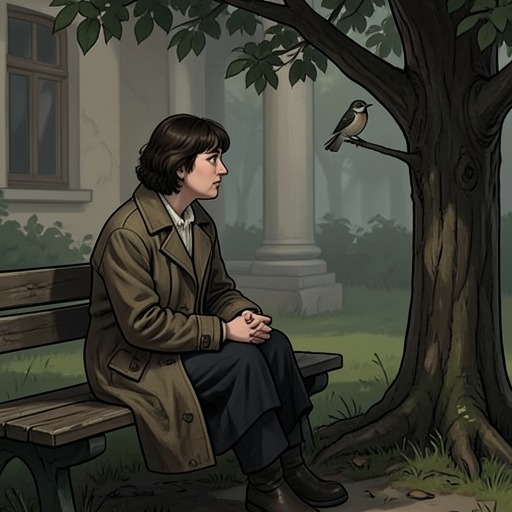
When Helen was nine, she went with her father to look for sparrowhawks nesting near the pines. She fidgeted as they waited, and he explained that seeing something desired might require staying still in one place. He connected this advice to his work: to get a particular photograph, he sometimes had to wait in a car for hours without leaving. His lesson was not merely about spotting birds; it was a way of describing the patience his work demanded. At the time, Helen heard a lecture rather than advice. Years later, after she had waited quietly and seen hawks, she recognized that she had learned what he meant.
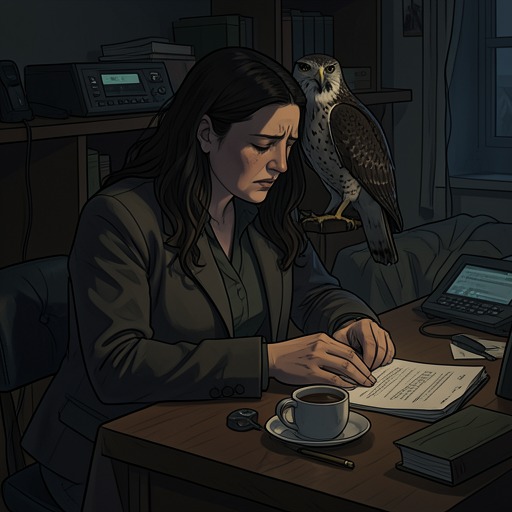
That memory became attached to a small piece of reindeer moss she carried home after seeing the hawks. She kept it on a shelf near the telephone. Three weeks later, when Helen's mother called to tell her that her father had died, Helen was looking at the moss. Its association with patient waiting and endurance made it an accidental marker of the transition between an ordinary day outdoors and the news that divided her life.
Photography, Memory, and Shared Projects
His photographs were more than a record of his assignments. Helen understood them as evidence that particular things had happened and could not be made not to have happened. His archive ranged from intimate human moments to public events and the natural world. The record included a baby placing a small hand in an elderly person's palm, a fox crossing a woodland path as a man raised a gun, a car wreck, a plane crash, a comet, and the Beatles in Paris in January 1964. In this sense, his work opposed disappearance: photographs carried moments beyond the limits of his own memory.
He was also alert to events that could not be repeated. After seeing a complex arrangement of ice halos and arcs in the sky above a London park, he urged a small boy to look and remember it. The child's lack of interest disheartened him. In retrospect, Helen understood his sadness as part of his awareness that unusual sights arrive and pass, sometimes unseen. The family albums he left included not only family portraits but also birds, blossom, frost, storms, comets, and eclipses.
His camera work extended into family life through a year-long project to photograph every bridge over the River Thames. Helen sometimes accompanied him on Saturday mornings as they followed the river from its source near Cirencester, consulted maps, explored muddy streams, and sought out crossings. Their search could involve trespassing and rebukes from farmers, as well as negotiating cattle, but he completed the project. The resulting slides formed a photographic record of the bridges from source to sea. Helen remembered him not only as her father but as a friend and partner in such excursions.
Their Relationship and Its Unspoken Affection
Helen's father took an interest in her falconry, though he deliberately called its equipment by the wrong names. When she made leather jesses for the hawk she was about to acquire, she remembered that he had called hoods hats and creances bits of string, and had assumed he was teasing her. In the midst of mourning, she reconsidered: he knew the proper terminology, but as a photographer he habitually called photographs snaps and cameras kit. His casual language, she realized, had not been mockery but a compliment to her expertise.
The realization came as she cut and shaped the jesses, the straps that would connect her to the hawk. Their practical purpose also made them an image of connection at a time when her father was absent. The work brought him vividly to mind: his grey hair, glasses, blue cotton shirt, slightly askew tie, and coffee cup. Helen could not recover the chance to explain what she had misunderstood, but the equipment she made became inseparable from the memory of his affectionate attention.
Other unfinished business surfaced after his death. Helen had borrowed a spotting scope from him for birdwatching and forgotten to return it on her last visit. His promise that there would be another chance became painful because there was no next time. As Helen, her mother, and her brother travelled to search for his car, the loss also became concrete in the ordinary tasks left behind. The car had been towed; Helen had to explain by telephone that its owner could not collect it because he had died, and the family took his death certificate to the compound to avoid the towing fee. The administrative resolution could not make the event feel comprehensible.
Death and the Meaning of His Legacy
Helen's father died after his heart failed while he was photographing storm-damaged buildings in Battersea. At the hospital, his camera was handed to Helen's mother. Its final photograph, which Helen saw once, showed an empty London street and a damaged wall beneath a stormy sky. She could not forget the image, though she did not want to see it again. The camera that had preserved so many moments had also recorded the setting of his final work.
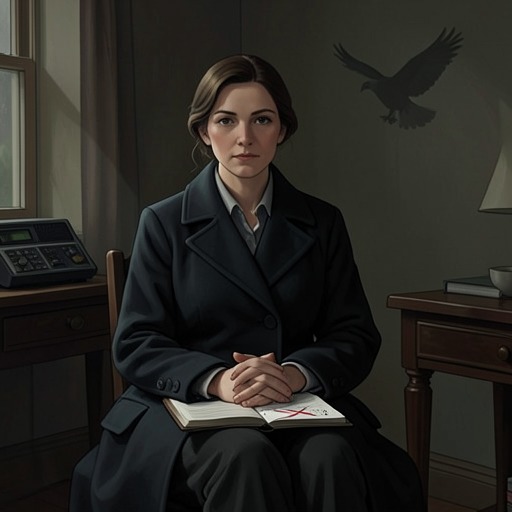
At Queenstown Road railway station, while walking with her mother and brother on the way to look for his car, Helen first understood that she would never see him again. She stopped and called out for him; her mother and brother held her as they cried together. The recognition was both intimate and irreversible: the quiet man with a camera on his shoulder, who had gone out to photograph the changing world, was gone. A story he had told the family over breakfast later became central to Helen's memorial address, showing how his remembered words continued to guide her even when she could not yet make sense of his death.
His influence persists in Helen's practice of watching. She had once thought of birdwatching as her own version of looking at flying things, distinct from his interest in aircraft. Later, she recognized that both had been forms of attention shaped by the same family habit: looking upward, waiting, and learning to identify what passed overhead. His photographs and their shared projects did not undo the separation. They gave Helen a way to remember him as someone whose life was directed toward noticing what might otherwise vanish.