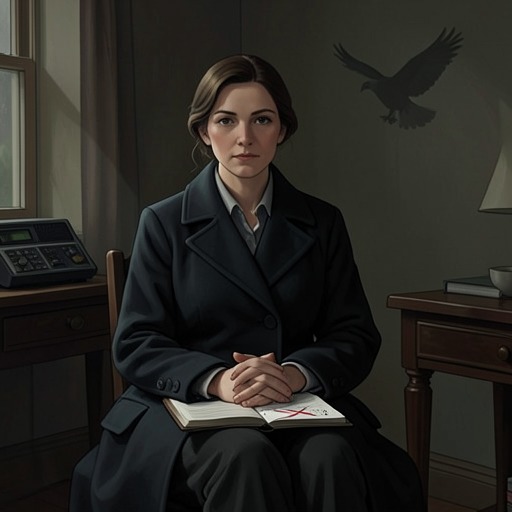
Helen's mother
H is for HawkHelen's mother appears in Helen's account not through a separate biography but through acts of shared attention and care: listening when Helen is upset as a child, accompanying her and her brother after Helen's father's death, and receiving her when she returns to the family home. These brief scenes trace a relationship shaped by ordinary domestic closeness and by the altered life that follows bereavement.
Family Role and Childhood
As a child, Helen finds her mother wiping the bathroom mirror after reaching a painful passage in T. H. White's account of training Gos. Helen is outraged that White leaves his goshawk to pursue other hawks, and goes looking for reassurance. Her mother asks whether this is the book Helen has been talking about; the question gives Helen the opening to explain why she is so upset. The scene establishes her mother as present in Helen's early emotional life, though it does not show her offering an interpretation or resolving the child's distress.
The Journey After Helen's Father's Death
Soon after Helen's father's death, Helen travels by train with her mother and brother to look for his car. The journey is remembered through concrete details: Helen gripping the coarse seat upholstery, the buddleia and clinker beside the tracks, a green gasometer, and the train slowing at Battersea Power Station. On the platform at Queenstown Road, the fact of the loss becomes suddenly undeniable to Helen: she understands that she will never see her father again.
Helen stops and cries out for him, then collapses into a howl of refusal. Her mother and brother put their arms around her, and the three cling to one another and weep. The embrace does not undo the loss; it makes the family's shared grief physically visible. In Helen's recollection, her father is at once the quiet man with a camera and the photographer who sought out the world's changing scenes, and the family's grief gathers around the knowledge that he will not return from his work.
The Family Home Afterward
Later, Helen returns to her parents' house for a weekend while preparing to move. She corrects herself as she thinks of it: it is now her mother's house. The change is small in wording but decisive in implication. Helen carries boxes into the garage, then sits with her mother in the kitchen while Mabel rests and preens on the sunny lawn. They drink tea, remember Helen's father and earlier times, and share laughter. Helen is glad to see her mother, but being there is difficult: the chairs should hold her father, the cups are ones he used, and his handwriting remains on a note by the back door.
The contrast between the kitchen's conversation and Helen's private pain marks the limits of what companionship can ease. Faced with the familiar objects, she runs to her old room and sits on the small bed, hugging her knees. Her mother's presence makes the home a place where memories can be shared, but the rooms also keep registering the absent person who once occupied them.
Narrative Significance
Helen's mother is drawn through relational moments rather than extended speech or independent plot action. She is there at a childhood threshold, when Helen brings her literary distress into the household, and again at the moment when bereavement becomes undeniable on a railway platform. Later, the two women can reminisce and laugh, even while Helen remains vulnerable to the house's reminders of her father. Across these scenes, the mother's role is not to explain grief but to share its setting and, at the station, its bodily expression; the family home consequently becomes both a changed domestic space and a place where affection and absence coexist.