Human–hawk identification
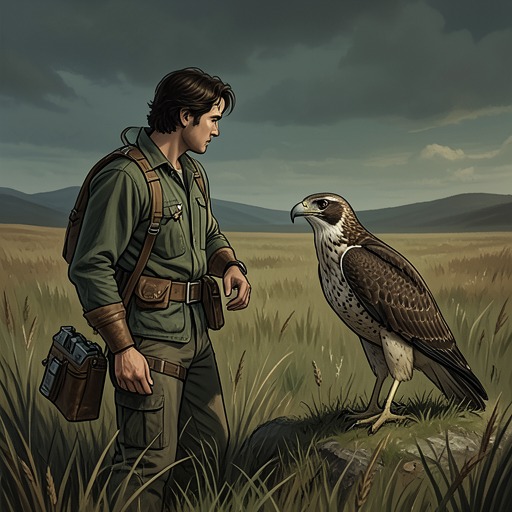
H is for HawkHuman–hawk identification is the process by which sustained attention to a hawk becomes a form of imaginative self-reconstruction. In Helen Macdonald’s account, training Mabel is not only a matter of learning the bird’s habits: during bereavement, watching her gives Macdonald a way to inhabit, and temporarily long to become, a different kind of being. The identification is powerful but not simple. It reveals the trainer’s vulnerability even as it depends on recognizing the hawk as a creature with moods and purposes of her own.
Grief and the imagined hawk
Macdonald connects this identification to the loss of her father. In the early weeks of bereavement, she describes the mind as selecting new figures to love and new selves with which to love them. Watching a film, she had partly recognized Prideaux as a father figure and found herself drawn to Jumbo, the lonely boy who tries to serve as a substitute companion to his teacher. On a Scottish quayside, in another moment she could not then explain, she felt herself choosing to be the hawk. These shifts are presented not as settled conclusions but as signs of a mind searching for forms in which to endure loss.
Mabel sharpens that search. Macdonald had trained many hawks before, so the practical stages of training were familiar. What was unfamiliar was the person undertaking them: she felt herself to be in ruins, while the young hawk on her fist seemed to embody qualities she desperately wanted—solitude, self-possession, freedom from grief, and numbness to human hurt. The identification therefore begins in contrast. Mabel appears to possess an independence that Macdonald longs for, but that apparent freedom is also an interpretation shaped by the trainer’s own bereavement.
A small misreading makes the distinction plain. Macdonald worries that Mabel is sleeping because she is sick, and wonders whether something is wrong with herself as well. The bird is not ill: she is a baby, and sleep is ordinary for her. Macdonald recognizes that her own orphaned, suggestible state has made her read the hawk through her confusion. This correction does not cancel the emotional force of identification; it shows why that force must be distinguished from knowledge of the animal. The hawk can become a model for a desired self without being reducible to that model.
Watching as a route across the boundary
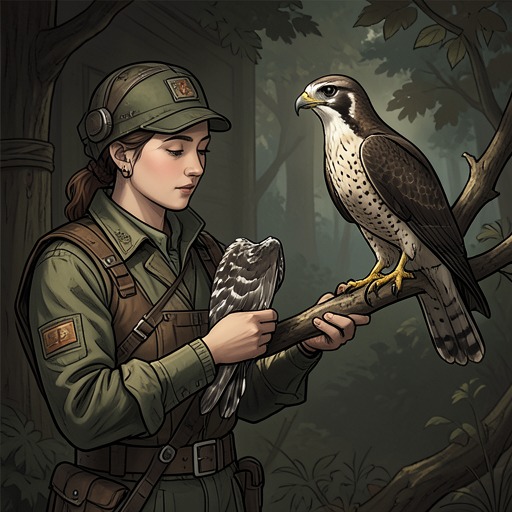
The transformation described in the book is neither bodily metamorphosis nor a claim that human and hawk are identical. It arises through the discipline of close observation. In the first days with a wild hawk, the trainer must judge when to move, sit, approach, or withdraw. Macdonald learns to read posture and feather position: feathers held close indicate fear, while a looser arrangement suggests ease. With continued attention she begins to notice finer changes, including subtle movements around the beak and eyes that help her distinguish states such as contentment or sleepiness.
This practical reading develops into anticipation. A skilled trainer can predict what a hawk will do by attending to what it notices and how it responds. Macdonald describes the process as an imaginative loss of self: the trainer seems to feel the bird’s apprehension and to share its field of attention. The claim is grounded in the habits of watching, not in any assertion that the hawk communicates in human terms. What changes is the observer’s attention and sense of self, trained to follow another creature’s cues.
For Macdonald, this capacity has a longer history. As a child she watched birds by making herself disappear into the act of looking; in that imaginative disappearance, the birds seemed to take flight. Training Mabel renews the same disposition under the pressure of grief. The language of becoming a hawk names an inward change produced by attention: her ordinary human perspective recedes as she tries to understand the bird well enough to train her. The book also gives that change a cost. Macdonald feels her humanity burning away in the darkened room, suggesting that intense identification can estrange her from ordinary human company as well as bring her closer to the hawk.
White, resemblance, and difference
T. H. White provides an earlier and unsettling counterpart. Macdonald had wondered why he bound himself to a hawk he seemed to hate. Training her own hawk opens a way for her to see both White and the bird in his account more clearly: a hurt man and a hawk being hurt. She recognizes a shared desire to cut loose from the human world and escape into wildness, while also seeing that such escape can strip away human tenderness and leave a person isolated. White becomes part of her story not as a subject whose life she claims to explain, but as a writer with whom training creates a quiet, continuing conversation.
The comparison does not make their experiences identical. White’s writing and Macdonald’s training belong to different lives, and Macdonald’s attention to his unhappiness sits beside her admiration for his delight in the natural world. His capacity to find the lives of other creatures surprising and novel matters to her precisely because it offers something beyond despair. The hawk thus connects two human histories without dissolving their differences: identification becomes a means of recognition, not proof that one person can fully know another, or that a human can simply become an animal.
Historical labels and the hawk’s agency
The book places personal identification beside the language through which falconers have classified hawks. Macdonald had once preferred Peregrine falcon, admiring its speed and ease in open air, while regarding goshawks as difficult, frightening, and associated with death. She later links some of the falcon’s elevated reputation to the land and resources required to fly it properly: broad moors, estates, and farmland were more accessible to wealthy or well-connected people. The solitary trainer of goshawks, by contrast, had often received a lower-status place in falconry writing. These histories show that judgments about birds can carry judgments about the people who fly them.
Descriptions of female goshawks expose another kind of projection. Macdonald encounters later falconry books that characterize the birds as sulky, contrary, or difficult, and notices how readily such language turns an animal’s reactions into a fault located in the animal. An encounter with a man who assumes that she and Mabel must get along because both are female first makes her reject the idea that gender alone explains the hawk’s behavior. Reading older accounts then gives her a different emphasis: Simon Latham describes hawks as shy and fearful but sociable when treated with kindness, while Edmund Bert presents the keeper as a friend and playmate. Macdonald prefers this account of a relationship shaped by considerate conduct rather than by a presumption that the hawk is inherently perverse.
These contrasts qualify the idea of becoming a hawk. Identification does not require claiming the bird as a human mirror; indeed, such a claim could repeat the very projections the book examines. Macdonald’s training depends on reading Mabel’s particular signals and allowing her behavior to correct the trainer’s expectations. The relationship remains asymmetrical—one is training the other—but attention can make that work responsive rather than merely interpretive. Human–hawk identification is consequently both an inward passage through grief and a discipline of acknowledging difference: Macdonald finds a possible self in the hawk while learning that the hawk is not simply that self.