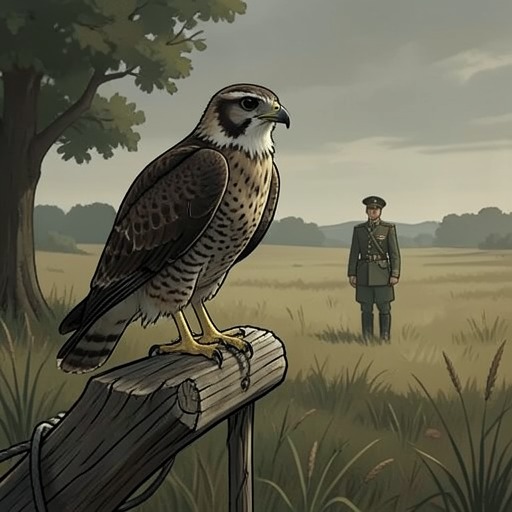
Interwar period
H is for HawkThe interwar period is presented not as a self-contained political history but as a layer in a landscape shaped by human use and interpretation. In the 1920s, pines were planted across the dunes to supply timber for future wars. In the 1930s, ruralist writing gave chalk downland a different charge, treating its exposed forms as a route to ancient and supposedly essential truths. These material and imaginative legacies matter because the book questions any account of the countryside that makes it seem untouched or historically simple.
A Landscape Made by Use
The interwar-era pine forest stands over an older, unsettled terrain. The Breckland landscape contains reindeer moss, flint fragments left by Neolithic craftsmen, and sandy ground altered by centuries of grazing and rabbit farming. The catastrophic movement of sand in 1688 belongs to a much earlier history, but it helps establish the larger pattern: what looks like wild terrain has been made strange through human activity. The pines planted in the 1920s add another layer, their purpose tied to anticipated war rather than to an ideal of pristine nature.
The forest therefore complicates the distinction between human history and wilderness. Its trees conceal much of the dune landscape, yet their presence is itself historical evidence. The book finds the region compelling not despite its industry, forestry, commerce, and disaster, but partly because those histories have produced an irregular countryside in which wildness and human intervention coexist.
Chalk and National Belonging
The 1930s chalk-cult supplies a contrasting way of reading the land. H. J. Massingham described the downland as a place where the visitor might encounter essential structures and archaic forms. The book connects this language to a wider cultural habit: treating open, elevated landscapes as purer or finer than the lowlands and imagining that intimacy with them confirms an inherited belonging.
The narrator later recognizes the exclusions concealed in that ideal. The chalk landscape can appear to offer an unbroken connection between people, ancestry, and nation, while obscuring other histories and other ways of living and working in the same place. The period's rural writing thus matters not only as a record of landscape appreciation but as part of a continuing myth about who belongs to the land. Its apparent simplicity can erase the complicated histories that made the countryside.
A Short Period in a Longer Ecological History
The book sets these interwar traces within ecological changes extending both before and after the period. Long-established rabbit warrens helped shape the sandy ground, while later outbreaks of myxomatosis devastated rabbit numbers and altered grasslands and predator populations. In a different landscape, the narrator contrasts chemically treated fields with organically farmed land and recalls the disappearance of birds that were once common. These later observations make the interwar landscape legible as one moment in a longer history of human influence, rather than a stable version of the countryside.
Goshawks provide another example of that longer chronology. Once native to the British Isles, they were persecuted and had become extinct there by the late nineteenth century. From the 1960s and 1970s, falconers brought birds from elsewhere in Europe and released some into the wild; their descendants eventually established breeding populations. That recovery does not belong to the interwar period, but it sharpens the book's account of the landscapes the period bequeathed: neither untouched nature nor a finished historical scene, but environments still changing through human action.
Retrospective Significance
The interwar period is encountered through evidence embedded in the present: the planted forest, the language of chalk-country idealism, and the histories those traces invite the narrator to reconsider. The book does not treat the past as a picturesque storehouse from which an uncomplicated English identity can be recovered. Instead, it shows how landscape images can conceal ecological loss and competing histories even as the land retains material signs of its transformation.
In this account, the 1920s plantation and the 1930s chalk-cult express different forms of human engagement with place: one practical and oriented toward future war, the other cultural and invested in imagined deep belonging. Their juxtaposition makes the interwar countryside neither a neutral backdrop nor a self-evident national inheritance. It is a historically made landscape whose meanings depend on what is remembered, what is overlooked, and whose presence is recognized.