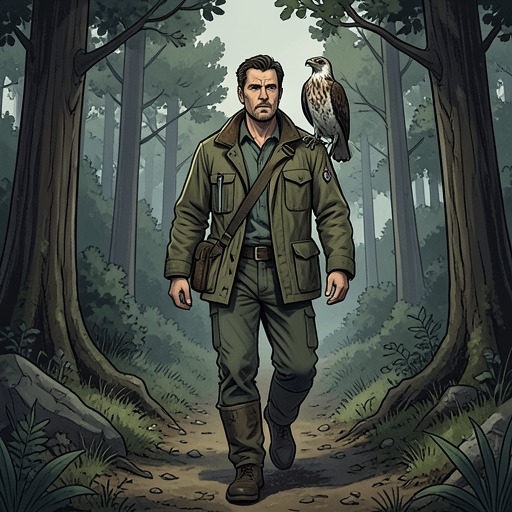
King Arthur
H is for HawkKing Arthur first appears in T. H. White’s The Sword in the Stone not as a king but as the Wart: an orphan raised in Sir Ector’s household, unaware that he is Uther Pendragon’s son and heir. Merlyn gives him an education unlike ordinary schooling, sending him into animal lives and unfamiliar encounters. The boy’s eventual kingship is therefore framed as the culmination of an education in power, danger, and responsibility. In Helen Macdonald’s account, however, the Wart’s most affecting lesson is also a perilous test of whether he can survive it.
Identity and Background
The Wart is described as kind, loyal, and slightly stupid. He grows up alongside Sir Ector’s natural son, but his place in the household does not reveal his true parentage: he does not know that he will become king. Nor is conventional social advancement available to him. He is not a gentleman, and so, as the book presents his circumstances, he will never become a knight. His future depends instead on Merlyn’s intervention and on an education that makes him see the world from positions other than his own.
That education gives the character a double structure. The Wart is at once a boy with no conscious claim to the throne and the future ruler whose identity is concealed from him. The revelation that he is Uther Pendragon’s son does not initiate his education; it arrives after it. He first learns through experience, and only later learns what those experiences have been preparing him to become.
Education Through Transformation
Merlyn rejects school desks and rote lessons in favour of transformation and encounter. As a fish, the Wart meets a pike in the castle moat and learns about a dictator’s appetite for power. As a snake, he encounters history; he hears trees speak and experiences the world’s beginnings through an owl’s senses. In a comfortably furnished sett, a learned badger discusses humanity’s role in God’s plan with him. These episodes make education an encounter with different forms of life and thought rather than the accumulation of classroom knowledge.
The method is not presented as harmless. The Wart’s animal lessons repeatedly place him in danger, and his education includes cruelty as well as wonder. That tension matters to the shape of his future: he is being prepared to rule, but the book does not make growing into that role a comfortable progression. His lessons test what he can endure and what he can understand while his identity remains uncertain.
The most frightening transformation comes when Merlyn turns him into a merlin and releases him into the castle mews at night. As a newly arrived bird among the trained hawks, the Wart must undergo the customary ordeal beside Colonel Cully, a goshawk. The test requires him to remain there while the other hawks’ bells ring three times. Cully is described as insane; as the trial proceeds, he mutters fragments of Shakespeare and Webster and becomes increasingly threatening. The scene makes the Wart’s position as both pupil and vulnerable animal impossible to ignore.
The Hawk Ordeal and Its Meaning
For a child reading the episode, the transformation unsettles the usual protection afforded to a human hero. A human child in a story may face danger, but the Wart has become a bird: the possibility that he might die seems newly real. Helen Macdonald recalls returning to the scene repeatedly, held by apprehension and by the need to reach its outcome. The Wart springs from the perch with Cully’s foot clutching his wing, wrenches himself free, and survives. His escape gives the scene its release, but does not erase the uncertainty that made the ordeal so powerful.
The test also connects the Wart’s fictional education to T. H. White’s interpretation of freedom. Macdonald reads the scene alongside White’s own experience of school ordeals and his belief that education prepares those under authority for eventual freedom. In that reading, the Wart is not simply being taught bravery for its own sake. The danger belongs to an education that is meant to lead beyond the test. The character’s survival therefore marks both a narrow escape and a step in a longer passage toward independent authority.
Kingship and Narrative Significance
At the end of The Sword in the Stone, the Wart pulls the sword from the stone, discovers that he is Uther Pendragon’s son, and is crowned King Arthur. The revelation resolves the gap between the boy’s unknown birth and his public identity, while his magical education supplies a foundation for the kingship that follows. Merlyn’s teaching is directed toward the morality of power: the boy who has encountered other lives is to become a ruler able to distinguish right from might.
The later conclusion to The Once and Future King, published as The Book of Merlyn, returns to Arthur as an elderly, tired, and despairing king awaiting his final battle. Merlyn appears, and Arthur wonders whether the wizard is a dream. In this later frame, the Wart’s education has become preparation for the burdens of rule, not merely the path to a crown. Merlyn is to teach him the morality of power and inspire him to found the Round Table, whose purpose is to fight for Right over Might. The character’s arc thus joins childhood transformation to an unfinished political and ethical task.
Macdonald also reads the Wart as a figure through whom White could imagine a different childhood. White places himself in the boy who runs freely around West Hill House, and gives that boy a magical teacher and an education without the fate White himself experienced at school. This reading does not make the Wart identical to his author; it shows how the character’s concealed royal identity and eventual power become a wish for restoration. In imagination, the lost hawk can be recovered and a new pupil can be trained. Arthur’s significance lies both in the legendary destiny he reaches and in the formative ordeals that make the journey there uncertain.