Knots and lines as bonds
H is for HawkKnots and lines as bonds are both literal equipment and a recurring way of thinking about attachment, control, and release in H Is for Hawk. Their meaning shifts across the narrator’s childhood and adulthood, and through T. H. White’s account of training Gos: a line may be a safeguard, a magical binding, or a tether deliberately made breakable. The motif’s central tension is that connection matters precisely because it cannot be made permanent without becoming confinement.
Childhood lines and the safety of a knot
The narrator connects the bond-making power of lines with an early memory of drawing a kestrel. In the picture, the jesses—the straps that tether a hawk—were pencilled over and over by her six-year-old hand. The repeated marks register more than attention to falconry equipment: in retrospect, they carry a child’s insistent wish for the safety of knots and lines. The image becomes a small, concrete record of the desire to make a bond secure enough to withstand loss.
That recollection gains meaning through Melanie Klein’s account of childhood mourning. Klein proposed that early states of mourning return when a person experiences later grief, and that adults may handle new losses through patterns formed in earlier ones. The narrator places the kestrel drawing beside that idea, not as proof of a single explanation but as a remembered image in which the longing for a secure tether had already taken shape. The drawn line is at once a falconer’s practical mark and an intimate trace of the child’s effort to hold something safe.
White’s leash: training toward freedom
White’s use of a line belongs to a different but related history. Having run from school to the woods, he nevertheless rented a cottage on the old road leading back to it. His escape changed his life without erasing the school’s idea of freedom: pupils advanced through successive years, gaining power and privilege before they finally left. The pattern made freedom an outcome reached through an ordeal, rather than a condition entirely separate from discipline.
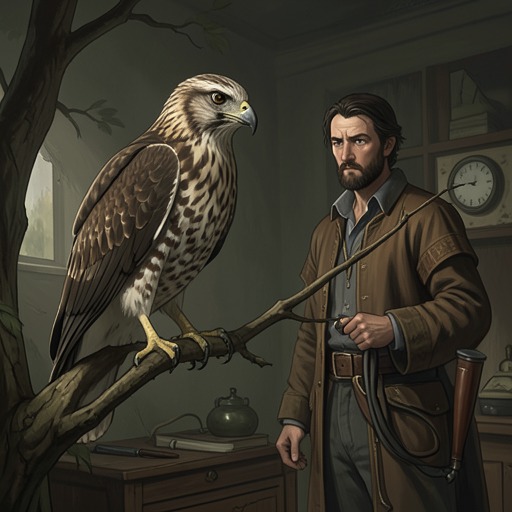
The book connects that inherited pattern to White’s choice to lengthen Gos’s leash with breakable twine. White had been a schoolboy who exercised authority over younger boys, and later became a schoolmaster and a falconer. The recurring arrangement, as the narrator interprets it, was that those under his authority were being trained for a future in which they would be free. The twine matters because it is not simply a stronger tether: its capacity to break makes the possibility of release part of the bond itself. White’s line can hold Gos during training while anticipating a time when the hawk will no longer be held by it.
Knots as spells in White’s imagined book
In Ireland in 1939, White considers writing about hawks again while recording the training of his falcons. He imagines a book about initiation, ordeal, and the falconer’s role in a hawk’s education. In that conception, knots become more than gear: White associates them with early spells and the invention of magicians. The hawks, bound to their blocks by the falconer’s craft, appear to be under enchantment. The practical act of tying thus becomes the seed of a story about power and belief.
White imagines the falconer moving through roles that include inquisitor, ritual guide, frightening tester, and finally Prospero, the magician who has led the hawks through the ceremonies of adolescence. This sequence gives the bond a dramatic arc: the falconer first appears to command, but the education is meant to culminate in the hawk’s independence. White imagines the escape as a charm being unwound, only for the escape itself to reveal a deeper charm: the wizard has been content for the hawk to get free. The knot’s power therefore lies not only in holding, but in making release part of the design.
Waiting, memory, and a bond that changes
The motif also meets the narrator’s reading of her father’s habits. His plane-spotting notebooks show an intense attention to things she had not understood. She comes to see them as records of ordered transcendence: watching aircraft, learning their movements, and waiting for them to pass could enlarge the watcher’s world. The patience her father spoke of is presented as bound up with that practice of looking and waiting. Here, connection is not represented by a tether around an animal, but by the sustained attention through which a person remains bound to what they observe.
A small object gives that understanding a physical focus. Between the notebooks the narrator finds a piece of brown cardboard with a silver key taped to it and a message in her father’s handwriting identifying it as the key to his flat. He had sent it so she could stay there while he was away; after she lost it, he had intended to have another cut, but had not done so. The rediscovered key brings back his handwriting and a childhood memory at Stonehenge, where he held her hand as she touched the stones and asked whether they formed a house. The remembered exchange associates a hand-held connection with a doorway whose destination remains unknown.
Holding the card, the narrator can at last feel the scale of her grief, which she compares to holding a mountain. Her father’s advice to wait returns with the object: time has passed, and the grief has changed into love. The passage does not make loss equivalent to a knot that can simply be retied. Instead, the key, the handwriting, and the remembered hand give the bond a form that survives its alteration. Across the book’s images, the line is most meaningful not when it prevents separation, but when it holds together memory, care, and the possibility of letting go.