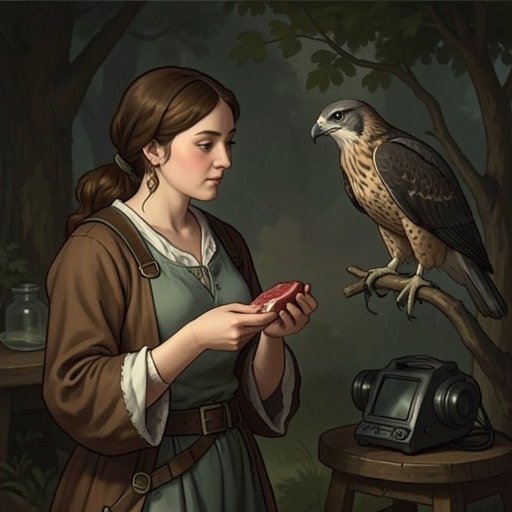
Mabel first eats from Macdonald’s hand
H is for HawkMabel first eats from Macdonald’s hand during an early test of whether the newly acquired goshawk can tolerate ordinary human activity. The moment is significant not only as a step in training, but as a correction to Helen Macdonald’s expectations: Mabel’s behavior must be read on its own terms, and their relationship begins to take shape through careful attention rather than a planned, solitary ritual.
Setting and First Exposure
Christina arrives with takeaway coffees and Sunday papers while Helen is living closely with the hawk in a darkened room. Helen is glad to see her and simultaneously resents the interruption; she wants company, yet thinks the two of them should be alone. The tension makes Christina’s visit an unplanned test of the gradual exposure on which hawk training depends. A person turning pages is one more unfamiliar presence for Mabel to observe.
Helen asks Christina to ignore the hawk and continue reading. With Mabel on the sofa, Helen removes the hood. Mabel stares, her feathers tight and her eyes wide, and Helen expects her to bate. The moment holds: after cautious observation, Mabel attends to the moving newspaper pages rather than fleeing. The scene shows acclimation beginning not through force, but through allowing the bird time to assess a new sight.
The First Feeding
An hour later, Helen and Christina are watching television, with Mabel balanced on Helen’s fist. Mabel suddenly bates. Helen initially reads the movement as fear and thinks she should hood the bird and let her rest. She then recognizes that fear is not what prompted it: Mabel is frustrated and hungry. Picking at her jesses, she turns to the meat beneath her feet and begins to eat.
The feeding is a first. Mabel picks, bites, swallows, and squeaks; she eats while still on Helen’s fist, with Christina present and the television playing. Her enjoyment becomes legible in her softened feathers and narrowed eyes. After finishing, she raises herself into a full rouse, holds the feathers out briefly, and shakes them back into place, a sign of contentment Helen has not seen from her before.
The setting sharply contrasts with Helen’s private idea of how the occasion ought to happen. She had imagined a moment born of solitude and meditative darkness. Instead, the first feeding unfolds in daylight, among another person, newspapers, and a comedy programme. That mismatch matters: the milestone belongs to the particular interaction Mabel accepts, not to the ceremonious scene Helen had anticipated.
Reading Mabel
The episode depends on Helen’s developing ability to interpret posture and feathers. Tight feathers indicate fear, while loose feathers suggest ease; closer attention reveals subtler cues in the bird’s face and behavior. The sudden bate first seems to confirm danger, but Mabel’s subsequent attention to food changes its meaning. Helen has to revise her reading in response to what the hawk actually does.
That work of watching is emotionally consequential for Helen. She describes becoming so attentive to Mabel that the bird’s apprehension begins to feel like her own, and that she can anticipate what Mabel may do. Here, however, close observation does not make the hawk an extension of Helen’s intentions: the misreading is corrected by Mabel’s distinct response. Hunger, frustration, and the discovery of food direct the moment, while Helen’s task is to notice and respond.
An Early Form of Partnership
The feeding is one step in an uneven process, not a declaration that Mabel is fully tame. Later, she can sit bareheaded on a perch and hop down to retrieve scraps of meat, yet she still bates when Helen edges too close with a garnished fist. The first eating therefore marks a limited but real change: Mabel will feed while perched on Helen’s glove, even as the distance at which she feels secure remains important.
Later scenes extend this emerging relationship beyond feeding. Mabel plays with paper and tissue toys, catches and tosses balls of paper, and invites Helen to throw them again. On a hunt, Helen tries to follow the positions of Mabel and a pheasant, finding her own perspective entangled with theirs. These later moments do not erase the boundaries between human and hawk; they deepen the story of attention and interaction first visible in the living room. The initial meal matters because Helen learns from the bird’s actions, while Mabel’s responses begin to make a shared practice possible.