Mabel's first unrestrained flight
H is for HawkMabel's first unrestrained flight is a decisive training episode in which a delayed, stressful evening turns an expected lesson into an uncertain release. Stuart's advice leads Helen to depart from her usual gradual method; Mabel takes flight, circles beyond immediate control, and eventually returns to the glove after an unsuccessful first approach. The outcome is recovery rather than loss, but the episode makes clear that flying free involves an independent animal whose return cannot simply be assumed.
Background and decision
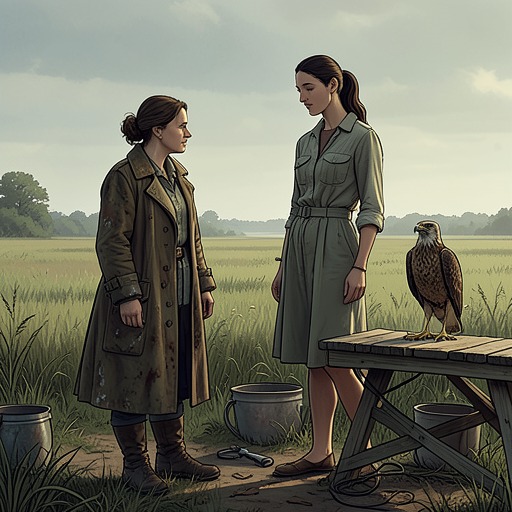
The evening begins with favorable conditions: the weather is suitable and Mabel is at the right weight to fly. Helen is eager, completing ordinary household tasks in anticipation, but her composure deteriorates as the afternoon progresses. She quarrels with her mother by phone and snaps at Christina, who has come to watch. Meanwhile, Stuart is delayed by a serious crash on the A14 near Cambridge. He tells Helen he is running late, but the resulting congestion diverts traffic through the city and leaves Helen, Christina, and Mabel caught in a slow-moving journey. Mabel bates repeatedly in the car; Helen's frustration and guilt rise together, compounded by her awareness that the accident has been severe.
At the hill, Stuart's Land Rover is already there. Mabel seems keen to fly during the walk up, but reacts to a brightly coloured training kite by bating repeatedly. Stuart persuades Helen not to abandon the attempt, saying they can find quarry for Mabel. Helen ordinarily intends to call Mabel to the fist on the creance, remove it, and allow one or two flights before trying her at quarry. This time she defers to Stuart, who has more experience with goshawks. The departure from her routine is important: the first free flight follows neither a calm journey nor the carefully staged progression she had expected.
Release and uncertain return
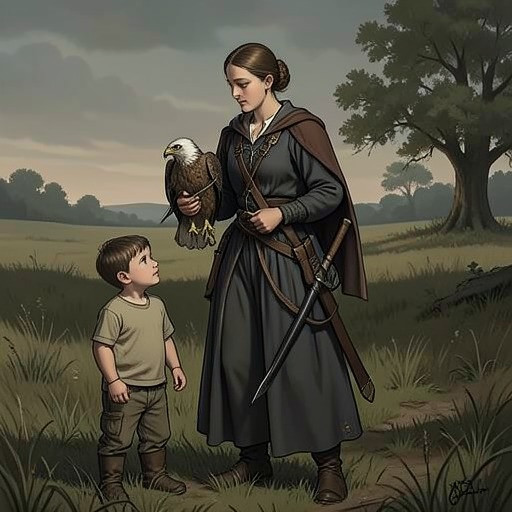
As evening darkens, Helen and Stuart walk into rough ground beside a copse. Helen has put Mabel in thin flying jesses, carried the swivel and leash in her pocket, and holds the jesses in her gloved hand. Following Stuart's instructions, she enters an area of thistles and dry seedheads while he beats the vegetation with a stick to flush hidden rabbits or pheasants. Helen is stressed and doubts the decision to release Mabel. When the hawk notices movement behind them and bates toward it, Helen lets her go.
Mabel flies powerfully for a short time, dips toward the movement, then begins circling and gaining height. Helen sees the space between them as an immediate rupture in their familiar relation: Mabel is exploring flight and unfamiliar ground, while Helen calls and whistles from below. The darkness and the ability to circle are new conditions for the hawk. Mabel does not return at once. She lands awkwardly on the crown of a young beech, whose branches bend under her weight, then comes toward Helen's raised fist when called. She strikes the glove but does not settle, and circles again before perching farther inside the wood, this time facing Helen.
Helen offers food and calls again. Mabel finally comes back to the glove. The recovery does not erase the uncertainty of the intervening flight: the first attempt to return has failed, and the hawk has moved farther into the trees before responding. Stuart tells Helen that Mabel is too high and that it is getting dark, but that getting her back makes the day end well. Helen is too shaken to answer easily and walks back to the car under the force of the experience.
Training, trust, and risk
The episode exposes a tension in falconry between a handler's planned sequence and the bird's actual choices. Helen's normal procedure would have separated untethered practice from flying at quarry. Under pressure, and relying on Stuart's experience, she accepts a riskier progression. Mabel's actions do not follow a simple command-and-response pattern: she pursues movement, circles, chooses a tree, misses the glove, and only later returns. Helen can call, offer food, and make the glove available, but she cannot dictate the hawk's route or timing.
The return is therefore both a practical success and a test of their working relationship. Helen uses several chicks on the glove and continues calling as Mabel watches from the trees. Mabel's eventual arrival restores contact, but does not turn the flight into a predictable exercise. The episode's ending is deliberately mixed: the hawk is back, yet the fading light and the danger of losing her have made the success costly in emotional terms. Helen's comparison of herself to T. H. White, a novice and fool, also places the scene beside the earlier account of White's attempt to recover Gos. Unlike that episode, this one ends with the hawk returned to the falconer's hand.
The goshawk and its inherited image
The flight also sits within the book's account of how goshawks have been described and valued. Falconry writing often elevated falcons as noble and graceful, while casting goshawks as difficult, solitary, and disagreeable. The distinction was not only about birds: flying falcons properly required extensive open land, access that tended to favor wealthy or well-connected people, while goshawks could hunt in more varied surroundings. The historical language surrounding the birds thus carried assumptions about status as well as temperament.
Helen has also encountered the gendered tradition of describing female goshawks as moody or troublesome. After someone suggests that she and Mabel naturally understand one another because both are female, Helen rejects the claim that sex explains the hawk's behavior. Her reading of older falconry books finds a contrasting account: goshawks could be shy and fearful, but also sociable and affectionate when treated with kindness. The first free flight gives these competing descriptions a practical counterpoint. Mabel is neither a passive emblem of female temperament nor a creature whose behavior can be reduced to a stereotype; she responds to unfamiliar circumstances in ways Helen must observe and accommodate. The bird's return matters precisely because it is an action Mabel makes, not an outcome Helen can guarantee.