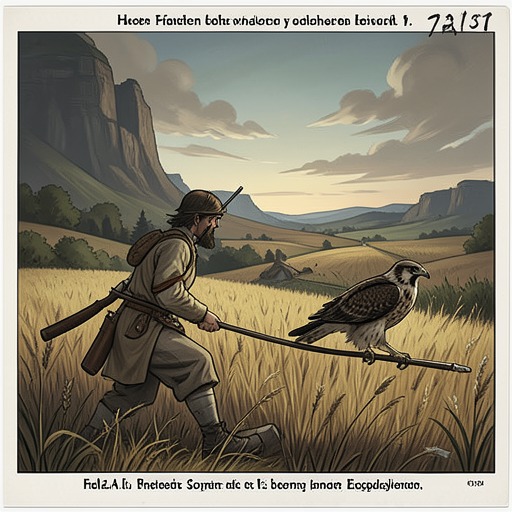
Mabel's pheasant kill
H is for HawkMabel's pheasant kill is a turning point in Helen's account of training the goshawk: a hunt that begins amid grief and disorientation ends with a changed understanding of the hawk, the prey, and the human participant. The day after Helen says goodbye to her father in hospital, she joins Mabel on the hill. As the hunt unfolds, Helen loses her ordinary sense of herself, then regains a connection to the world through the small, material fact of Mabel holding the dead bird. The scene does not present hunting as either simple brutality or a cure for grief. Instead, it makes Helen's involvement in the kill part of a difficult relationship among attention, responsibility, life, and death.
Background and setting
The episode follows Helen's final visit to her father. At his bedside she struggles to speak, then tells him that she loves him and will miss him. She waits for an answer before understanding that the conversation is over. The next day, out on the hill with Mabel, Stuart, and Mandy, the emotional force of that farewell has not passed; it becomes part of how Helen experiences the hunt.
Mabel pursues a common pheasant, which disappears into brambles beneath a tall hedge. She settles on top of the hedge and waits for Helen to flush the bird. Helen believes she remembers where it has gone, but her attention is divided between searching the ground and trying to understand what the hawk is doing above her. The other people are present, yet Helen can no longer see Stuart and Mandy. Mud slows her as she moves through the hedge, and the practical task of locating the pheasant narrows the possibilities she can imagine for what will happen next.
The hunt and divided attention
Because Helen cannot see Mabel while searching for the pheasant, she tries to work out the hawk's position by imagining herself in the bird's place. She experiences herself as both the human below and the hawk in the branches. The scene's perspective then divides further: Helen imagines the pheasant looking up from cover and the hawk looking down from above, while she feels detached from her own capacity to affect events. The participants become positions in a spatial relation, rather than parts of a familiar human-centred account of the hunt.
For a moment, Helen believes she cannot flush the pheasant and is not present in the scene at all. Time seems to stretch, and the detachment brings a brief fear of losing her place in the world. The reversal comes when the pheasant is flushed and Mabel launches from the hedge. The action restores a connection that Helen has felt slipping apart: the lines linking her to the hawk and the prey, and to possible futures, seem to gather in the encounter. The hunt does not erase the separation between the species or make Helen the author of the hawk's actions. It makes her participation consequential: she has been searching for the prey Mabel is waiting to pursue.
Recognition and care
When the chase ends, Mabel grips the dead pheasant and looks back at Helen. Helen had expected to feel bloodlust or revulsion at the violence of the hunt, but instead finds that neither response describes the moment. She sees Mabel differently: not as a creature defined by violent death, but as a young hawk that has discovered what she is capable of doing. This is Helen's interpretation of the encounter, rather than a claim that the bird shares her human understanding of it.
Helen begins plucking the pheasant alongside Mabel, helping prepare the prey for the hawk to eat. The gesture makes care part of the aftermath of pursuit. It neither cancels the pheasant's death nor treats Mabel as a mere instrument of Helen's grief. Mabel has hunted; Helen assists her with the food. As Mabel eats, Helen watches. The movement from pursuit to feeding gives the event a practical conclusion, while leaving its emotional meaning open and complicated.
Grief, history, and the meaning of the hawk
Helen cries as she watches Mabel eat. Her tears are for the pheasant and the hawk, for her father and his patience, and for the child she remembers as waiting by a fence for hawks to appear. The scene therefore brings together several kinds of loss and attention without making them interchangeable. Her father's death is not explained or repaired by the hunt; rather, the encounter gives her a way to remain attentive to other lives while grief is still present.
The episode also develops the book's challenge to inherited images of goshawks. Helen has encountered writing that treats them as difficult, ill-tempered birds, and older accounts that instead describe them as shy, responsive, and capable of affection when handled with kindness. Her experience of Mabel playing with paper and responding to Helen's attention has already complicated the image of the goshawk as nothing but a killing creature. The pheasant hunt extends that complication: Mabel acts as a predator, but Helen sees a young animal learning through action, not a symbol that can be reduced to violence.
That change in perception matters because Helen is not only watching the hunt from outside. Her effort to read Mabel's position and flush the pheasant draws her into it, while the final act of helping with the food acknowledges her role in the encounter. The kill thus joins observation to participation and mourning to care. It leaves the death of the prey visible, but changes what Helen can see in the hawk: not simply a force of death, but an independent animal whose actions and needs shape the relationship between them.