Merlin
H is for HawkMerlin is a figure remade across the traditions discussed in the book: first a grief-struck man who withdraws into the woods and becomes almost indistinguishable from the wild, then a magician and teacher who guides the future King Arthur. In T. H. White’s The Sword in the Stone, Merlin’s backward movement through time gives him knowledge of the future; in the book’s interpretation of White, it also makes him an imagined future self, a way to picture survival and renewal after the loss of Gos.
The Wild Merlin
The book introduces Merlin through Geoffrey of Monmouth’s twelfth-century Latin poem Vita Merlini. Its Merlin has lost many friends in battle. For three days he weeps, covers himself with dust, and refuses food; then a new fury overtakes him, and he secretly flees to the forest. There he hides beneath ash trees, watches wild animals feeding, and alternates between chasing them and running past them. He lives on plants and fruit, remaining concealed for a whole summer, forgetful of himself and his kin.
This is not yet the settled image of a court magician. Merlin’s defining passage is away from human society and toward an animal-like existence: the woods shelter him, but they also mark the depth of his bereavement. The narrative describes his change as a form of becoming wild, not as a calculated escape or a magical performance. The book connects this figure with later versions of Merlin as prophet and seer, and with the teacher who appears as Merlin in The Sword in the Stone. The different roles preserve a tension between withdrawal from human life and the power to guide it.
The account also places Merlin’s movement between worlds within a broader history of stories about animals and the dead. Earlier discussion of hawks crossing boundaries between this world and the next gives the forest episode a wider resonance: the wild is not simply scenery, but a threshold where ordinary human identity can loosen. Merlin’s loss, flight, and estrangement therefore anticipate the book’s recurring interest in how contact with the nonhuman can unsettle the self.
Teacher of the Wart
In The Sword in the Stone, Merlin is the Wart’s magical teacher. Rather than educating the boy through desks and rote lessons, he transforms him into animals and sends him into experiences that teach through encounter. As a fish, the Wart meets a pike in the castle moat and learns about the dictator’s appetite for power. As a snake, he encounters history; through the trees and an owl, he sees the world from perspectives beyond his own. A conversation with a badger in a furnished sett turns to humanity’s place in God’s plan.
These lessons make Merlin’s teaching more than the delivery of information. Each transformation changes the Wart’s position in the world and gives him a different vantage from which to consider power, history, nature, and human responsibility. The education culminates when the Wart draws the sword from the stone, discovers that he is Uther Pendragon’s son, and becomes King Arthur. Merlin’s role is thus both practical and political: he prepares a future king to think about the use of power before that power is his to wield.
The book also connects Merlin’s teaching to White’s own experience of childhood. White’s Wart is an orphan of unacknowledged royal blood, raised by Sir Ector alongside his natural son. White had been sent away to school after a freer childhood at West Hill House; in fiction, he gives the Wart an education without that separation. The protection is incomplete, however. The lessons still contain cruelty, and the Wart’s ordeal as a hawk is described as frightening. Merlin’s imaginative education offers an alternative to school discipline, but not a world without danger.
The Cottage and White’s Imagination
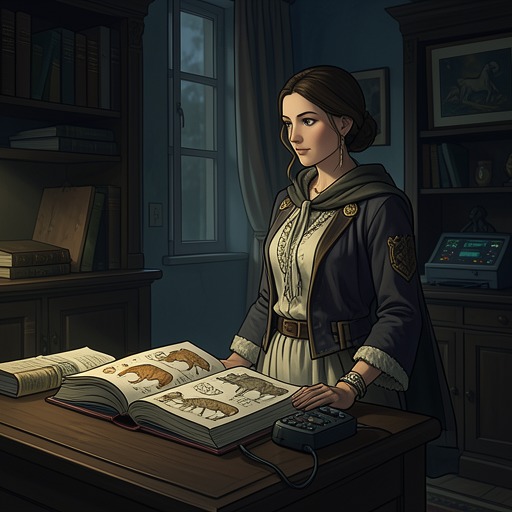
When the Wart finds Merlin in the woods, the magician’s cottage is crowded with books, stuffed birds, live grass snakes, young badgers, and an owl named Archimedes. It also holds glassware, fossils, paint-boxes, fishing equipment, and other objects. The range is not incidental to the book’s reading of the character: nearly all these things were present in White’s own cottage as he wrote. Merlin’s home can consequently be read both as a storehouse for a writer’s interests and as a place White imaginatively made his own.
That overlap gives the teacher a particular intimacy with his creator without reducing him to a simple portrait. Merlin is the figure who can gather knowledge from books, animals, and the material world, then turn it into an education for the Wart. White’s cottage becomes a fictional treasury, while the fictional cottage offers a setting in which the life White wanted to lead could be assembled and inhabited. Merlin’s abundance of objects contrasts with the earlier Merlin’s retreat into the woods, yet both versions are defined by distance from ordinary social life.
Living Backwards Through Time
The book’s most personal interpretation of Merlin develops from White’s experience after losing Gos. White described emerging from a grave-like period as if he had undergone a rebirth, and the account presents that renewal as a reversal of time. Merlin, in turn, is conceived as someone born at the wrong end of time: he lives backward, surrounded by people moving forward, so that what they regard as the future belongs to his past. His prophetic ability follows from this unusual temporal position.
This backward life makes Merlin, for White, an imagined future self. After the defeat associated with Gos, Merlin offers a way to picture a life that continues with wisdom rather than ending in loss. The character’s magic is therefore bound to White’s act of reconstruction: the author turns an experience of rupture into a figure who can endure, know what comes next, and teach someone younger. In the later conclusion to The Once and Future King, Arthur meets Merlin before his final battle and wonders whether the wizard is a dream. Merlin rejects that interpretation by recalling his own life as a twentieth-century schoolmaster, joining the legendary future to the modern world from which White created him.
Repair, Power, and the New Pupil
Merlin also gives White a fictional means of changing the outcome of a loss. White could not recover Gos in life, but in the imagined world Merlin captures the lost hawk with feathers and a fishing line and brings it back to the castle with the Wart. The episode does not erase the real loss; it makes recovery possible within the story. Merlin then has a new pupil, not a hawk but the boy who will become king.
That transfer from hawk to boy reshapes the meaning of Merlin’s role. The teacher who once guides a child through animal forms will help form a ruler, encouraging the founding of the Knights of the Round Table and a struggle for right over might. The book links this future instruction to White’s wish to repair what had been broken: a lost hawk is returned in fiction, and a child is given a guide whose example may lessen violence over time. Merlin’s significance lies in holding these functions together—the wild survivor, the transforming teacher, the backward-looking prophet, and White’s imagined self through whom grief becomes a story of education and possible renewal.