Middle Ages
H is for HawkThe Middle Ages enters the book as both a history of falconry and a story people tell about history. A hawk on the fist can make centuries seem to fall away, bringing the modern handler into imagined company with medieval falconers. Yet that sensation of continuity is selective: it can obscure who had access to land and hunting, whose traditions are remembered, and how profoundly landscapes and wildlife have changed.
Falconry, privilege, and access
The book connects falconry’s medieval glamour to the unequal ownership and use of land. Flying falcons properly requires open country—grouse moors, partridge estates, or extensive farmland—places that have not generally been easy to obtain without wealth or powerful connections. The falcon, celebrated as the finest and most noble bird, consequently became associated with an aristocratic sport. Gilbert Blaine’s account of falconry makes that exclusivity explicit: possession of the noble falcons belonged to the aristocracy as a privilege.
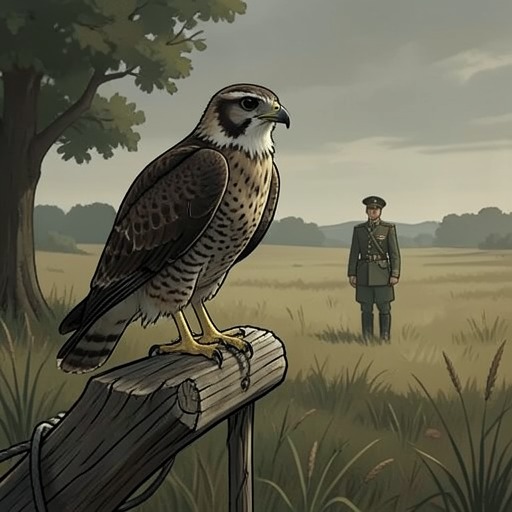
Goshawk training offered a contrast. Because a goshawk pursues prey in a short dash from the fist at close range, it can be flown in more varied places. Its solitary trainer, the austringer, nevertheless received a markedly less prestigious treatment in falconry writing. A fourteenth-century Norman author, Gace de la Bigne, mocked austringers as malformed, antisocial figures unfit for the falconers’ company. The contrast exposes a social hierarchy within the sport: the celebrated bird and the open land required to fly it carried associations of rank, while the solitary goshawk trainer was disparaged. The imagined medieval world of falconry was therefore not simply a timeless pageant of knights; it also encoded distinctions of access and status.
The book sets this history beside a different hunting tradition in Maine, where common-law access to land is presented as an egalitarian ideal. A 1942 hunting article invoked that ideal against systems in which hunting was restricted to estate owners, their guests, and the powerful, while acknowledging that Britain shared such restrictions. This comparison makes the class-bound history associated with British falconry more visible: the sport’s medieval aura could signify a cherished inheritance, but it could also carry the memory of exclusion.
A hawk as a bridge across time
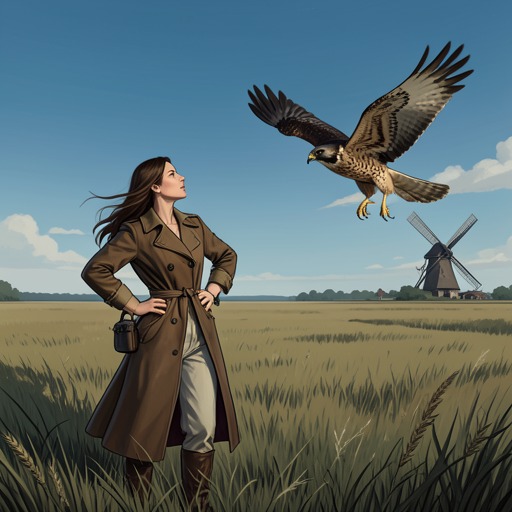
Falconry can make the distant past feel physically close. The book describes trained hawks as a peculiar kind of historical presence: individual birds die, but their species remain, without domesticated breeds, across long spans of human history. Holding a hawk may prompt the handler to imagine an earlier falconer holding what feels like the same bird. As with an ancient pot marked by a maker’s fingerprints or an old coin held in the hand, an object—or, here, a living animal—seems to collapse the distance between unknown people in different eras.
That imaginative collapse has consequences. If a modern falconer feels continuous with an earlier one, it becomes easy to picture the land as having been walked for centuries by people much like oneself. The ancestors selected for that story tend to be lords, earls, or kings. Nineteenth-century falconer Gage Earl Freeman treated falconry’s high descent and ancestral pride as inseparable, and rejected the suggestion that the sport’s appeal might be independent of antiquity or the Middle Ages. In the book’s account, this is not merely nostalgia: it is a way of constructing belonging through a selective lineage.
Medieval imagery in a modern landscape
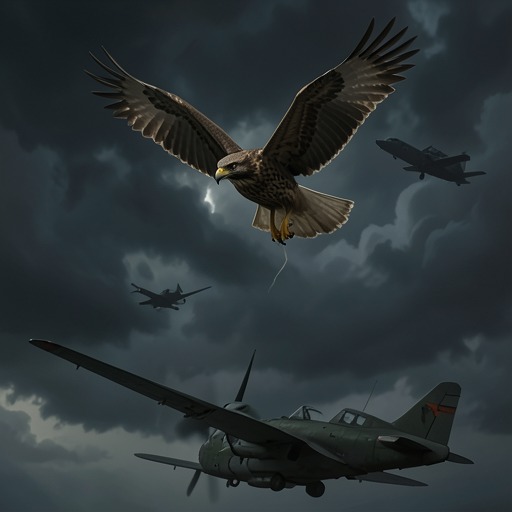
The Middle Ages also supplies a visual language for imagining national continuity. In the opening sequence of the 1944 film A Canterbury Tale, a knight releases a falcon; a cut turns the bird’s silhouette into a diving Spitfire, and the knight’s face reappears beneath a modern military helmet. The transformation joins medieval falconry to twentieth-century air power, presenting the two as expressions of an essential Britishness that persists through time. The scene shows how the romantic image of the medieval hawk could be recruited to make modern warfare seem part of an inherited natural and national order.
The book resists treating such images as transparent history. A medieval falconer’s relationship with a hawk may feel immediate to a modern handler, but that closeness does not establish that the two people shared the same world or saw it in the same way. Nor does falconry’s historical glamour represent everyone who lived in the landscape. The intimacy created by the hawk can bring the past near while quietly screening out the ordinary people, unequal access, and changing environments that complicate the image.
History, ecological change, and the limits of inheritance
The book’s accounts of landscape make the limits of an unchanged medieval inheritance especially clear. In Breckland, traces of human activity accumulate across strikingly different periods: flint worked in Neolithic times, rabbit warrens established for meat and felt, and a forest planted in the 1920s for timber for future wars. Rabbit grazing, together with that of sheep, helped leave sandy ground vulnerable to the shifting sands of 1688. Later, falconers brought goshawks back to Britain through a quiet, unofficial release scheme; their descendants eventually numbered around 450 pairs. These histories describe a landscape made and remade by human use, rather than a surviving medieval countryside.
Other changes are losses rather than returns. Myxomatosis arrived in Britain in 1952 and killed about 95 percent of the rabbit population within two years, with repercussions for grasslands and predators. On farmland elsewhere, the narrator recalls successive disappearances of birds, from turtle doves and corn buntings to ravens and black grouse. Against such evidence, the Middle Ages cannot serve as a simple standard for an enduring natural Britain. Its power in the book lies in its double role: falconry can make the past feel close enough to touch, while the histories of land and wildlife warn that this felt continuity may conceal exclusion, transformation, and loss.