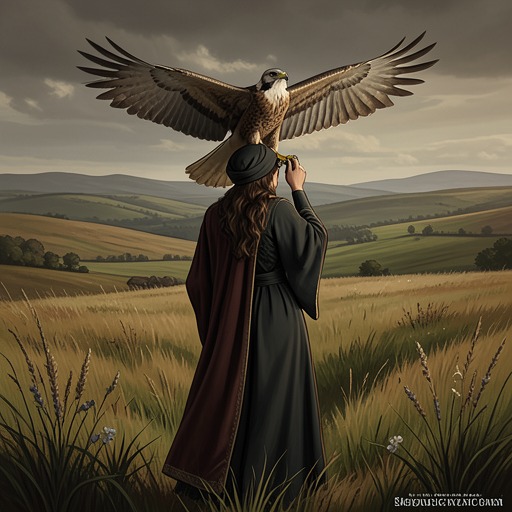
Nature as a cure for grief
H is for HawkNature as a cure for grief is a promise Helen Macdonald initially embraces and later recognizes as a dangerous simplification. After her father’s death, she turns toward wildness and Mabel, hoping that immersion in the natural world will relieve her loss. The book follows the consequences of that expectation: close observation can deepen understanding, but identifying with a hawk and treating her as a mirror cannot replace human connection or resolve grief by itself.
The appeal of a natural remedy
On the train home after her father’s memorial service, Helen reconsiders the idea that she should flee into the wild to heal. She recognizes its appeal partly in the nature books she has read: accounts in which grief or sadness sends people in pursuit of elusive animals, through remote landscapes, or along trails and coasts. John Muir’s writing gives eloquent form to the belief that nature can soothe human affliction. In this tradition, turning toward the natural world appears not merely comforting but curative.
Helen’s reversal is sharp. She becomes angry at her own certainty that this was the cure she needed and calls the belief a beguiling but dangerous lie. The problem is not that nature has no value, but that its restorative promise can be mistaken for a complete answer to human suffering. Hands, she realizes, are also for holding other people; they should not be reserved solely for a hawk. Her correction challenges the familiar literary pattern in which wild landscapes serve as a ready-made treatment for grief: an encounter with nature may matter profoundly without healing every affliction.
Attention, identification, and self-erasure
The account also shows why the turn toward a hawk feels so compelling. In the early days of training, the handler must read the bird’s posture and feathers to judge whether she is afraid, at ease, or ready for a particular interaction. With sustained attention, smaller changes become legible: Helen learns to interpret subtle movements around Mabel’s beak and eyes. Predicting what the bird may do next depends on this close observation, and Helen describes the process as a kind of imaginative entry into another creature’s perspective.
That attentiveness has a cost when it becomes a loss of self. Helen connects her increasing sensitivity to Mabel’s moods with grief and with a condition in which she is not fully herself. She can become so absorbed in watching that she seems to feel what the hawk feels and notice what the hawk notices. This capacity helps her understand the bird, but it also makes disappearance seem like intimacy. The book distinguishes learning to attend to another animal from believing that the animal has become oneself.
Mabel’s behavior repeatedly unsettles any simple idea of her as a vehicle for Helen’s recovery. When Christina visits, Mabel tolerates the unfamiliar activity of a person turning newspaper pages; later, during a calm hour together, the hawk suddenly bates. Helen initially mistakes the movement for fear and considers ending the session, then recognizes that Mabel is frustrated and hungry. On another occasion, Mabel turns her head upside down and plays with a paper ball. Helen is surprised because this playful behavior was absent from her books about goshawks. These moments show a bird responding to her surroundings and initiating activities of her own, not merely reflecting a human state of mind.
The hawk as relationship, not remedy
Helen’s later games with Mabel make the distinction more explicit. She fashions toys from paper, tissue, and card; Mabel picks them up, drops them, and catches and tosses crumpled paper balls back toward Helen. When Helen tells Stuart that she plays catch with the hawk, he does not believe that goshawks play. Yet the activity matters because it brings warmth into a life Helen describes as otherwise cold. It is a specific, shared practice, not evidence that the hawk can serve as a substitute for people.
Helen contrasts her circumstances with those of other falconers, for whom time with a goshawk is one part of a broader life that also includes partners, children, meals, television, and work. She does not have that balance, and comes to see that she does not need still more wildness. Her distinction is not a rejection of Mabel or of the relationship they have built. It is an acknowledgment that affection across species does not make the relationship human, or make it answer every human need.
Recognition and correction
The limits of identification become particularly stark during a pheasant hunt. As Helen searches through the brambles while Mabel waits above, she tries to understand the scene from the hawk’s position. Her awareness splits between the bird, the pheasant, and herself; for a time, she feels detached from her ability to affect what is happening. The sequence ends when Mabel and the pheasant meet on the ground and Helen’s sense of connection returns. The episode gives bodily and narrative form to the danger of losing herself in the encounter: attention can become estrangement before it becomes understanding.
After the memorial service, Helen also realizes that she has failed to recognize Mabel’s hunger. The hawk has gained muscle over their weeks on the hill but has become too low in weight and increasingly aggressive. Helen links this oversight to a previous pattern in her grief: after her father died, she made a man she barely knew into someone who could serve her loss. She sees that she has repeated the error with Mabel, fleeing into an imagined hawk-self while turning the actual hawk into a mirror of her own misery. Feeding Mabel a whole pigeon becomes part of this recognition: Helen attends to the bird’s condition rather than treating her distress as an expression of Helen’s own.
Her final image revises the fantasy of transformation. However often she has lost herself in fields and in the presence of the hawk, she is not the bird vanishing into another world. She is the person waiting beneath the tree for the hawk to return. That distinction does not cancel her grief or diminish the importance of wildness; it restores separation as well as connection. Later, as despair and distrust persist, Helen seeks a doctor and says she thinks she may be depressed. The episode confirms the book’s refusal to present nature as a universal cure: being changed by the natural world is not the same as being cured by it.