Rabbit prey
H is for HawkRabbit prey appears in the book both as a force in the history of Breckland and as an animal encountered in the close, practical world of falconry. Its roles range from farmed commodity to food offered to a hawk and quarry pursued in the field. Across these settings, it helps show how human use of animals and land can shape what seems wild, while a hawk’s relation to its prey remains distinct from human intentions and grief.
Farming and the Breckland landscape
In Breckland, Rabbit prey was farmed for meat and felt in large enclosed warrens. The warrens left their names on the landscape, including Wangford Warren and Lakenheath Warren. Their commercial purpose was inseparable from their ecological effects: close grazing by the animals, together with grazing by sheep, reduced the short vegetation to a thin layer of roots over sand. Where grazing was most intense, wind could take hold of the exposed ground and move it into drifts.
The consequences accumulated over time before becoming catastrophic. In 1688, strong south-westerly winds lifted the broken ground into a vast cloud of sand. The shifting land encircled Brandon, engulfed Santon Downham, and choked its river; after the winds stopped, dunes extended for miles between Brandon and Barton Mills. Thus the warrens belong not only to the history of farming but also to a landscape altered by sustained human and animal pressure. The account does not make Rabbit prey the sole cause: it places its grazing alongside that of sheep and traces the disaster through the condition of the land and the force of the winds.
Food and a failed attempt at care
Rabbit prey also enters the history of T. H. White’s training of Gos. When White noticed pale transverse marks on the young hawk’s tail feathers, he understood them as hunger traces formed while the feathers were growing. He feared that the marks meant he had damaged the bird and responded with guilt by trying to compensate through food. The account explains that the feathers were already fully grown, so feeding the hawk more could not repair them.
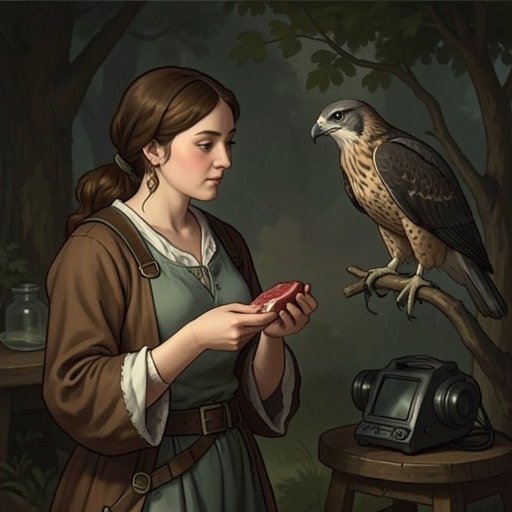
In his anxiety, White offered more food than Gos could eat. At one point, he tried to coax the full hawk with a split Rabbit prey skull, stroking the bird’s breast feathers as he urged it to feed. The gesture was intended as care, but it could not answer the hawk’s immediate condition: Gos was satiated and wanted to be left alone. White’s repeated attempts to tempt him with different foods, followed by further overfeeding when the hawk became hungry enough to eat, established a cycle of failed accommodation. Rabbit prey is therefore present not just as food but as part of a scene in which White’s fear of having caused harm leads him to misread what the hawk needs.
A sound that calls up the hunt
The book also uses Rabbit prey to clarify the force of a goshawk’s hunting reflex. Helen Macdonald discovers that a squeak made by drawing air through the teeth, like the sound of an injured Rabbit prey, causes Mabel the goshawk’s toes to contract at once and her talons to close on the falconry glove. The response is described as innate: a deeply established action whose appropriate stimulus has not yet been supplied. Other sharp or squealing sounds can provoke the same grip, including door hinges, brakes, an unoiled bicycle wheel, and singing on the radio.
The comic surprise of the sound-response pairing does not erase its danger. A small child’s wail outside the window also prompts Mabel to grip the glove in forceful spasms. In these episodes the sound associated with Rabbit prey helps make the hawk’s predatory responsiveness legible, but it does not mean that the hawk is choosing to attack a person. Macdonald’s account instead distinguishes the stimulus from its accidental setting: an instinct organized around hunting can be activated by a sound that is not prey.
Quarry, consumption, and grief
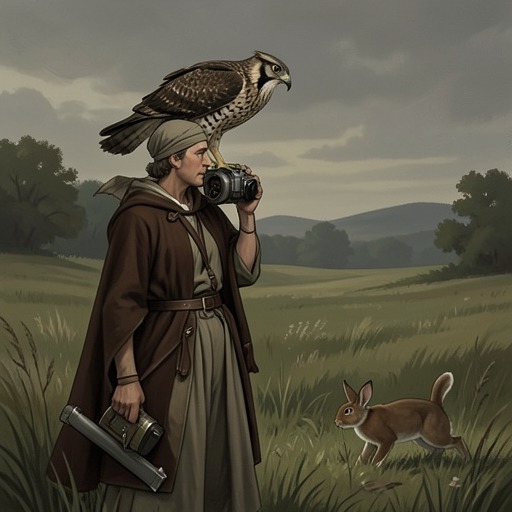
Later, Rabbit prey appears as the quarry of Mabel’s hunting and as food for the hawk. Macdonald watches the hawk hunt and eat while registering the distance between the bird’s actions and her own human response. The scene is set against her bereavement: she describes human hands as meant for holding other people, not for handling the consequences of a kill. Around the hawk, the Rabbit prey stops breathing and is eaten; the surrounding world seems to continue without pause, while Macdonald experiences the moment as an oppressive present.
That contrast gives the animal a role beyond its use as an emblem of wildness. Rabbit prey is an actual hunted animal in a relation shaped by the goshawk’s capacities and the falconer’s practice, while the human observer struggles with what witnessing predation means during grief. The book places the farmed animal, the food used in White’s anxious training, the sound that triggers Mabel’s reflex, and the quarry in the field beside one another without collapsing them into a single meaning. Together, these appearances connect landscape history to the intimate obligations and limits of living with a hunting bird.