Responsibility and death in the hunt
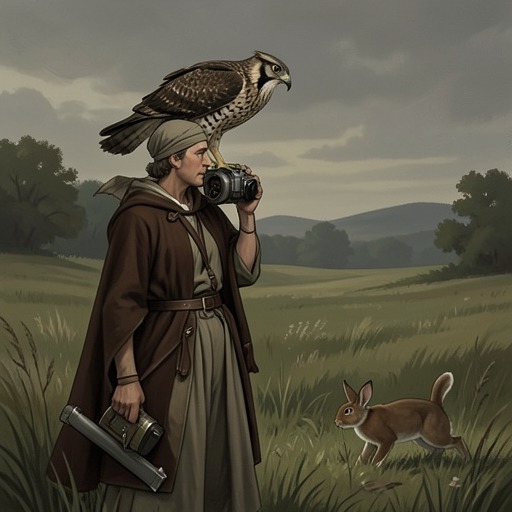
H is for HawkResponsibility and death in the hunt is a central ethical tension in Helen Macdonald’s account of hawking with Mabel. Hunting draws Macdonald toward the hawk’s way of perceiving and acting; the death of the prey returns her to human awareness, where she must decide what care and accountability require. The hunt is therefore neither simply an expression of animal instinct nor an uncomplicated argument for obtaining food: it makes the human participant answerable to the particular animal whose life has ended.
From Watching to Participation
Before hunting with Mabel, Macdonald had defended hawk-caught meat as preferable to meat produced in crowded farms. She had also maintained that prey either escaped or was caught, and that what the hawk caught was eaten rather than wasted. In the field, those arguments proved inadequate to the encounter itself. They described a system of food production, but not the experience of being beside a living animal as it was caught and died.
During a hunt, Macdonald’s attention becomes organized around the hawk’s needs: finding prey, following its movement, and anticipating where it might fly. The landscape takes on a practical coherence through this pursuit. Past and future recede as she concentrates on the immediate course of the hunt. The transformation is real but temporary. Each capture interrupts her identification with the hawk and makes the human consequences of its actions impossible to set aside.
That interruption is expressed through a repeated contrast: hunting draws Macdonald toward animal perception, while death makes her conscious of being human. She is pleased by Mabel’s success and at the same time grieves for the individual rabbit. This response does not treat the rabbit as a mere symbol or as an interchangeable unit of food. Its death brings her attention back to the specific life involved, and to her own place in ending it.
The Responsibility of the Kill
When Mabel has caught a rabbit, Macdonald sometimes has to intervene to prevent it from dying gradually while the hawk feeds. The decision is not presented as a denial of the hawk’s nature: it arises because the hawk will continue its meal and the rabbit may die in the process. Macdonald takes responsibility for bringing that death to an end, an action she understands as care for the prey rather than as a claim that she stands above it.
The responsibility changes her position in the scene. She is no longer only watching a hawk hunt; she is accountable for a decision that affects the animal’s death. The account distinguishes this brief, demanding responsibility from indifference. To act, Macdonald has to steady herself, but the need to do so does not mean that the rabbit’s life matters less. The animal’s importance is precisely what makes the decision difficult.
This experience also makes mortality personal. Beside the dead rabbit, Macdonald becomes sharply aware that she, too, will die. The recognition does not remove her from the immediate task or turn the rabbit into a simple lesson about human life. Instead, the animal’s death joins two forms of attention: sorrow for this particular creature and an awareness of death as something that reaches beyond the scene. The hunt’s ethical weight lies in that uneasy closeness between them.
Beyond the Hawking Field
The limits of Macdonald’s earlier defence of hawking become clearer in the contrast between her general arguments and the particular deaths she witnesses. Saying that prey is not wasted or that hawk-caught food is preferable to farmed meat cannot settle what it means to be present when an animal dies. Nor does regret mean that she denies the hunt or Mabel’s success. Macdonald separates regret for the rabbit from regret at having hunted: she can acknowledge the hawk’s achievement while mourning the prey.
A later encounter extends this responsibility beyond the relationship between hawk and quarry. On a drive home, Macdonald sees walkers gathered beside a sick rabbit on a roadside verge. They are concerned but do not know how to help, and eventually leave. Macdonald stops and, after they have gone, ends the animal’s suffering. The action echoes her interventions after a hunt, but here the rabbit is not prey caught by Mabel. The encounter shows that her sense of responsibility is not confined to the choices made within falconry.
The rabbit has myxomatosis, a disease that arrived in Britain in 1952. Within two years, the virus had killed about ninety-five per cent of the country’s rabbit population. The account places this individual animal’s suffering against a much wider ecological loss, linking its condition to a disease that devastated rabbit numbers and altered the countryside. The sick rabbit persists in Macdonald’s memory as a reminder that animal deaths are not always contained within a single encounter or caused by a predator’s immediate needs.
Access, Tradition, and the Meaning of Hunting
The book also sets individual responsibility against the social conditions that shape who hunts and how hunting is understood. Macdonald reflects that falconry has been marked by differences in access. Falcons require open spaces for their characteristic pursuit of prey, such as extensive farmland or grouse moors, resources more readily available to people who are wealthy or well connected. Goshawks, which hunt at close range, can be flown in more varied places. Historical writing often praised falconry with falcons as an aristocratic pursuit while disparaging the solitary trainers of goshawks and other hawks.
Descriptions of goshawks also reveal how human attitudes can displace attention from the animal’s own circumstances. Later falconry accounts characterize female goshawks as difficult or ill-tempered, and a man tells Macdonald that she and Mabel naturally get along because both are female. Macdonald rejects the assumption that shared sex explains the relationship. Reading seventeenth-century accounts, she finds a different emphasis: goshawks could be shy and self-willed, but their responses were connected to how their keepers treated them. This contrast makes the human handler’s conduct part of the question, rather than locating every difficulty in the bird’s supposed temperament.
A further comparison comes from Maine, where Macdonald describes hunting as less visibly divided by the traditions of land ownership that shape British field sports. Common-law access to land and the widespread November deer hunt make hunting part of everyday community life for many residents. The contrast does not erase the deaths involved in hunting; it shows that access, custom, and class affect how people encounter and justify it. Across these contexts, the account returns to the same ethical demand: explanations for hunting do not remove the hunter’s responsibility to the animal that dies.