Return of goshawks to Britain
H is for HawkReturn of goshawks to Britain is a population recovery shaped by falconers, changing landscapes, and the species’ capacity to survive independently. After British goshawks disappeared in the late nineteenth century, a quiet, unofficial release scheme helped restore them. In the account, their return unsettles the idea that wild nature must be untouched by people: the birds’ renewed presence is itself the result of human intervention, but they remain elusive animals living beyond human control.
Extinction in a worked landscape
Goshawks once bred across the British Isles. Their disappearance followed overlapping changes in land use and hunting. Land enclosure restricted ordinary people’s opportunities to fly hawks, while accurate firearms made shooting more fashionable than falconry. Goshawks came to be treated as vermin, and persecution by gamekeepers compounded the effects of habitat loss. By the late nineteenth century, the British population was extinct; a photograph of one of the last birds shot, stuffed and glass-eyed, stands as a stark record of that absence.
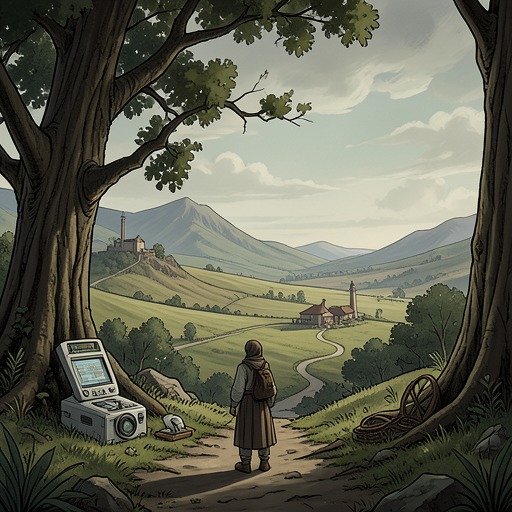
The account places this loss within a landscape already altered by human work. In the Brecklands, flint-working dates back to the Neolithic, and later extensive rabbit warrens supplied meat and felt. Rabbit and sheep grazing weakened the vegetation on sandy ground; in 1688, powerful south-westerly winds raised and shifted the exposed sand, engulfing settlements and choking a river. Pines planted in the 1920s for future timber needs later covered much of the dune landscape. These histories matter to the return story: the goshawks came back not to an untouched wilderness, but to a place layered with industry, disaster, forestry, and changing land use.
The falconers’ release scheme
In the 1960s and 1970s, members of the British Falconers’ Club developed a quiet way to bring goshawks back. The calculation was practical: for the cost of importing one bird for falconry, a falconer could bring in a second and release it. The hawks came from Sweden, Germany, and Finland. Some were deliberately released into forests; others were lost. Rather than depending on continuing human care, they survived, found one another, and bred.
The scheme was unofficial and spread through like-minded falconers across Britain. Its outcome was larger than the release of individual birds: descendants formed a population that could reproduce without being managed as a captive breeding project. At the time of the account, their number was estimated at around 450 pairs. The scheme’s quietness contrasts with the scale of its consequence. A series of individual decisions to import and release birds helped establish a lasting presence in the country.
Class, access, and the reputation of hawks
The return also sits within a history of unequal access to hunting and falconry. Goshawks hunt by making a rapid dash from the fist at close range, a method that can be used in many kinds of landscape. Flying falcons properly, by contrast, requires extensive open ground such as grouse moors, partridge estates, or large farms—places more accessible to the wealthy and well connected. Gilbert Blaine described possession of noble falcons as an aristocratic privilege. The distinction shaped not only who could fly which birds, but also the prestige attached to them.
The solitary austringer, who trains goshawks and sparrowhawks, received a less admiring portrayal in falconry writing. Goshawks themselves were often described as difficult, disagreeable, or unruly. Helen Macdonald revisits those judgements through older accounts that instead describe goshawks as wary and responsive to harsh treatment, but capable of affection when handled with kindness and consideration. This contrast suggests that a bird’s reputation can record the falconer’s expectations and conduct as much as the bird’s character. The return of the species therefore restores more than a missing predator: it also makes visible the histories of class, access, and human interpretation attached to falconry.
Wildness and human participation
A sighting in the Brecklands gives the population recovery its immediate presence. At eight thirty, Macdonald sees a pair soaring above the pines. Crows mob them, but the goshawks continue their flight, moving in relation to one another before vanishing from view. Their brief appearance makes the restored population tangible while preserving its elusiveness: the observer can witness the birds, but cannot hold the sighting in place or claim the animals as possessions.
The account sets this wild pair alongside the close, learned attention involved in training Mabel. Macdonald describes reading the goshawk’s posture and feathers to recognize fear, ease, or smaller shifts of mood. During an early feeding, Mabel’s first bate in the room proves to reflect frustration and hunger rather than fear; later, she plays with paper and other improvised toys. These encounters show a bird responding in ways that exceed inherited descriptions of goshawks as simply sulky or hostile. They do not make her domesticated, nor do they explain the recovery of the wild population. Instead, they complicate any easy division between human influence and animal independence: a hawk may live in close relation with a trainer and still remain self-directed, while free-living goshawks can owe their renewed presence to human choices.
Significance of the return
The recovery gives the account a concrete answer to the claim that wildness must be wholly separate from human history. The imported birds and their descendants were not products of an untouched landscape; falconers helped create the conditions for their return. Yet the resulting population survived, met, and bred beyond the scheme that introduced its ancestors. Human action initiated the recovery without converting the goshawks into human property or fully predictable symbols.
That distinction matters in a book attentive to the ways people project meanings onto hawks. Goshawks have been cast as aristocratic birds, solitary companions, frightening predators, and emblems of wildness. Their return reveals the limits of each label. They belong to a landscape made by people, but their continued existence is not reducible to human intention. The recovery is therefore both ecological and interpretive: it restores breeding birds while challenging the assumption that what people help bring about can no longer be wild.