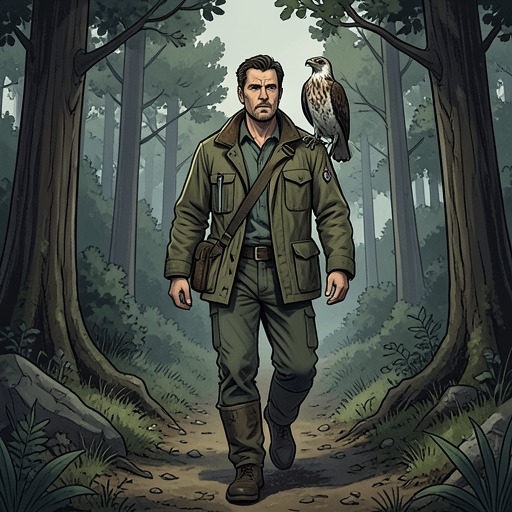
School ordeals and belonging
H is for HawkSchool ordeals and belonging is the idea that a person must undergo tests of courage and endurance to earn membership, status, or eventual freedom. In Helen Macdonald’s account of T. H. White and The Sword in the Stone, this logic is at once a school culture, a pattern repeated in White’s treatment of others, and the structure of a childhood reading experience in which a boy transformed into a hawk may not survive his test.
Ordeal as a condition of belonging
At school, White encountered a social order in which bravery had to be demonstrated rather than simply claimed. Tests on the playing fields and beatings by masters and prefects stood alongside boys’ own initiation ceremonies. The ordeals were not incidental to belonging: enduring them marked a pupil as fit to enter a group and, later, its secret societies. Pain could therefore be understood within the school’s code as evidence of self-command and a route to acceptance.
Macdonald gives a specific example of this logic in a ritual involving an unloaded revolver. White had placed his hand between the weapon’s cocked hammer and frame before its trigger was pulled. The act made the test’s terms plain: the participant proved himself by accepting pain, and the ability to bear it became a sign that he belonged. The ritual did not merely assess courage; it helped define courage as submission to a dangerous test set by others.
That system also reproduced itself through hierarchy. White had suffered at the hands of older boys, but he later joined groups that terrorised boys weaker than himself. In one term’s test, a younger pupil, Puppy Mason, was expected to jump from a window in Big School. When Puppy was afraid, White helped push him out. The fall caused a serious injury; the boys admired his silence, and Puppy was admitted to their fraternity. White then helped conceal what had happened by giving the masters a false explanation. The episode shows belonging being granted through a cruel reversal: the younger boy’s harm counted as successful performance, while the group’s approval and its cover story protected the ritual.
White’s ordeal and the transformed Wart
Macdonald connects this school culture to White’s fiction through the Wart’s ordeal as a hawk in The Sword in the Stone. Merlyn turns the Wart into a merlin and releases him into the castle mews at night. As a newly trained bird among the castle’s hawks, he must stand beside Colonel Cully, a goshawk, until the other hawks have rung their bells three times. The task is an initiation, but its danger is not safely symbolic: Colonel Cully is unstable, and the Wart is physically vulnerable beside him.
The scene makes the ordeal’s pressure build through the bell sequence. Colonel Cully mutters fragments of plays, begs for the test to stop after the first bell, and grows more threatening as the next bell sounds. The Wart must remain brave while the hawk moves towards him. Macdonald reads the scene as involving more than a boy’s conventional trial of courage: the Wart has become an animal, and the protection usually afforded to a human child hero no longer seems certain. His altered form unsettles the boundary that would normally reassure a young reader that a protagonist cannot die.
The test ends when the Wart springs from the perch and frees himself from the goshawk’s grasp. His survival provides release, but not a simple victory over danger: the scene’s force comes from the possibility that the transformed child may not survive at all. The ordeal therefore makes belonging and bravery inseparable from exposure to real peril, while the reader’s uncertainty about the Wart’s identity intensifies that peril.
White’s history within the pattern
Macdonald interprets White as both a victim and a later participant in the school’s system. He fled school for the woods, yet the habits and definitions learned there remained active in his understanding of freedom. The boy who had endured tests also helped impose them on younger pupils. His fiction’s ordeal scenes can thus be read against a history in which suffering was not only remembered but reproduced as a model for how authority and membership worked.
The pattern also helps explain the shape of White’s imagined education for the Wart. White wrote himself into the boy of unacknowledged royal blood who can run freely around a castle, unlike White, who had been sent away to school. The Wart’s education avoids the school beatings White knew, but it is not free of cruelty. The animal lessons repeatedly place him in danger, and the hawk ordeal concentrates that contradiction: an education meant to prepare a boy for his future also exposes him to frightening tests. The imagined escape from White’s own childhood therefore does not erase ordeal; it relocates it within the Wart’s adventures.
Macdonald’s childhood encounter with the ordeal
Macdonald recalls reading Colonel Cully’s confrontation with the Wart repeatedly, fascinated and afraid. As a child, she did not understand the social logic by which pain could serve as a passage into belonging, or why a test might be treated as a necessary stage towards self-reliance. She initially understood Merlyn’s lessons as training the Wart to be brave because he would need courage to become a king. The reading experience, however, gave that explanation an unsettling edge: the Wart was now a bird, and might therefore be mortal in a way a human child hero did not seem to be.
The repeated reading itself took on the shape of an ordeal. Macdonald describes being held by apprehension until the Wart escaped, then feeling relief at having made it through the scene and being able to read it again. The fear was not simply an obstacle to enjoyment; it was part of the scene’s repeated hold on her. Its unresolved question about whether the Wart remained a protected child or had become a vulnerable animal made each return a fresh test of the same uncertainty.
Freedom, falconry, and wider hierarchies
White’s school experience also shaped his conception of freedom as the end of a staged progression. At school, pupils moved from year to year, gaining power and privilege before finally leaving. Macdonald argues that White never entirely escaped this model even after he ran to the woods and rented a cottage on the old road to his school. It continued to inform his role as a schoolmaster and a falconer, and his expectation that those under his authority were being trained for a future in which they would be free. The logic of the ordeal thus persisted beyond school: freedom was imagined as a destination reached through training and tests.
Macdonald places this account beside other hierarchies surrounding falconry. Properly flying falcons required extensive open ground, such as grouse moors and large estates, making the practice more accessible to wealthy or well-connected people. Goshawks, which could hunt after a short dash from the fist, could be flown in more places; yet the solitary austringer who trained goshawks and sparrowhawks was disparaged in falconry writing as socially awkward and inferior. The contrast shows how access to land and social standing could determine which forms of expertise were admired and which practitioners were treated as outsiders. In Maine, Macdonald encounters a different tradition: common-law access to land supports an egalitarian account of hunting, in contrast with the restricted estates and exclusive grounds associated with Britain. These examples extend the question of belonging beyond school, showing how institutions and access to space can set the terms on which people participate.
The book also links group assumptions to the way goshawks were described. Macdonald finds that later falconry accounts often treated their difficult behaviour as an innate defect, whereas earlier writers described goshawks as fearful, self-willed, and responsive to considerate treatment. This contrast does not make falconry identical to school initiation, but it reinforces a question central to the ordeal theme: whether a subject’s resistance is understood as proof of bad character or as a response to the way authority treats it. Across school, fiction, and falconry, belonging and freedom are never neutral gifts; they are shaped by who sets the test, who must endure it, and who is permitted to name the outcome.