Scotland
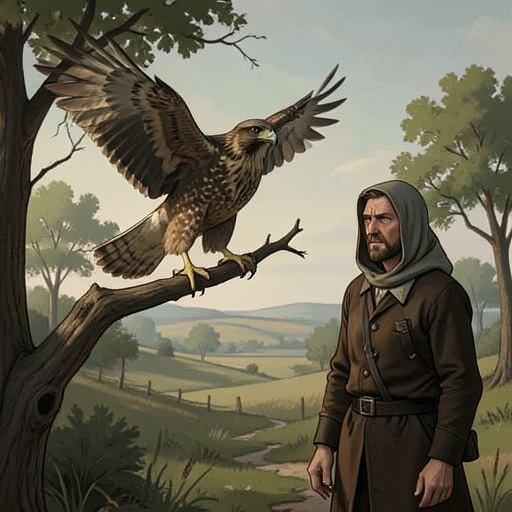
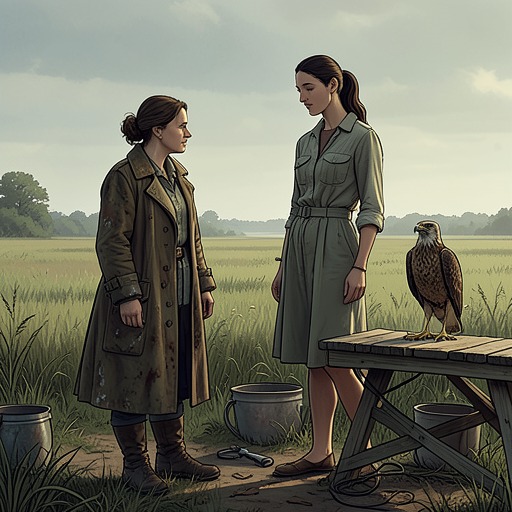
H is for HawkScotland is the setting for the pivotal journey on which Helen Macdonald acquires Mabel: after a long drive, she meets a breeder at a quay to collect a young goshawk. The exchange is complicated by two similar transport boxes and an initial mix-up over which bird is hers. Scotland thus marks more than a point on the route. It is where Macdonald’s abstract decision to keep a goshawk becomes a particular relationship, chosen through a moment of uncertainty and insistence.
A journey made in grief
Macdonald arranges the trip after finding a breeder in Northern Ireland with a goshawk from that year’s brood. The bird is ten weeks old, small for a goshawk, and of mixed Czech, Finnish, and German breeding. Macdonald plans to drive to Scotland to collect her. The choice she makes in advance is chiefly a choice of size; she regards the identity of the hawk as something already settled, as if the bird has selected her rather than the reverse.
The journey takes place in early August, when Macdonald is about four hundred miles from home and travelling with Christina. They wait for a ferry on a Scottish quayside after a long drive and a night in a hotel. The trip is practical, but the book places it within Macdonald’s bereavement: she is using her father’s car, whose boot still holds his film canisters, an unfinished crossword, aspirin, and winter gloves. These left-behind objects accompany her to the meeting, linking the acquisition to a loss that has not yet receded into the past.
The overnight stop adds to the journey’s disorientation. The hotel has a broken computer, a sink that is not connected to plumbing, a cooker guests are told not to use, two televisions, and a sunken bath. Macdonald and Christina are tired after driving through numerous service stations and a near-accident caused by inattention. By the time they reach the quay, collecting the hawk is not an isolated errand but the destination of an exhausting passage undertaken while Macdonald is still struggling to find her bearings.
The quayside exchange
A man arrives carrying two large boxes containing the birds. He explains that another falconer is due to collect the younger bird, while Macdonald is meant to take the older, larger one. Before opening the boxes, they compare the birds’ ring numbers with the Article 10 documents that accompany captive-bred rare birds. The paperwork is an essential safeguard: it establishes which bird is which and prevents an accidental exchange.
The first box is opened, and the younger hawk is briefly brought out and hooded. The bird is not Macdonald’s according to the ring numbers, despite the immediate intensity of the encounter. When the second box is opened, it contains the older, larger hawk specified for her. Macdonald finds that this bird does not feel like the one she has come to collect. The distinction is not simply between two birds of different sizes: faced with the actual animals, she recognizes a preference she had not expected to have.
After the documents are checked and the payment exchanged, Macdonald asks whether she can take the first bird instead. She knows that requesting a change at this stage breaches the expected arrangement, and her appeals are hesitant and difficult to formulate. The breeder agrees. The reversal makes the quay a threshold in the narrative: the process of identification has exposed a mismatch between the assigned bird and the one Macdonald wants, and her request changes the outcome. Mabel’s acquisition therefore depends on both formal verification and a personal choice that the paperwork alone could not make.
From collection to relationship
The quayside encounter establishes the practical conditions of Mabel’s arrival: captive breeding, transport in boxes, a hood used to limit the bird’s exposure to unfamiliar sights, leg rings, official forms, and the exchange of money. It also shows the sharp difference between arranging to own a goshawk and meeting an individual bird. Macdonald had decided only that she wanted a small hawk; the encounter forces her to respond to the birds as distinct animals rather than interchangeable answers to that plan.
The relationship develops after the journey, through sustained attention to Mabel’s behavior. Macdonald learns to read changes in posture and feather position as signs of fear or ease, and increasingly notices subtler cues. This observation shapes the training: rather than treating the bird’s reactions as a fixed character, she tries to anticipate what Mabel will do and adjust her own conduct accordingly. Scotland is the point of acquisition, while the later work of learning one another takes place over time.
Some early milestones make that process visible. At home, Mabel becomes calm enough to sit bareheaded while Christina reads the paper. During a later feeding, the hawk’s response reveals that her sudden movement has arisen from hunger and frustration rather than fear; she eats and then performs a rouse, a sign Macdonald reads as contentment. In another scene, the two play with paper: Mabel catches and returns scrunched balls, a behavior that challenges the expectation that goshawks do not play with people. These developments are not events in Scotland, but they show what begins there: a partnership built through repeated encounters with a bird whose capacities exceed Macdonald’s prior assumptions.
Retrospective significance
The acquisition also gains meaning from the book’s account of how falconry has ranked birds and their handlers. Historical writing praised falcons as noble and associated their proper flight with access to extensive hunting grounds, wealth, and aristocratic privilege. Goshawk trainers, by contrast, were often presented as solitary and socially inferior, while the birds themselves were described in dismissive terms. The Scotland episode puts a particular goshawk at the center of Macdonald’s experience, complicating those inherited distinctions through direct attention to the animal rather than reputation alone.
Later, Macdonald’s reading of older falconry books leads her to question descriptions of female goshawks as irrational or sulky. Earlier writers had also recognized the birds as fearful, self-willed, and responsive to harsh treatment, while describing kindness and continued care as central to the keeper’s role. Mabel’s playfulness and varied responses deepen that reconsideration. Scotland is not the setting for all these later reflections, but it is where Macdonald first chooses the individual hawk whose behavior will prompt them. The journey’s significance lies in that transition: a planned collection becomes the beginning of attention to a specific animal, and the beginning of a relationship that unsettles established ideas about what a goshawk can be.