Stuart
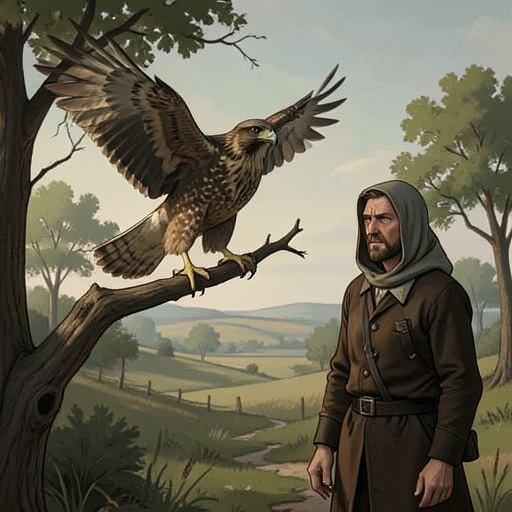
H is for HawkStuart is the experienced falconer who guides Helen through the uncertain early stages of training Mabel. He offers practical expertise in handling, flying weight and fieldwork, and his calm manner helps Helen manage a bird whose responses she cannot yet read. Their relationship is not simply one of reassurance: when his confidence leads the training forward faster than Helen feels ready for, she must decide whether to defer to his experience.
Identity and Role
Stuart appears as an established falconer with hands-on experience of goshawks and a tiercel of his own. Helen turns to him when Mabel’s behavior breaks the patterns she knows from other hawks: Mabel seems eager to fly to her, yet becomes afraid at the last moment of landing on her glove. Helen asks whether the problem might be insufficient manning or excessive weight. The account records her uncertainty and her call to Stuart, establishing him as someone she expects to help interpret a difficult training problem, even though it does not preserve his answer in that exchange.
His role belongs to a tradition shaped by unequal access to land and hunting. Falconry with falcons required large open spaces, often associated with wealth and social connection, while goshawks could be flown in more confined settings. Historical accounts also demeaned the solitary austringer, the trainer of goshawks and sparrowhawks, and cast goshawks themselves as difficult, disagreeable birds. Stuart’s practical work takes place within this inherited culture, but the scenes with him concentrate less on status than on the knowledge required to handle an individual hawk.
Handling and Practical Instruction
When a bell is fitted to Mabel’s tail, Stuart holds her on a kitchen cushion, supporting her closed wings firmly but gently. He checks her calm by feeling her heartbeat, and Helen attaches a small bell near the base of the tail feathers. The procedure makes visible a quality that recurs in Stuart’s work: he can handle the hawk without treating her as though she were either fragile beyond approach or merely an object to be controlled. The bell is intended to help locate her when she flies free, though Helen also plans to use a radiotransmitter because sound alone cannot always reveal where a motionless bird is.
Stuart also identifies the importance of setting. After Mabel flies past Helen rather than taking food from her glove, he points out that the training is taking place in a new environment and that the bird needs more space. He invites Helen to join him on a hill the following morning while he flies his tiercel, proposing open fields away from streets and houses. The advice connects Mabel’s response not only to her training or weight, but to the surroundings in which she is being asked to fly.
On the hillside, Stuart takes Mabel on his fist and handles her with an ease that reassures her. He and Helen unwind the creance and call the hawk across the field. Mabel approaches but flinches, and Helen brings her down on the line; Stuart tells Helen that the bird needs to become keener. Helen finds that advice difficult to bear and asks him to promise that Mabel will not die during the night. His role here is both technical and emotional: he sets a training standard while confronting the fear that makes Helen reluctant to follow it.
Trust, Progress, and Conflict
When Mabel weighs one pound and fifteen ounces, Helen calls her without expecting her to come. Instead, Mabel flies across the ground, lands on the glove and stays. She repeats the flight three times along the creance, without hesitation. Stuart recognizes the change and tells Helen that Mabel has reached her flying weight; after a few more days, he says, they can fly her free. The result confirms his practical assessment: Helen had miscalculated the weight for weeks. Yet Helen also interprets the success through her own bereavement, imagining that having admitted how bad she felt had made her less off-putting to the hawk. The scene distinguishes Stuart’s measurable explanation from Helen’s emotionally charged one without suggesting that the two experiences cancel each other out.
Their next move toward a free flight exposes a sharper difference in confidence. Mabel becomes unsettled by a brightly colored training kite, and Helen is already stressed by the journey and the prospect of flying her without the usual gradual steps. Stuart persuades her not to return home and says they will find something for Mabel to fly at. He directs Helen to a patch of rough ground near trees while he beats through the vegetation with a stick to flush possible quarry. Helen defers because Stuart has trained goshawks many times, although she feels the situation is moving too quickly and does not want to release Mabel.
When Mabel reacts to movement and bates toward it, Helen lets her go. The hawk flies, makes a brief attempt toward whatever has moved, and then circles upward. The release is therefore both a training threshold and a test of the relationship between Stuart’s expertise and Helen’s judgment: his encouragement has helped bring them to the field, but Helen experiences the decision as frightening and wishes she had not made it. The passage records the hawk beginning to circle, not the eventual outcome of this flight.
Attitudes Toward Hawks and Gender
In one conversation, Stuart tells Helen that she and Mabel get along because both are female. Helen rejects the idea that their different species share a bond of sisterhood and responds politely, though angrily. Later, she examines falconry books that describe female goshawks as moody, sulky or contrary. She contrasts those judgments with earlier writers who presented goshawks as shy and fearful, but also sociable and capable of affection when treated kindly. Her reading turns the episode into a question about how falconers explain an animal’s behavior: whether they attend to the bird’s nature and their own handling, or dismiss resistance as a flaw in the bird.
The exchange complicates Stuart’s position as a trusted guide. His practical experience is valuable throughout Mabel’s training, but this gendered explanation does not persuade Helen, who sees it as repeating a stereotype rather than accounting for the hawk’s individual behavior. The contrast matters because her training depends on learning to observe Mabel as a distinct animal, not assuming that human categories explain her. Stuart thus serves both as a source of knowledge and, at moments, as a point of disagreement against which Helen clarifies what kind of relationship with a hawk she wants.