Suffolk
H is for HawkSuffolk is where Mabel is left to moult in a large borrowed aviary, making the county the setting for a necessary change in her care and a difficult parting from Helen Macdonald. Its flat farmland and hedged lanes frame a shift from their close daily routine to months apart: Mabel gains the space and conditions she needs to grow new feathers, while Helen drives away without her.
Setting
The account places Tony’s home in the flat lands of south Suffolk, about half an hour from the sea. The little lemon-coloured house stands behind trees on a road between two fields and lines of hedgerow elms. This is not an abstract countryside backdrop: the fields, hedges, and household mark the destination of a practical journey with an emotional cost.
The move for the moulting season
On 27 February, Helen is preparing to drive Mabel to Tony’s home. Tony is an old friend, a skilled falconer, and a generous host, and he has offered a spare aviary for the moulting season. Mabel must be left there rather than make a brief visit. Her feathers need to fall and grow again, and she must be well fed while that happens. In the preceding week Helen has given her as much quail and Common pheasant as she will eat, leaving her round with food.
The change in Mabel’s condition also tests an assumption in the falconry books: that a fat goshawk becomes wild. Though she is less tolerant of strangers while well fed, she remains tame with Helen. On the morning before the journey, the two play with paper balls; later Mabel sleeps on Helen’s fist as the latter watches television. The departure therefore follows an intimate, ordinary day together, not a sudden rupture in their bond.
The aviary and the parting
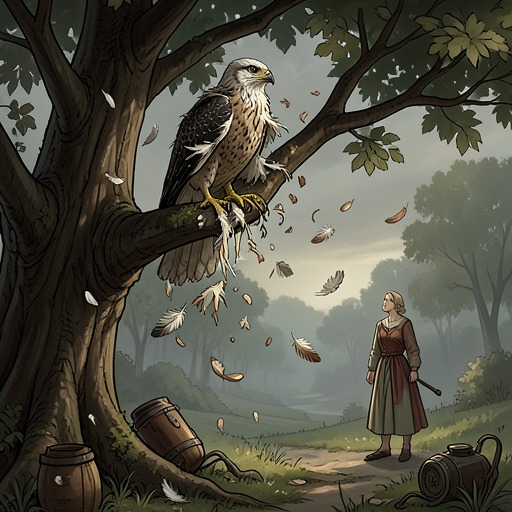
After an earthquake frightens Helen during the night, Mabel sleeps through the drive to Suffolk. Tony’s aviary is high-walled and spacious, fitted with bark-covered branches, astroturf-covered perches, a bath, a food chute, undergrowth, gravel, a nest ledge, and a patch of sun. Above its wire-mesh roof lies the Suffolk sky. The range of places to perch, bathe, and rest makes the enclosure a carefully prepared home for the months of moult.
Once inside, Helen removes Mabel’s jesses, leaving her on the glove without them. Mabel surveys the aviary, following the roofline to its corners and examining the foundation walls. Helen recognizes the echo of their first meeting in the moment when Mabel attends to her surroundings rather than to her; now she anticipates that Mabel will forget her again during the separation. She says she will see her after summer, then releases her toward a perch. Mabel lands, shakes her tail, and leaps to a branch facing away from Helen. The bird’s immediate occupation with her new space gives the farewell its quiet finality.
Narrative significance
Suffolk holds together necessity and loss. Mabel needs to be left undisturbed and well fed to grow her new plumage, but the arrangement requires Helen to return alone. The anticipated change is physical as well as relational: Mabel’s new feathers will be stone-grey and white, replacing the earth and ochre tones, and her eyes are expected to deepen to orange. The place is thus associated with a period in which Mabel will change while Helen is absent, and with the uncertainty of reunion and recognition.
The departure does not end in solitude without support. Tony waits outside, understands Helen’s feeling, and invites her into the house, where dogs lie on the kitchen floor and a kettle whistles. Against the open sky above the aviary, this domestic welcome offers a small human counterweight to leaving Mabel behind. Suffolk’s role in the narrative is grounded in that contrast: it provides a suitable home for the hawk and becomes the place where care takes the form of letting her go.