T. H. White
H is for HawkT. H. White was an English writer and schoolmaster whose celebrated Arthurian books grew alongside a less settled life marked by fear, loneliness, and a longing to escape ordinary human society. His attempt to train the goshawk Gos, begun as war approached, became a failed contest of wills and the subject of The Goshawk. In Helen Macdonald’s account, White matters not simply as a predecessor in falconry but as a writer whose struggle with a hawk exposes the danger of confusing mastery with care.
Identity and public life
Known to pupils as Tim, White was twenty-nine in 1936 and had taught at Stowe School for five years while writing for seven. He cultivated an unconventional presence: he flew aeroplanes, fished, hunted, and kept grass snakes in his room; he also published racy novels under the pseudonym James Aston. Pupils admired his glamour and insubordination, but feared his disdain. He demanded emotional sincerity and could puncture the pretensions of boys who did not show it. For all his apparent bravado, he described himself as someone who attempted frightening things because he feared injury and death.
White’s later fame rested especially on his reworking of Arthurian legend. The Sword in the Stone, published in 1938, established his reputation and brought him financial success; Disney acquired its rights, and White went on to write The Once and Future King. His version of the Arthur story reached well beyond its books: it inspired the musical and film Camelot, and its image of Merlin helped shape the familiar wizard in a tall, star-embroidered hat. Yet The Goshawk belonged to an earlier, more precarious phase of his writing, before those works made him famous.
Fear, childhood, and the wish to become feral
The book presents White’s fear as rooted in an unsafe childhood. His memories of India included his parents’ bitter conflict and drinking, and the threat of violence within the family. He later recalled a childhood in which he felt at risk and powerless. That history gives weight to his adult efforts to prove himself brave: flying and riding were not evidence that fear had disappeared, but repeated tests undertaken in its presence.
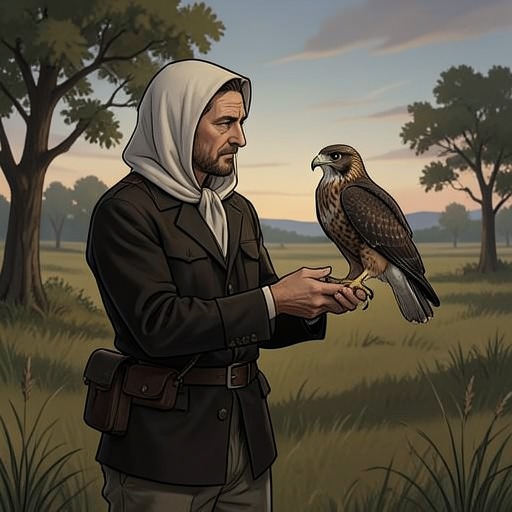
As war drew nearer, White’s anxieties about violence and modernity intensified. He had written of a civilization threatened with collapse and wanted to get away from the world he distrusted. Reading Captain Gilbert Blaine’s account of a lost goshawk that returned to a feral state gave this wish a figure. White was struck by the possibility of becoming free and ferocious, and took a farm labourer’s cottage for five shillings a week before writing to Germany for a goshawk. The bird promised an escape into wildness, but White also invested it with parts of himself he found difficult to accept. His hope was that training the hawk might teach him something about freedom while giving him a life and a book to build around it.
His choice of hawk also stood against the social prestige attached to falconry. Falcons required open country that was more accessible to wealthy or well-connected hunters; goshawks could be flown in more confined landscapes. Older falconry writing accordingly associated noble falcons with aristocratic privilege and treated solitary goshawk trainers with contempt. White’s interest in the goshawk placed him on the less celebrated side of that tradition. The book’s larger setting makes that distinction legible as a matter not only of birds, but of access to land and the social status attached to hunting.
Gos and the failure of mastery
White’s relationship with Gos began with a misunderstanding of how to train a hawk. The young bird was already familiar with people and willing to come to a falconer for food, but White did not understand the value of measured feeding and interpreted signs of earlier hunger as damage he ought to repair. His anxious attempts to feed and reassure Gos therefore worked against the trust he wanted to establish. Care, in this early phase, became difficult to distinguish from the urge to make amends and secure affection.
White later tried calling Gos across a distance using a creance, a line attached to the hawk, and a hymn as a call. He had grasped that hunger could prompt the bird to fly, but not the importance of rewarding an immediate response or ending a lesson when the hawk did not come. The episode became a painful example of falconry knowledge acquired too late: his fear and uncertainty disrupted the very encounter he was trying to control. In another scene, White’s improvised creance and his belief that the hawk would return if hungry show how readily confidence could outrun practical understanding.
The struggle lasted for weeks. White described it as a battle, and the narration interprets the contest through his childhood: the hawk’s resistance and his own repeated attempts to overcome it recast an old pattern of fear and power. This is not presented as a conscious plan. Rather, White came to recognize that he had become a persecutor while telling himself he was helping. His efforts to tame a wild bird without breaking its spirit ended in a relationship shaped by mistrust; neglect helped make Gos wild again, and the hawk was eventually lost. The failure was therefore more than a setback in training. It forced White to confront the difference between loving an animal and demanding that it answer his needs.
Writing, concealment, and later life
White began The Goshawk while living in a cottage as war approached, but his literary identity continued to develop in other directions. In 1939, hiding from the war in County Mayo, he argued to himself that he had more important work than enlistment: completing an epic about the Matter of Britain. The sound of hawk bells from his trained birds prompted him to reconsider the hawk book. He imagined it not as a conventional natural history but as a work about the falconer’s role in the bird’s education, a sequence of ceremonies and ordeals. The conception joins the practical business of training to the symbolic roles White assigned himself—as a figure who could test, bind, and eventually guide the hawk.
His private life remained more complicated than his public literary persona suggested. White’s sexuality was concealed, and his private writings contained material his friends later feared would harm his reputation. He was also troubled by desires that he understood through the history of his own abuse; therapy did not make them disappear. These facts sharpen the significance of his writing about power and harm, but do not reduce the hawk book to autobiography. Its force comes partly from the gap between White’s wish to become a master of wildness and his eventual recognition of the damage that mastery could do.
In March 1949, publisher Wren Howard found the hawk manuscript beneath a sofa cushion at White’s home on Alderney. White resisted publication because he had become a more knowledgeable falconer and felt embarrassed by the earlier work; the loss of the hawk weighed on him too. Howard took the manuscript to London and urged its publication. White eventually agreed on the condition that he could add a postscript explaining, in light of his later experience, how he should have trained the bird. The manuscript thus preserved not only the failed attempt but White’s later reconsideration of it.
Narrative legacy
White died of heart failure in January 1964 aboard the SS Exeter in Greece. After his death, biographer Sylvia Townsend Warner encountered his life through the objects in his house, including an unfinished hawk hood and his books. In Helen Macdonald’s account, White remains present as a literary and imaginative companion: training her own hawk opened a way to see more clearly the distress of both the man and the bird in his story. Their connection is not a meeting between contemporaries but a conversation across books and experience. White’s importance lies in that unresolved inheritance: his writing makes the desire for wildness vivid, while his history with Gos warns that a wish to possess or transform the wild can reproduce the very violence from which escape was sought.