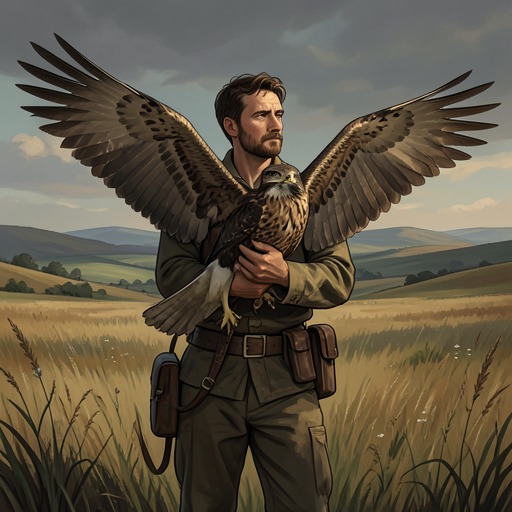
T. H. White and Gos
H is for HawkT. H. White and Gos are joined in a falconry experiment that becomes a reckoning with the difference between caring for a wild animal and trying to control it. White hopes that training the goshawk will let him escape the pressures of his life and recover a freer self. Instead, their repeated failures expose how his longing to protect and educate Gos is bound up with the urge to master him. Gos’s escape leaves White with remorse and a changed idea of what their relationship should have been.
Formation of the relationship
White’s decision to acquire a goshawk grows out of fear of the approaching war and a desire to withdraw from the society he regards as broken. While reading Gilbert Blaine’s account of a lost hawk reverting to a feral state, White is struck by the possibility of becoming feral himself. He rents a farm-labourer’s cottage and writes to Germany for a goshawk. In the bird he invests a cluster of qualities he wants to recover: freedom, ferocity, and distance from the life he has known. Gos is therefore not simply a pupil in a new falconry project. From the outset, White sees him as a figure through which he might remake himself.
That imagined escape is incomplete. White’s cottage stands on the Stowe estate, beside an old route leading towards the school where he had been a schoolmaster. The setting makes his retreat from his former life look less like departure than an attempt to settle at its edge. The same tension enters his approach to training. White wants to leave behind the schoolroom’s punitive methods and finds falconry attractive as an education based on patience rather than punishment. He proposes a book, The Goshawk (book), as a patient journey into the past as well as a record of learning to train Gos. The relationship thus becomes a way to revisit his own history while trying to offer the hawk a different kind of instruction.
Books, ideals, and methods
White has little practical experience to guide him. He studies modern falconry books but becomes especially absorbed in Edmund Bert’s seventeenth-century An Approved Treatise of Hawkes and Hawking. He privately develops an intense admiration for Bert and chooses to follow the older hawk-training practice of keeping a bird awake through prolonged watching. White treats this as a solitary ordeal: a test of endurance and resolve in which trainer and hawk must remain together. During one vigil he gets only six hours of sleep in six days, carrying Gos, keeping him awake, and reciting plays and poems to him. The method gives the training the character of a private rite, but its severity also shows how readily White turns instruction into a trial of will.
The gap between White’s ideal and his practical understanding is evident from the first night. Gos, a young male goshawk already familiar with people, steps onto White’s fist and feeds at five minutes past three. White does not understand that successful training depends on measured hunger and carefully timed food rewards. Disturbed by pale marks in Gos’s tail feathers, which he associates with earlier food deprivation, he responds by offering more food than the hawk wants. Gos becomes full and withdraws; White interprets his refusal as a problem to solve by trying different foods and waiting for another chance to feed him. The pattern repeats: when Gos eventually eats, White gives him too much, and their distance returns. White’s desire to repair what he fears may have been done to Gos becomes, in practice, an insistence that the hawk accept his care.
White’s written observations preserve the unsettled rhythm of their lessons. One entry records him walking repeatedly around Gos with a rabbit leg while the hawk keeps away, then leaving without feeding him. White is frustrated that the attempt has achieved nothing, but the record also shows that he knows he is learning outside the instructions in his books. On another occasion, he decides that a hungry hawk will come to the fist and that a well-fed one will not. With Gos on a railing and a long, doubled length of tarred twine attached as a creance, White calls him with a tune based on The Lord Is My Shepherd. After an hour of waiting, White pulls the line to bring Gos down. The hawk returns to its perch repeatedly before eventually approaching, and White takes the lesson as a partial success. It teaches him something about Gos’s condition, but the forced repetitions reveal how easily a lesson about attention can become a contest over compliance.
Misunderstanding and conflict
White’s care is genuine, but it does not ensure that he reads Gos accurately. He worries about the hawk’s health and appetite, feels shame when he mishandles a lesson, and hopes to become the kind of teacher who does not punish. Yet worry and affection repeatedly lead him to intervene when Gos is trying to withdraw. White’s later account of a training day records a rabbit leg rejected by Gos, White’s frustration at having spent the day trying to attract him, and his regret over a previous moment when he had prevented the bird from returning to his fist. He considers withholding food to address a possible stomach problem, then abandons the plan by morning and gives Gos most of a rabbit. His resolutions, including the plan to keep the hawk awake, do not last. In White’s own description of the cycle, both trainer and bird seem to answer the other’s actions with renewed resistance.
The failed attempts also carry a history White does not initially recognize. He has imagined Gos as the wild and unruly part of himself that he wants to release, but he is also trying to civilize that part. The opposing wishes lock the pair into a relationship in which the hawk is at once the emblem of freedom and the object of training. White’s account connects this conflict with his childhood and his experience of powerlessness. The book interprets his repeated efforts to master Gos as a form of repetition compulsion: an unconscious return to painful patterns in the hope of overcoming them. In that reading, White’s belief that he is acting as a gentler teacher does not prevent him from occupying the role of persecutor. The bird he wants to protect can also become the recipient of the control he means to reject.
Escape and aftermath
Gos’s first serious entanglement makes the risks of White’s equipment and limited experience unmistakable. Left on the railings while White briefly goes to speak with Mrs Wheeler, Gos climbs an oak tree, carrying the creance into its branches. White’s attempts to call him down and handle the line make the situation worse. It takes an hour and a half to bring Gos to the ground, using a screwhook attached to a salmon rod. The episode leaves White with a vivid reminder that a line intended to keep the hawk close can instead restrict his movement and increase the danger. Despite this, he continues to hope that Gos will soon fly free.
That hope ends when Gos escapes during a period of rain and high wind. White has tied the hawk’s swivel to a bowperch outside the barn with the same weak tarred twine that has already broken twice. He means the arrangement to give Gos more freedom to fly outside and return. After leaving the bird to work indoors, White returns to find the perch empty and the twine snapped. Searching in the storm, he eventually sees Gos in a tree. The soaked hawk begins to descend towards White, who is holding food, but the wind catches him and carries him away. White cannot recover him.
For days, White sees Gos at a distance, circling over the trees. He recognizes that the hawk appears happy in the wild and wishes him freedom, even as he fears that the jesses and swivel still attached to him may catch on a branch and lead to his death. White imagines what he would do if Gos came back: treat him as a partner instead of a slave. The resolution cannot undo the training or restore the relationship, and the book does not confirm Gos’s eventual fate. It marks, instead, White’s recognition that affection does not cancel the consequences of control.
Significance within the book
The account of White and Gos informs Helen Macdonald’s understanding of her own work with Mabel. Her close attention to a goshawk’s posture, feathers, and changing responses shows training as a practice of observing an animal rather than assuming that human intentions explain its behaviour. A later moment of play between Mabel and Helen Macdonald also unsettles inherited descriptions of goshawks as merely sulky or difficult: the bird’s responses reveal capacities that the books have failed to record. These contrasts sharpen the significance of White’s story. Gos is both the hawk White tries to train and an animal whose needs and responses exceed the meanings White assigns to him.
The relationship also sits against the social history of falconry described in the book. The open country needed to fly falcons properly was often associated with wealth and privilege, while the solitary trainer of goshawks had a poorer reputation. That contrast helps explain why the goshawk could carry a different imaginative charge from the aristocratic falcon: White’s choice of bird belongs to his wish to reject established social and personal limits. Yet the story does not present wildness as something a trainer can simply claim. Gos’s escape exposes the difference between wanting freedom as an ideal and making room for another creature’s independence. Their relationship remains tragic because White’s search for a way out of his own past becomes inseparable from the constraints he places on the bird he hopes to understand.