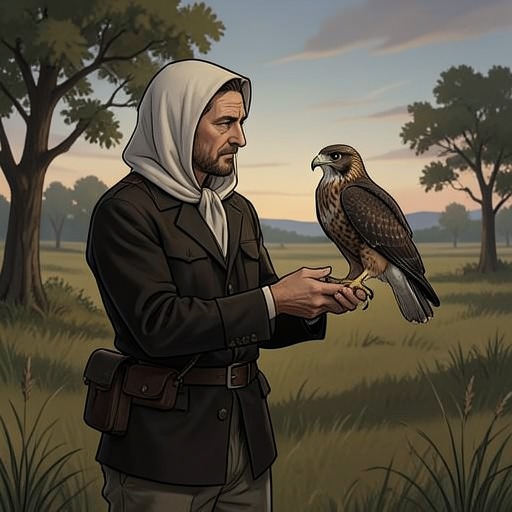
T. H. White begins training the goshawk Gos
H is for HawkT. H. White begins training the goshawk Gos at a moment when fear of war, distrust of modern civilisation, and a longing for personal transformation converge. A story of a goshawk returning to a feral state gives him an image for escape: he will try to train the hawk while also using the undertaking to remake himself. The project takes physical form in a rented farm-labourer’s cottage, where White prepares to live with the bird and build a life apart from the school and metropolitan worlds he wants to leave behind.
Fear, withdrawal, and the idea of the feral
White’s decision emerges from a period of mounting unease. War seems close, and his fear of it joins older anxieties: nightmares of bombs, poison gas, tunnels, and escape routes beneath the sea. In his recent book Gone to Ground, foxhunters shelter underground while bombs and incendiaries destroy the civilisation above them. White presents that civilisation as broken and its modern politics as dangerous and futile. Against this prospect, the past seems like a possible refuge. He turns to a book on falconry by Captain Gilbert Blaine, looking toward an older practice as a way to leave the present behind.
Blaine’s account of a lost goshawk supplies the decisive idea. The bird, initially as tame as a household parrot, had reverted within a week to a feral state and become a local legend. White is struck by the possibility implied in that change. The hawk’s return to wildness becomes more than an account of animal behaviour: it offers him a model of freedom from the conditions that have confined him. He begins to imagine that he, too, might become feral, fierce, and free. The proposed training therefore contains a paradox from the outset. White wants to train a hawk whose imagined power lies in its escape from human domestication, and he hopes that the work will transform both bird and trainer.
A cottage made into a refuge
White’s plan becomes concrete when he rents a farm-labourer’s cottage for five shillings a week and writes to Germany for a goshawk. The modest rent matters: this is not a grand country estate, but the first home he has lived in by himself. Its water comes from a well and its toilet is an earth-closet in the garden. White nevertheless understands it as a refuge and begins making the rented place his own, treating it as a workman’s cottage and a badger’s sett.
He alters the interior with conspicuous care. The ceilings are varnished; rooms are painted in bright colours, including glossy red and blue; birds’ wings, a spill-jar, patterned wallpaper, a mirror, and books furnish the house. He spends £66 on deep-pile carpets and buys a winged brocade armchair and Madeira. Upstairs, he turns the guest bedroom into a private, fairy-tale space of mirrors, gilt, blue bed-linen, a golden bedspread, and candles. Yet he cannot bring himself to sleep there, choosing instead a camp bed in another room with brown curtains. The contrast between the room he creates and the bed he can actually use registers the distance between his imaginative refuge and his unease. The hawk is to live in the barn; both bird and man are to belong to this newly claimed home.
The hawk as a figure of self-transformation
White does not approach the goshawk as a neutral subject. He finds himself in the lost bird from Blaine’s story and attaches to it qualities he has pushed away in himself, including his sexuality and his desire for cruelty and mastery. The hawk becomes an image in which these conflicting elements can be held together: it may hurt him, but he is resolved not to let go. Training it promises a double education, in which White will teach the bird and himself, and eventually turn the experience into a book about an ancient and doomed art.
His imagined future is deliberately set against the life he is leaving. He pictures himself flying the goshawk, eating the pheasants it catches, and surviving as a yeoman on the land when war brings ruin and anarchy. This pastoral self-image offers distance from the sexual confusion of the metropolis and the smaller conflicts of school life. It also turns falconry into an act of allegiance: White imagines himself raising the flag of a defeated country, choosing an older, rural identity as the world around him threatens to collapse. The account makes clear that this is not simply a practical plan for keeping a hawk. It is a vision of escape built around a bird onto which White projects his hopes for freedom and his capacity for violence.
Class, reputation, and the goshawk
The choice of a goshawk also places White within a history shaped by class and by unequal access to land. Falcons require open country—grouse moors, partridge estates, and broad farmland—so flying them properly has often depended on wealth or social connection. Captain Gilbert Blaine described possession of the supposedly noble falcons as an aristocratic privilege. Their elevated reputation, in this account, reflects not only their flight but also the status of the people able to fly them.
The solitary trainer of goshawks, by contrast, had often been treated with contempt. A medieval writer mocked austringers as antisocial and physically misshapen, while later accounts transferred similar disdain to their birds. Blaine’s descriptions cast goshawks as disagreeable, sulky, and bloodthirsty, in sharp contrast to the noble peregrine. White’s project thus centres on a bird already burdened by classed and gendered judgments about roughness, solitude, and difficult temperament. His attraction to the goshawk’s feral potential challenges the ideal of falconry as an aristocratic display of mastery, even as his own desire to master and transform the bird remains part of the undertaking.
Arrival and the beginning of the undertaking
The account marks the hawk’s expected arrival as the threshold between White’s preparation and his new life. The cottage has been furnished, a place has been set aside for the bird in the barn, and White anticipates a household made up of himself, his dog, and the hawk. His opening of this life is therefore both domestic and symbolic: he is preparing for an animal companion while imagining that the animal might lead him beyond ordinary human constraints.
The episode establishes the central tension of White’s training project before any particular lesson with Gos is described. He seeks freedom through an art of control, and a refuge from the present through a practice inherited from the past. The goshawk is at once a real bird he intends to train and a figure onto which he loads his hopes for a different self. That gap between the bird’s independent existence and White’s need for transformation gives the beginning of the undertaking its significance.