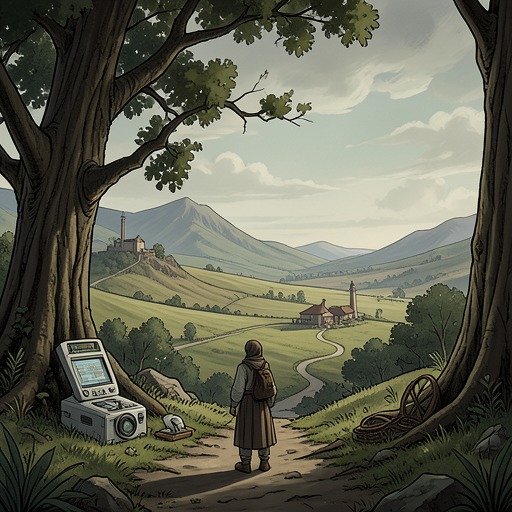
The Ridgeway
H is for HawkThe Ridgeway is an ancient track whose significance in the book lies less in a documented sequence of events than in what it teaches Helen about landscape and history. A childhood walk along it near Wantage first made the past feel present; later, she reconsidered the inherited ideas of belonging that such landscapes can carry.
Setting and Early Memory
Helen grew up among the lowland pine forests and heaths of sandy Surrey, a landscape that differed from the high ground she encountered on the Ridgeway. Near Wantage, corn buntings called from fence posts as she walked with her father. He told her that the track beneath them was ancient. The knowledge impressed her: the path offered a sense of time reaching far beyond the scale of an ordinary childhood walk.
The Ridgeway belonged to a wider landscape culture that was especially visible in the 1970s. Helen recalls that decade’s renewed interest in chalk and the past, alongside experimental Iron Age re-enactment villages at Butser, children’s television dramas about the stone circles at Avebury, and great bustard reintroductions on Salisbury Plain. These examples form the period’s cultural backdrop, not events on the Ridgeway itself.
A Childhood Sense of Deep Time
At nine or ten, walking the Ridgeway was where Helen first understood the power a person might feel by aligning themselves with deep history. The path became more than a route through the countryside: her father’s account of its age gave the ground a temporal depth that she could imagine entering. This was a formative way of seeing, made through walking and family memory rather than through formal historical study.
The experience sits within a larger pattern of childhood encounters with the past. Helen remembers laying a hand on a stone at Stonehenge when she was five, but the Ridgeway walk marks a distinct later realization: that a person could feel connected to history through a landscape. The book preserves the force of that early feeling while also showing that it was not a neutral inheritance.
The Chalk Landscape and Its Inherited Stories
Only later did Helen understand that the appeal of chalk downlands could rest on assumptions of an organic connection between people and place. A sense of belonging might be sanctified by an imagined lineage, while the landscape’s national history became entangled with its natural history. The childhood exhilaration of deep time therefore acquired a more troubling counterpart: ideas that seem to root people in a place can also privilege some histories over others.
Helen’s criticism is not that the Ridgeway’s age or the feeling it inspired was unreal. Rather, she came to see how a powerful landscape story could narrow the past, making one version of belonging appear natural and timeless. Such myths can erase other cultures, histories, and ways of loving, working, and living in a landscape. The Ridgeway thus remains both a site of genuine childhood discovery and part of a broader chalk-country tradition that Helen later learned to question.
Narrative Significance
The Ridgeway’s place in the narrative is defined by this change in understanding. As a child, Helen experienced the ancient path as an invitation into deep time. As an adult, she could recognize that the same language of historical belonging might conceal exclusion and historical loss. The memory does not simply cancel the earlier wonder; it complicates it, holding together the path’s power to make history palpable and the risks of treating any single account of a landscape as complete.