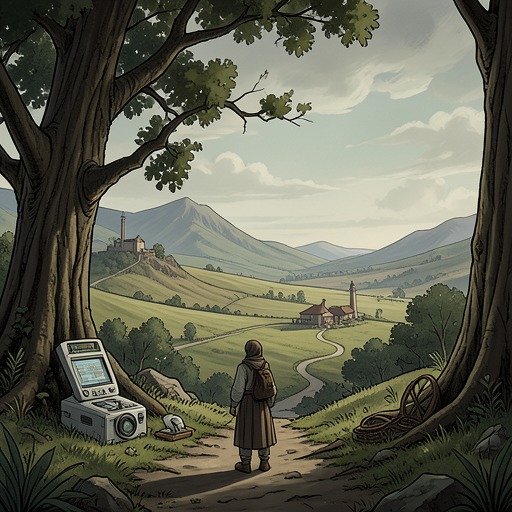
The chalk-cult
H is for HawkThe chalk-cult describes a strand of English nature-culture that loads chalk landscapes with feelings of antiquity, purity, and belonging. In Helen’s account, the downlands can inspire genuine exhilaration, but the stories attached to them are not innocent: an appeal to ancient landscape and imagined lineage can privilege one history while erasing others. The concept names both the attraction of these places and the danger of mistaking a cultural myth for the landscape’s full history.
Landscape and historical belonging
Helen describes chalk as producing an almost expectant feeling, as though revelation were near. She recognizes that this response participates in a longer tradition of chalk mysticism. Its characteristic landscape is elevated, open, and apparently remote from ordinary life; the ruralist H. J. Massingham presented the downland as a place where a person could attend to the essential forms of existence. The appeal is aesthetic, but it also carries assumptions about who belongs. The chalk landscape can seem to offer a direct connection between people, land, and deep time, as if belonging were inherited and confirmed by the terrain itself.
Helen’s childhood memories show how that historical feeling takes shape. She grew up among the lowland pine forests and heaths of Surrey, but a photograph recalls her at five, touching one of the stones at Stonehenge. Later, walking with her father along The Ridgeway, she learned that the path was ancient. These experiences gave history a physical presence: a child’s hand on a stone, a walk on a path whose age seemed to extend beyond any individual life. In the 1970s, this appetite for chalk and antiquity also appeared in experimental Iron Age villages at Butser, children’s television dramas about the stone circles at Avebury, and great bustard reintroductions on military land on Salisbury Plain. Helen recalls the cultural pattern without claiming a single cause for it; economic depression and the oil crisis occur to her as possibilities, not explanations she can establish.
The encounter with the downland
The concept becomes concrete when Mabel’s attention draws Helen across a hedge and into an unfamiliar chalk landscape. A field of game-cover crops opens onto a downland valley. From exposed, chalk-rich ground, Helen sees a brown hare and, lower in the valley, a herd of thirty fallow deer. The scene supplies the very combination that makes the chalk-cult persuasive: open land, visible animals, ancient-seeming ground, and the sense of standing within a larger history. Helen walks toward the deer, and they move in a line toward the distant wood; the hare runs in the opposite direction. The encounter is compelling, but it does not confirm a timeless pastoral ideal. It prompts Helen to question the meanings she has brought to the view.
Her unease concerns the history hidden inside the pleasure of landscape. The chalk-cult can turn an experience of beauty into a claim about organic connection, as though one imagined ancestry were the natural measure of belonging. Helen recognizes that such myths can displace other people’s histories and other ways of living and working in a place. The risk is not simply that a story about the past is inaccurate. It is that a reassuring story can make exclusion seem natural, while rendering the landscape’s complicated human histories less visible.
National myth and erased histories
A conversation after the encounter makes that danger explicit. A man presents the landscape as a remnant of an authentic England and links its supposed survival to hostility toward immigrants. Helen is unable to answer him at the time. Walking home, she connects his claim to the darker political uses of landscape and national belonging, including the exclusionary history represented by Göring’s plans to bar Jews from German forests. She also thinks of Finnish goshawks that made the Brecklands their home, her grandfather, who spoke only Gaelic until he was ten, and a Lithuanian builder she had met gathering mushrooms. These memories resist the idea that English landscapes have one uncomplicated, native history. They make migration, language, work, and knowledge part of the story of place.
Helen’s criticism extends from national myth to environmental memory. The fields where she flies Mabel near Cambridge are organically farmed and teem with life; the landscape she has just crossed looks superficially familiar but supports far less variety. Chemical treatment leaves few plants beyond crops and reduces the presence of bees and butterflies. The apparent continuity of fields and trees disguises successive losses: turtle doves were there ten years earlier, corn buntings and large flocks of lapwings thirty years earlier, and red-backed shrikes, wrynecks, and snipe seventy years earlier. Further back, ravens and black grouse had also disappeared. The idealized countryside is thus not merely selective about human history. It can also hide ecological change by making a diminished landscape look like the one people remember.
Memory, responsibility, and significance
Helen calls Old England an imagined place assembled from cultural representations such as words, woodcuts, films, paintings, and picturesque engravings. These images can make history seem stable and available for reuse, while encouraging people to forget what lived in a place before their own brief experience of it. In that sense, the chalk-cult’s promise of deep time is paradoxical: it invokes antiquity, yet may narrow attention to a comforting past and obscure both older ecological abundance and the histories excluded from national belonging.
The encounter changes how Helen understands her own use of the hawk. She had wanted to escape history by turning toward Mabel and the landscape, but recognizes that flight as dangerous when it becomes a way to forget. Her regret at not challenging the man’s remarks accompanies a resolve to resist such forgetting and to defend landscapes for their varied life, rather than for their power to confirm an imagined national identity. The chalk-cult therefore remains double-edged in the book: it explains why chalk places can feel charged with memory and possibility, while insisting that this feeling must be examined against the histories and living communities it may conceal.