The conversation of death
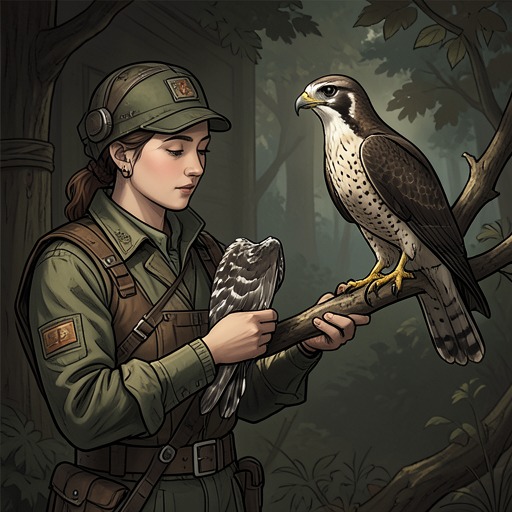
H is for HawkThe conversation of death is Helen Macdonald’s name for the silent, consequential attention she sees passing between a hunter and its potential prey. The idea arises while she watches Mabel hunt: the goshawk disregards rabbits close at hand, attends to others across the field, and makes her choice in flight. For Macdonald, the episode is not simply an illustration of instinct or a human allegory. It raises the possibility that the animals are engaged in an exchange whose terms the human observer can only partly perceive—and that watching such an exchange may implicate the watcher as well.
The idea and its source
Macdonald associates the phrase with Barry Lopez’s account of the glances between caribou and hunting wolves. In that account, attention becomes a wordless negotiation over whether the animals will become hunter and hunted or pass one another. The concept gives Macdonald a way to consider hunting as a relation unfolding between living animals, rather than as a sequence in which a human falconer simply directs a bird toward prey.
Her question is whether Mabel participates in anything like this exchange. The question remains interpretive: the narrative cannot establish what the goshawk understands, but it can register what she notices and does. Macdonald’s close observation—elsewhere sharpened by learning to read changes in a hawk’s posture and feathers—makes the limits of human knowledge part of the subject. Attention may allow her to anticipate Mabel’s behavior, but it does not make the bird’s perception fully available to her.
Mabel chooses her quarry
In the field, Mabel is in Yarak, yet she ignores three rabbits only a few yards away. Macdonald tries to direct her attention toward them, but Mabel keeps looking toward the far end of the field. She then leaves the fist and flies low across the nettles, missing one rabbit before making a rapid change of target and taking another. Macdonald understands that the rabbits at the far end were the ones Mabel had been attending to. The hunt thus unsettles the assumption that proximity, or the falconer’s preference, determines the hawk’s choice.
The capture requires the two of them to act in relation to one another: Mabel holds the rabbit in a hole, and Macdonald reaches in and helps draw it out. The scene is not a picture of effortless human command. Mabel has selected and held her quarry; Macdonald’s participation follows the circumstances of the hunt. Her attention is divided between reading the hawk, locating the rabbit, and working out what has happened. The phrase gives that uncertain, shared action a name without resolving it into a simple account of animal intention.
The same instability of perspective appears in Macdonald’s account of Mabel pursuing a pheasant. While searching the hedge, Macdonald tries to understand events from the positions of both hawk and prey. Her consciousness seems to separate among the three participants, and the lines connecting them become, for a moment, a way of thinking about her own relation to life and death. When the pheasant is flushed and Mabel strikes, those imagined lines seem to become joined again. The hunt briefly makes Macdonald feel implicated in the action rather than safely outside it.
A phrase that returns
After the rabbit hunt, the conversation of death keeps returning to Macdonald at ordinary moments. She later treats that recurrence as a warning: things are going wrong, though she does not yet understand what the thought is trying to tell her. The phrase’s return shifts its emphasis. It began as a way to consider the relation between predator and prey; it now also signals the strain of Macdonald’s own relation to Mabel and to the world beyond the hawk.
That shift becomes stark when Mabel unexpectedly grips Macdonald’s arm. The incident alarms her, and she checks whether the weighing machine might explain a change in the bird’s behavior. It does not. Macdonald recognizes instead that she herself has become increasingly anxious and withdrawn, avoiding visitors and ordinary encounters. She rejects explanations that would keep the hawk outside the account of her experience: abstract accounts of attachment, loss, and grief cannot substitute for attending to the particular life she shares with Mabel. The phrase consequently remains double-edged—an idea about the animals’ encounter and a sign that Macdonald has not yet understood her own condition.
Looking beyond inherited judgments
The book places this attention against a history of writing that often judged goshawks through human expectations. Falconry literature elevated falcons partly because flying them properly required access to extensive open land, while goshawk falconry could be practiced in more varied places. Macdonald notes the accompanying hierarchy: aristocratic falconers and their birds received prestige, while the solitary austringer and the goshawk were disparaged. Such judgments shape what observers expect to see before the hawk acts.
Descriptions of female goshawks as sulky or contrary provide another example of inherited interpretation. Macdonald contrasts later complaints with seventeenth-century accounts that describe these birds as shy but responsive to kind and considerate treatment. That older writing leaves room for a goshawk to be self-willed, fearful, affectionate, and sociable without reducing her to a human stereotype. Mabel’s playfulness—shown in her response to a paper toy and in games of catch—likewise exceeds what Macdonald had learned to expect from the books. These moments do not prove what the hawk means; they make the limits of prior assumptions visible.
The phrase therefore gathers together the book’s attention to animal choice and the observer’s responsibility to look closely. In Maine, Macdonald contrasts hunting practiced across land under a common-law tradition with the class-bound access associated with British estates and shooting grounds. Across these contexts, hunting is never only a private encounter between falconer and hawk: land, custom, and inherited ideas about which animals are noble or disagreeable shape its meaning. The conversation of death resists treating Mabel as a mere instrument or emblem. It keeps the focus on the particular exchange Macdonald witnesses, while leaving open what the hawk’s attention means beyond the actions it makes possible.