University of Cambridge
H is for HawkThe University of Cambridge is both Helen Macdonald’s place of academic work and a landscape through which her account of grief and falconry measures a changing sense of belonging. She is identified as an affiliate in the Department of History and Philosophy of Science and recalls three years as a Cambridge Fellow. During that period, the routines and prestige of college life coexist with a growing conviction that the institutional future once available to her no longer feels like her own.
Identity and Academic Connection
Helen Macdonald is a writer, poet, illustrator, historian, and affiliate at the Department of History and Philosophy of Science at the University of Cambridge. Her academic and literary work meet in a distinctive way in the book: university libraries and historical research help her investigate T. H. White, while her own training of Mabel gives that research an embodied, immediate counterpart. Cambridge is therefore not simply a professional affiliation. It is one of the settings in which Macdonald’s attention moves between scholarship, memory, and close observation of a living animal.
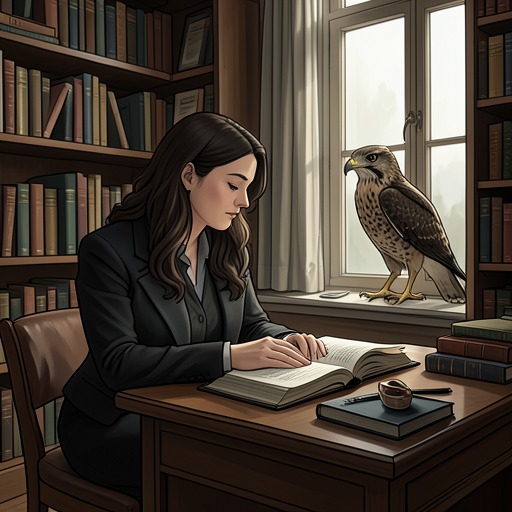
The University’s library also figures in the historical thread about White’s falconry. Macdonald notes that he had read Edmund Bert’s 1619 treatise on goshawks, a rare book he did not yet own. She considers whether he may have consulted a copy kept in the Cambridge University Library and whether that might have been the copy she herself studied as a student. The possibility is not presented as established fact. Its importance lies in the tentative contact it creates across time: Macdonald’s research into White’s reading brings her into proximity with the same old falconry text, while leaving the exact history of the copy uncertain.
College Work and Everyday Life
Macdonald describes three years as a Cambridge Fellow through the accumulated rhythms of academic work: lectures, libraries, college meetings, supervisions, admissions interviews, and long nights spent writing papers and marking essays. The account also recalls the ceremonial side of college life, including pheasant at candlelit High Table, carols, port, and silver on dark-polished refectory tables. These particulars show the University environment as both a workplace and a social world, shaped by repeated duties as well as by traditions and displays of belonging.
That world is materially present in the college buildings and grounds. Macdonald’s office is in a red-brick Victorian building with battlements, mullioned windows, and a small Gothic tower; from the cricket pitch she sees its familiar façade. Elsewhere on campus, she registers objects and spaces that make the surroundings feel strange to her during a spell of derealisation: painted chapel angels, a bronze Benin cockerel, a skeleton in a Fellows’ cloakroom, clipped yew trees, and sculptures on the lawns. A recent Alice in Wonderland-themed ball has left potted bay trees and fabric roses around the college. The buildings and decorations remain recognizable, yet their sudden accumulation makes the college seem less like a settled home than a collection of historical objects gathered around her.
Falconry on College Ground
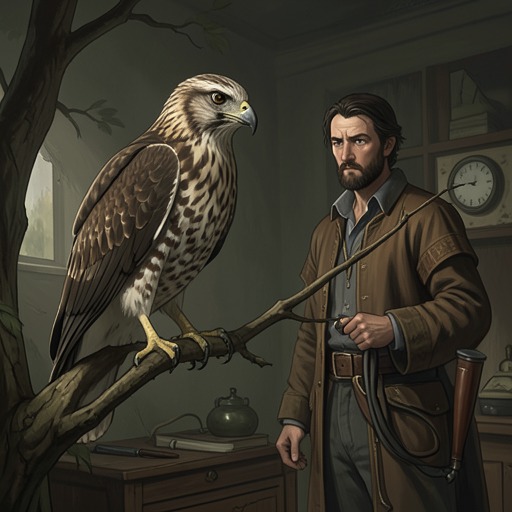
The college grounds provide a practical setting for Macdonald’s work with Mabel. At the cricket pitch, she prepares the goshawk for calling-off lessons, carrying the creance and food in the many pockets of her hawking waistcoat. When a porter approaches during a later training session, Christina explains that Macdonald is a College Fellow and that the activity is not against the rules. The encounter makes her institutional position concrete: she is not simply on campus with a hawk, but acting there as a recognized member of the college community.
Her falconry also enters the college’s social life. Fifteen days after Mabel’s arrival, Macdonald brings her to a summer lunch party at the Master’s Lodge. While the goshawk eats a rabbit leg, Macdonald gives the assembled family an impromptu account of falconry. The invitation has come from the Master’s wife, who has heard that Macdonald is flying the bird on college grounds and wants her family to meet her. In this scene the hawk does not remain separate from academic life: Mabel becomes the focus of a conversation that connects Macdonald’s specialist knowledge with the people around her at the college.
The occasion also brings Macdonald’s awareness of class and educational background into view. She remembers arriving from a state-school family whose parents had not attended university, and describes Cambridge as having seemed to her a mysterious place associated with privilege and spies. Her father had joked that she must be a spy because, as a child, she hid with binoculars in bushes and trees. At the Master’s Lodge, her presence with Mabel makes the distance between that childhood image of Cambridge and her actual position there especially visible. The institution offers a place in which she can speak with authority, even as she remembers how improbable that place once seemed.
Departure and Significance
The University’s importance changes as Macdonald’s account approaches the end of her college employment. She has declined an offer of work at a German university for the coming winter. In the letter, she has explained that her father has died and that she needs to remain where she is; privately, she recognizes that this was not the real reason. The decisive thought was that she could not go to Berlin because she had a hawk to fly. Her attachment to the immediate demands of Mabel’s training has displaced the career plans by which an academic future might ordinarily be measured.
Macdonald knows that in two months she will have no college job, office, salary, or home. The prospect sharpens a sense of loss, but she also feels that the old arrangement has already become unreal: the college and its traditions had never entirely felt like hers. This does not make her time at the University insignificant. Rather, the contrast between its structured academic life and the uncertain future she faces shows how grief has altered what she can imagine wanting. Cambridge remains the setting of her work and a source of intellectual and social belonging, but it no longer guarantees a stable destination. Its role in the narrative is to give that change a specific shape: an office, a cricket pitch, a lunch at the Master’s Lodge, and an approaching end date, set against the demands of a hawk whose training has overtaken Macdonald’s former plans.