Watching and invisibility
H is for HawkWatching and invisibility is both a practical principle of goshawk training and a way of understanding how attention can unsettle the boundary between observer and observed. With Mabel, the trainer learns to reduce the threat her presence poses so the bird can attend to food; in turn, sustained watching alters the trainer’s own sense of self. The method’s promise of partnership therefore carries a personal cost: a skill that helps a hawk feel safe can also draw a person into retreat from other people.
The practice of becoming less present
In the first encounter after Mabel’s hood is removed, she tries to get away, and her response makes plain that the trainer’s intended care does not cancel the fear produced by captivity and unfamiliarity. The trainer must accept this gap between intention and the bird’s experience. Training cannot begin by demanding trust; it begins by making food available without adding further pressure.
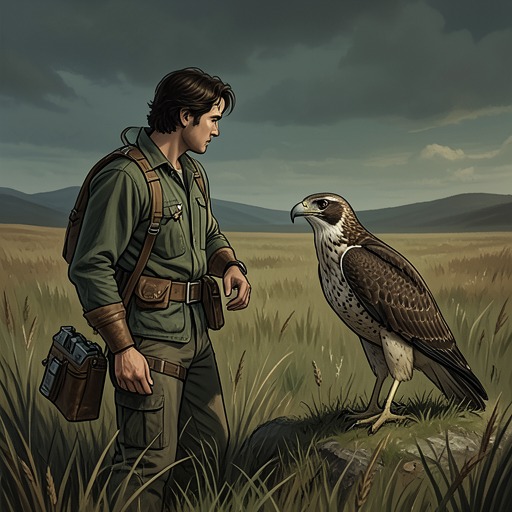
The trainer’s method is to keep still, empty her attention of herself, and allow the food to become the focus. The point is not simply to wait patiently. A fresh hawk watches the person as a possible threat, so even a small change in posture or state of mind may matter. When Mabel turns her attention toward the meat, the trainer can gradually become more present. The desired outcome is not immediate obedience but a movement across the distance between fear and feeding, toward a relationship that may eventually make the bird a hunting partner.
This is a specific discipline of attention: the trainer observes the hawk while also monitoring how her own presence affects what the hawk can do. Food, the gloved hand, and stillness structure the encounter. The bird is not treated as a social animal that can be brought around through punishment or force; the account instead describes food as the means by which a less fearful interaction can begin. In this sense, invisibility is not the absence of relationship. It is a temporary adjustment that makes a relationship possible.
Childhood watching and altered identity
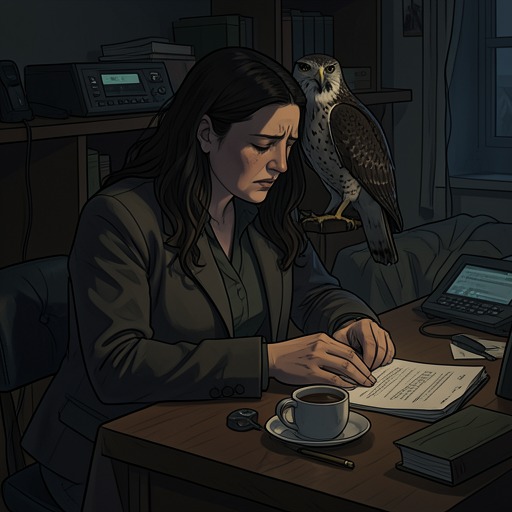
The practice feels familiar to the trainer because watching unseen began in childhood. As a girl, she would climb the hill behind her house and hide beneath a rhododendron, looking down at the world from a concealed position. The appeal lay in seeing without being seen, and in the security of observing without taking part. This memory links the technical skill used with Mabel to a longstanding personal habit rather than presenting it as something learned only from falconry.
That habit has consequences beyond the training room. The narrator recognizes that disappearing into observation can be ill suited to love, work, homes, and human company. With Mabel, however, it becomes a particular advantage: for the first days with a new hawk, reducing one’s visible threat can be essential. The contrast is central to the concept. The same self-effacement can be attentive care in one relationship and a failure to participate in others.
Watching also changes the watcher. The trainer describes her transformation as arising from grief, close observation, and not being herself. To judge when to move closer or withdraw, she studies Mabel’s posture and feathers as signs of mood. Tight feathers suggest fear and loose feathers ease; closer attention reveals smaller expressions that the trainer reads as possible happiness or sleepiness. Such observation becomes increasingly fine-grained, until she anticipates the hawk’s next action and feels that she understands the bird from within.
The account connects this imaginative identification to the capacity to remake oneself in response to another character or environment. The trainer’s response to Mabel is therefore not only knowledge about a bird: she describes herself as putting herself into the hawk’s wild mind. That identification assists the work of taming, but it also threatens to consume the human identity it serves. The image of turning into a hawk gives form to this double movement: attention creates understanding, while the watcher risks losing the distance that makes her a separate self.
Being forgotten
The first change in Mabel’s attention is modest but decisive. After a period of rest, she begins examining the room rather than fixing all her attention on the trainer. When she then turns and notices the person again, she jumps in surprise. For a moment, the trainer had ceased to dominate the bird’s awareness. Mabel’s brief forgetting becomes evidence that the hawk is beginning to accept the surroundings and the person within them.
The moment matters for the trainer for a second reason. She is delighted by the sign of Mabel’s growing ease, but also thrilled that she herself has been forgotten. The scene reverses the usual terms of observation: the watcher’s aim is not to command the hawk’s attention but to become unimportant enough for the hawk to look elsewhere. This does not establish complete trust or resolve the difference between human and animal. It marks a small interval in which the bird can attend to the room without the trainer being its whole world.
Social judgments and the histories of falconry
The concept also sits against a history in which birds and the people who flew them were assigned unequal status. The narrator had once preferred falcons and regarded goshawks as difficult and unsettling. She later recognizes that the prestige of falconry with falcons was connected to access: flying them properly required extensive open land, which was more available to the wealthy and well connected. Goshawks could be flown in a wider range of places because they hunted at close range. The reputational hierarchy between birds thus also reflected differences in land, privilege, and who could take part.
The solitary austringer, who trained goshawks and sparrowhawks, was disparaged in older writing, while the hawk itself was often described as coarse, troublesome, or difficult. The narrator’s reading of falconry books reveals how such language made a bird’s reactions seem like fixed defects rather than responses to its treatment. In accounts from the seventeenth century, by contrast, goshawks are described as shy but sociable and capable of affection when treated with kindness and consideration. One falconer presents himself as the bird’s friend and playmate. The contrast shifts attention from an allegedly bad-tempered animal to the conduct of the human trainer, making observation and responsiveness—not mere control—the basis for a different relationship.
A comparison with hunting in Maine further shows that access is not organized identically everywhere. The narrator describes a common-law tradition in which land can be hunted over, and local pride in the relative egalitarianism of that practice, unlike Britain’s history of exclusive estates and restricted access. This context does not erase the class divisions attached to falconry in Britain; it clarifies that the social meaning of hunting depends partly on who is permitted to participate. Across these examples, watching and invisibility reaches beyond a training technique: it asks who gets to observe, who is judged, and whether close attention can replace inherited assumptions with a more responsive relation to the animal.