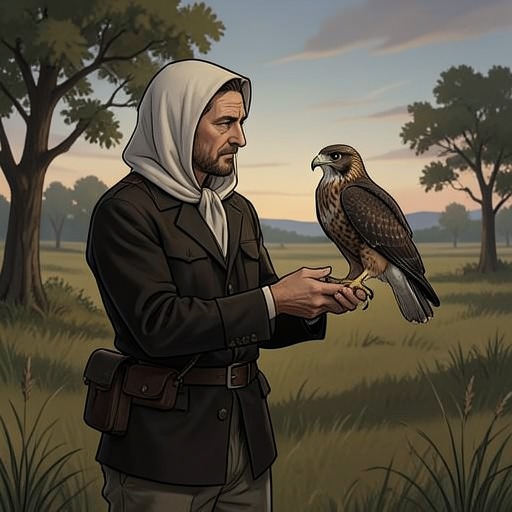
White's goshawk-training vigil with Gos
H is for HawkT. H. White’s goshawk-training vigil with Gos turns falconry into a private ordeal: White tried to tame a young hawk by staying awake beside it, making endurance itself part of the training. The episode is significant not simply for its severity, but because White recast a practical method as a solitary test of character. In Helen’s account, the barn vigil brings together his literary imagination, his reading of falconry history, and the struggle to confront in the hawk qualities he had long tried to suppress.
Background and Sources
White approached falconry as a mystery to be mastered without a teacher. His available guides included Gilbert Blaine’s recent Falconry and Gerald Lascelles’s Coursing and Falconry, but the book that captivated him was Edmund Bert’s An Approved Treatise of Hawkes and Hawking, published in 1619. The treatise focused on goshawks, and White had read it even though he did not own a copy. Its authority was not merely practical: Bert became an imagined presence accompanying White as he trained Gos.
That attachment was personal as well as intellectual. White privately described having a schoolgirlish “pash” for the falconer who had lived three centuries earlier, and Helen characterizes his feeling as love and a desire to impress Bert. The old book thus offered more than instructions. It gave White a past in which to place himself, and a model for turning hawk training into a test of resolve.
The method White took from that tradition was to keep the hawk awake by carrying it on the fist and remaining awake himself. Earlier falconers could have friends or attendants relieve them, but White chose to do the vigil alone. Helen presents this as a wilful misreading of the older practice: he wanted the solitude and privation of a rite of passage, rather than a division of labour. His decision made the trainer’s endurance inseparable from the bird’s ordeal.
The Six-Day Vigil
White remained awake with Gos for six days, sleeping for only six hours in all. He carried the hawk on his fist and watched it through repeated attempts to settle, continuing to keep it awake through his own movement and attention. The training therefore depended not on a single decisive action but on duration: the vigil extended the struggle across successive nights and made fatigue part of the encounter.
As exhaustion took hold, White tried to occupy the hours with performance. In the kitchen and the lamplit barn, he recited passages from Hamlet, Macbeth, Richard II, and Othello, followed by the sonnets he could remember. He whistled hymns and played Gilbert and Sullivan and Italian opera for Gos; after reflecting on the experience, he decided that hawks liked Shakespeare best. The range of material shows how he met the silence and repetition of the vigil: he filled the long hours with the literature and music available to him, while trying to control the tone in which he spoke.
The barn becomes, in Helen’s account, a theatrical setting for White’s self-conception. He imagines himself as an executioner in a mask and sees the place as a dungeon or the Bastille, with Gos cast as a prisoner. The account describes the cramped, makeshift interior through its sticks, empty jars, broken grate, beer barrel, and pool of lamplight. These details do not turn the vigil into a literal imprisonment; they show how White’s imagination frames the training as a contest between captor and captive, even as he insists to himself that he is free.
Discipline, Projection, and Conflict
White understood his method as a struggle against cruelty as well as against fatigue. He believed the hawk should not be punished, even when its attempts to break away made the work difficult. Patience was the restraint he set against force, and the principle by which he hoped to prevail over both the bird and himself. Yet the vigil’s design still depended on keeping Gos awake. Its central contradiction is that White sought to avoid overt punishment while imposing a sustained ordeal on a frightened hawk.
Helen places that contradiction within White’s psychological relationship to Gos. She interprets the young German goshawk as carrying qualities White had tried to repress: wildness, ferocity, unruliness, and cruelty. He had tried to fit the expectations of civilized society, but the pressure of his years at Stowe, his analysis, and fear of war had brought him close to breaking point. In training Gos, he was attempting to civilize in the bird what he could not escape in himself. The vigil consequently becomes more than a demonstration of persistence: White’s effort to master the hawk doubles as an effort to master a part of his own nature.
That projection helps explain the episode’s unstable roles. White casts himself as both the man who holds the captive and the exhausted participant subjected to a test. He imagines a contest between man and bird, with God as umpire, and treats endurance as proof of his word. The ceremony promises triumph, but its prolonged strain brings him close to madness. The more insistently he makes the vigil a heroic passage, the more clearly it reveals the costs of trying to impose a clean victory on a relationship built around fear, dependence, and control.
Significance in the Narrative
The vigil is a formative episode in Helen’s account of White and Gos because it establishes the tragic tension that shapes their training: White longs for the wildness he associates with the hawk, yet tries to conquer and reform it. His homage to Bert’s old manual gives the ordeal a historical and quasi-chivalric frame, but the solitary vigil is White’s own construction. He transforms a practical hawking method into a personal ordeal, measuring time by the repeated effort required to keep the hawk awake and himself at his post.
The episode also offers a contrast to the later account of Helen’s own work with Mabel. Helen describes learning a hawk’s moods through close observation, attending to changes in posture and feathers rather than assuming she already understands what the bird feels. That later emphasis on reading an animal’s responses throws White’s self-imposed contest into sharper relief: in his vigil, discipline and projection pull against attention to Gos as a frightened, independent creature. The comparison does not erase the differences between their experiences; it shows how the book uses White’s history to question what a trainer believes is being mastered when a hawk is trained.
In the narrative, then, the vigil is both method and warning. It reveals White’s capacity for extraordinary endurance, but also the danger of turning falconry into a symbolic battle in which the bird must carry the trainer’s inner conflict. Gos is not merely the emblem White makes of him: the hawk’s fear and resistance remain part of the event, and prevent the rite from resolving into a simple story of human triumph.