World War II
H is for HawkWorld War II is a recurring historical layer in Helen Macdonald’s memoir, joining a present-day encounter with a bomber to memories of her father’s childhood and to the cultural history of falconry. The war’s aircraft are at once machines from a specific past and images through which the book examines watching, danger, and the stories nations tell about violence.
A wartime aircraft in the present
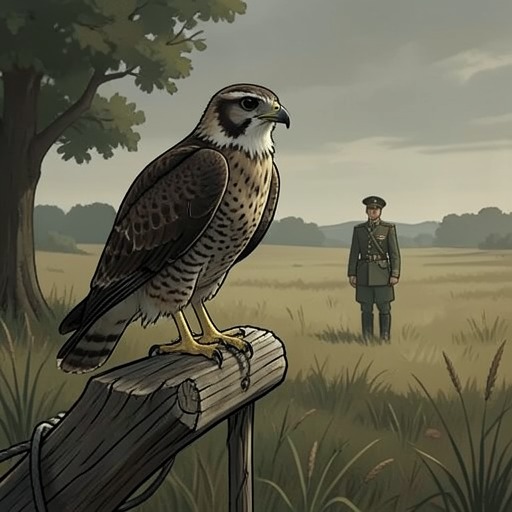
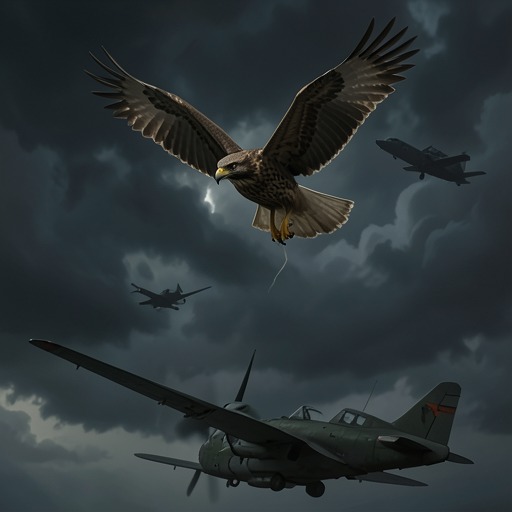
During a hunt with Mabel the goshawk, a Flying Fortress appears above the field. The surrounding wildlife reacts to the aircraft, but Mabel continues eating the rabbit she has caught. The contrast draws Helen Macdonald’s attention away from the hunt and toward the bomber’s scale and military purpose. It is not simply a historical object passing through the scene: its presence changes the meaning of the sky she and the hawk share.
The aircraft prompts Macdonald to recall lines by W. H. Auden about the viewpoint of a hawk or a helmeted airman. From that elevated perspective, both can seem to observe the world at a distance, but the passage refuses to equate height with safety. Macdonald imagines the American airmen who operated such aircraft from Britain: they endured cold and unreliable equipment, flew to and from Germany, and faced the danger of missions from which one in four did not return. The commanding view associated with the airman is therefore shadowed by the vulnerability and consequences of wartime flying.
Helen’s father and the practice of watching
The bomber scene turns Macdonald toward her father’s early life. For the first four years of his childhood, he and his family lived beneath formations of aircraft crossing overhead. The possibility that a plane might attack or defend them made identification consequential. As a boy, he learned aircraft details, built models, read Aeroplane Spotter, and developed an intense interest in distinguishing one machine from another.
That interest became a practice of patient observation. When older, he cycled to airfields including Farnborough, Northolt, and Blackbushe with a Box Brownie camera, notebook, pencil, and a bottle of Tizer, waiting by perimeter fences. Macdonald understands her own attention to birds as partly inherited from this habit: her father looked up at engine sounds and distant contrails, while she learned to watch flying birds. The connection does not make their subjects identical, but it places both forms of looking within a family history shaped by wartime skies.
The memory also acquires a place in Macdonald’s bereavement. While sitting in the field, she recalls a story her father once told at breakfast. It gives her a way into the memorial address she had struggled to write, and the book presents remembrance as something that can arrive through a concrete recollection rather than through a prepared account of grief. World War II thus persists not only as public history but as a source of family stories passed into the present.
Hawks, aircraft, and the language of war
The memoir links this family history to a wider visual and political association between birds of prey and aircraft. Since the emergence of military aviation, hawks have been treated as warplanes made flesh: both hunt and kill, and both can be represented as embodiments of aerodynamic power. Military propaganda drew on this resemblance to make air warfare appear part of a natural order. Falconry supplied another resource, lending modern warfare the prestige and romance of an older tradition.
A Canterbury Tale, the 1944 film by Powell and Pressburger, offers a concentrated example. Its opening shifts from a medieval knight releasing a falcon to the silhouette of a diving Spitfire, then presents the watcher as a modern soldier in a helmet. The sequence joins medieval imagery to contemporary military technology and frames that continuity as an essential Britishness. In Macdonald’s account, the film demonstrates how readily the hawk could make modern air power appear both traditional and natural.
This imagery complicates the apparent affinity between a hawk’s perspective and an airman’s. The view from above may suggest detachment or command, but the history of bombing and wartime flying gives that view a human cost. The book’s movement from the field to the imagined aircrew prevents the resemblance between bird and aircraft from becoming a simple celebration of power.
War, falconry, and social order
Macdonald places wartime imagery alongside the class history of falconry. In the tradition described by earlier writers, flying falcons properly required large open spaces such as grouse moors and partridge estates, access that tended to belong to the wealthy or well connected. The solitary trainers of goshawks and sparrowhawks, by contrast, were disparaged as socially awkward outsiders, and goshawks were often described as inferior to the aristocratic falcon. These inherited hierarchies help explain why the falcon could serve so effectively as an emblem of nobility and national prestige.
The book also recalls a 1942 American hunting article that contrasted access to hunting in the United States with restrictions associated with European estates, including those in fascist Italy and Nazi Germany. The article appealed to an egalitarian national tradition while acknowledging that Britain shared elements of the land system it criticized. This comparison shows how wartime writing could use hunting access to distinguish political and social identities. Read beside the film’s fusion of falconry and military aviation, it reveals that the war’s meanings in the memoir extend beyond aircraft: they also concern who controls land, who may participate in hunting, and whose version of national tradition is made to seem natural.