Yarak
H is for HawkYarak is the hunting state in which Mabel’s fear and uncertainty give way to concentrated readiness, and it makes falconry a test of attention shared unequally between hawk and human. Helen Macdonald describes its bodily signs, but the state cannot be reduced to a set of visible cues: Mabel chooses what to pursue, while Helen must decide when to release her and when to hold her back. The hunts that follow show both the power and the limits of that judgment.
Meaning and visible signs
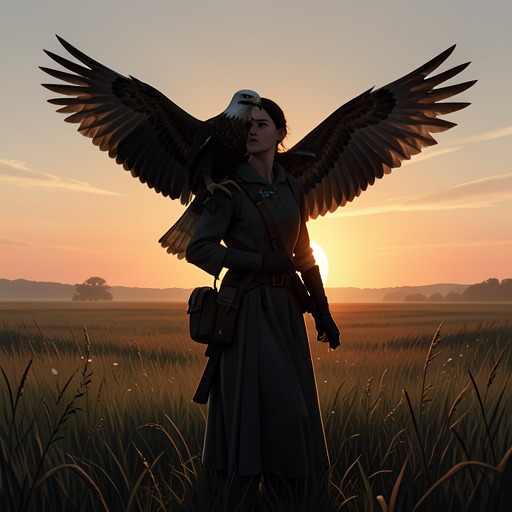
Falconers use yarak for a hawk in a mood to kill; Helen notes that the word derives from the Persian yaraki, associated with power, strength, and boldness. On the hill near Cambridge, she watches Mabel enter this state during their daily walks. Her crest feathers rise, she leans back, her belly feathers fluff, her shoulders drop, and her toes tighten on the glove. The change is a shift in bearing as well as intention: Mabel moves from seeming frightened by everything to behaving as if she commands the field.
Helen likens the transformation to a disturbing possession, yet the passage describes a working state of heightened attention rather than a supernatural event. Mabel becomes intensely responsive to possible quarry, and her readiness can attach to things she cannot reasonably catch. She bates at larks, distant racing pigeons, and even a farmyard cat. Helen keeps hold of the jesses rather than allowing every surge of interest to become a flight. Yarak therefore requires restraint as well as release: the hawk’s readiness does not make every target an appropriate opportunity.
Reading the hawk and judging the moment
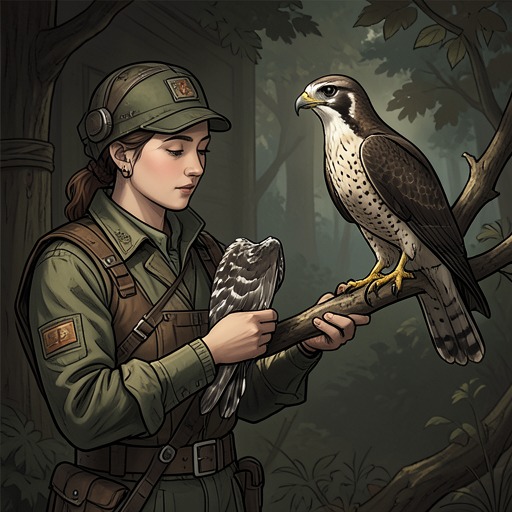
The book places this work within a longer practice of watching minute changes in a hawk’s posture and feathers. Helen explains that tight feathers can indicate fear and loose feathers ease; sustained attention makes subtler signs legible as well. Such observation can help a trainer anticipate what a hawk may do, but it does not give the human control over the bird’s attention. The distinction matters in yarak, where a bird may appear intensely ready while fixing on something the falconer has not seen.
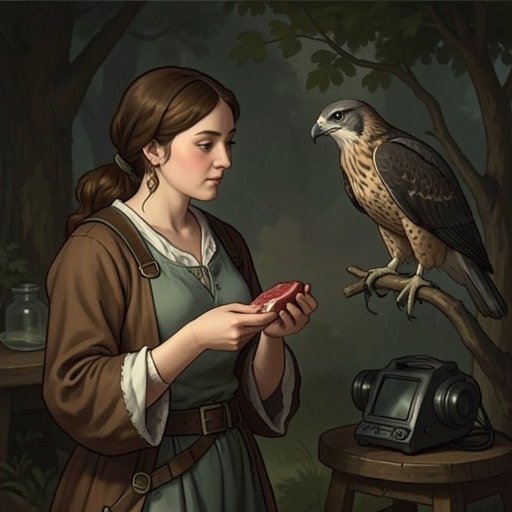
An earlier training episode sharpens the difference between watching a hawk and correctly interpreting her. When Mabel makes a sudden bate in the room, Helen first thinks fear has prompted it and considers hooding her so she can rest. She revises that judgment: the movement came from frustration, and Mabel was hungry. That incident is not itself a hunting flight, but it shows why the discipline of reading the bird matters. A visible reaction does not announce its cause; successful handling depends on attending to the hawk rather than simply imposing a human explanation on her.
Failed pursuits and the limits of human help
In one field pursuit, Mabel chases a hen pheasant that has too much of a head start. After about fifty yards she slows, turns in mid-air, and returns to Helen’s fist over a hedgerow ash. In another, she dives after a rabbit, overshoots when it stops, and loses it as it doubles back to a hole. Mabel lands confused and crestfallen. Helen feels the disappointment too, not because she wants a kill at any cost, but because she does not want Mabel discouraged.
The conditions make hunting difficult. It is September, when the easy opportunities available to young wild goshawks have passed; young birds in the wild may wait concealed for vulnerable prey, but the season’s small, inexperienced quarry has grown. Many goshawkers use a dog to find game or a ferret to drive rabbits out for the hawk. Helen has neither, so she walks with Mabel and hopes that they encounter something. The difference is not merely one of equipment: Mabel’s senses can register movement that Helen misses.
At a bramble-covered gully, Mabel dives toward the undergrowth, but Helen has not seen what attracted her and does not release her. She searches with a stick after the possible prey has disappeared, unable to tell whether it was a mouse, pheasant, or rabbit. The missed opportunity exposes the human as a liability within the hunt: the falconer must act on information that the bird may possess first. On another difficult afternoon, Stuart offers to run dogs and try to find game, but Mabel bates, calls, and glares rather than accepting their presence. Helen feeds her and takes her home. Yarak does not guarantee a smooth partnership; weather, quarry, other animals, and the falconer’s limited perception all shape what can happen.
Attention, success, and the changing relation
A later hunt makes Mabel’s independence of attention unmistakable. Helen is tired and has a headache, but when she releases Mabel into the field the pain recedes and her exhaustion fades. The hawk flies with a speed and style that astonish her. Helen walks toward three rabbits sitting only a few yards away and tries to turn Mabel’s head toward them. Mabel ignores the nearby animals and keeps looking across the field, toward something several seconds of flight away.
Then Mabel leaves the fist. She flies low over the nettles, avoids one rabbit, adjusts her attention in an instant, and strikes another. Helen understands that the hawk has been attending to the rabbits at the far end of the field, not the ones Helen had tried to indicate. She runs to find her, hearing the muffled bells before she sees her head rise above the nettles. Mabel has hold of the rabbit, which has retreated into a hole; she braces herself against the ground and keeps her grip. Helen reaches in, finds a foot, and works the rabbit out. The capture depends on Mabel’s choice and persistence, while Helen’s part is to locate and assist her without mistaking the hawk’s focus for her own.
Helen connects this selective attention to what Barry Lopez calls the conversation of death: a wordless exchange of attention between hunter and potential prey. She wonders whether Mabel has been engaged in such an exchange with the rabbits before she flies. The idea complicates the ordinary image of a hunt as a simple command followed by pursuit. Mabel does not respond to the nearest quarry merely because Helen points it out; she watches, chooses, and acts on her own assessment. The successful capture gives concrete form to the independence that the failed hunts had already made difficult for Helen to accept.
Grief, responsibility, and the hunt’s meaning
The successful pheasant hunt after Helen’s father’s death gives the relation between hunting and grief a different weight. The following day, Mabel chases a pheasant into brambles and waits above it on a hedge while Helen searches below. Helen cannot see the hawk and must imagine her position while trying to locate the bird. Her sense of herself splits between the human searching and the hawk waiting overhead; for a time she feels detached from her own place in the scene. When the pheasant finally rises and Mabel crashes after it, Helen describes the connections among heart, mind, future, hawk, prey, life, and death as coming together again. Yarak belongs here not as a cure for loss but as part of the difficult, embodied attention that briefly restores a sense of connection.
The word also sits within a history of judgments about hawks and the people who fly them. Helen had once preferred falcons, whose flight she admired, and regarded goshawks as unnerving, difficult birds. She later connects falconry’s praise of falcons with the privilege of access to the wide estates needed to fly them properly; goshawks can be flown in more confined places, while solitary goshawk trainers received a disparaging reputation in older writing. Accounts of goshawks likewise often cast them as troublesome or sulky. Against that inherited language, Helen’s observations of Mabel’s attention and independent choices resist turning the bird into a fixed character type. Yarak names an intense hunting condition, but the episodes surrounding it show a particular animal making decisions and a falconer learning that responsible participation requires both close attention and restraint.