
The Garden and the Island Dream
Hallowe'en PartyThis thread traces Michael Garfield’s landscape artistry from a commissioned garden to a grander private vision, showing how creative ambition becomes entangled with money and violence.
increasing Bearing strength in each event
 decreasing
Bearing strength in each eventdecreasingA Quarry Reimagined
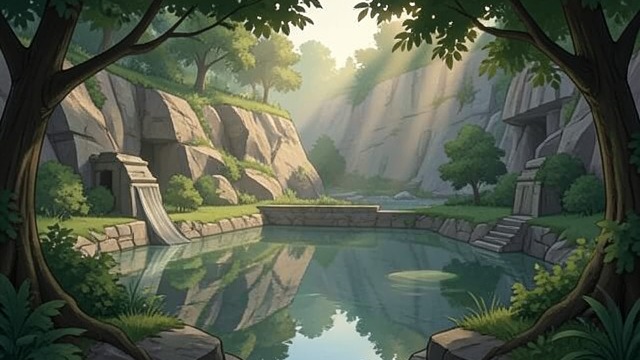
A Quarry Reimagined
A patron’s commission
Mrs Llewellyn-Smythe hires Michael Garfield to transform an abandoned quarry into a sunken garden. The project gives her a landscape shaped by her interests and gives Garfield the resources to exercise a distinctive artistic vision.
Design beneath the surface
Poirot later studies the garden and recognizes that its apparent naturalness is carefully planned. The space becomes an early sign of Garfield’s ability to make a personal conception appear to be someone else’s idea, a talent with implications beyond landscape design.
The Artist’s Discontent

The Artist’s Discontent
Beauty as a vocation
Garfield describes his work as a negotiation between artistic purpose and the need to satisfy clients. He is proud of the garden and speaks of its delicate design, yet he also admits that commercial compromise is part of his profession.
A restless temperament
He is already dissatisfied with ordinary commissions and considers leaving for another landscape where he can create on his own terms. Poirot sees that Garfield’s desire is not merely to earn a living: he wants a canvas large enough to embody an increasingly absolute idea of beauty.
A Garden Beyond England

A Garden Beyond England
A new scale of ambition
Garfield imagines making a garden on a barren Greek island, where rock and soil could be shaped into a world of his own design. The idea extends his earlier work in Quarry Garden but demands much greater resources and freedom.
Money becomes necessary
He regards the island not as a casual fantasy but as a possible culmination of his creative life. Poirot’s questions about motive begin to connect this ambition with the financial stakes surrounding the inheritance and the people whose lives stand between Garfield and the money he wants.
A Living Model in the Wood
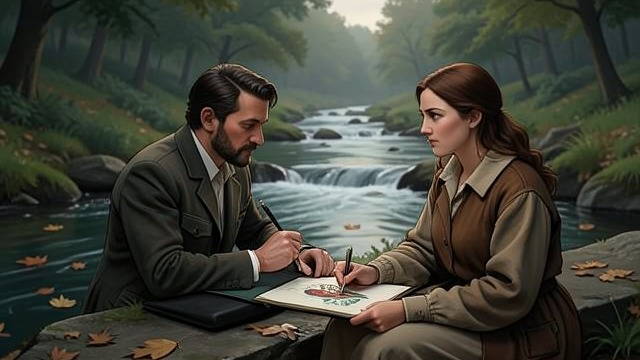
A Living Model in the Wood
Miranda as an image
Garfield sketches Miranda Butler beside a stream in Quarry Wood, explaining that he wants to preserve the memory of her face and presence. His language makes the drawing sound like an artist’s attempt to hold a fleeting image against time.
Beauty without protection
Poirot later sees that this aesthetic attention does not guarantee affection or mercy. Garfield’s ability to admire Miranda as an image coexists with his willingness to endanger her when her life obstructs his security, exposing the gulf between artistic reverence and human responsibility.
The Island Dream Collapses
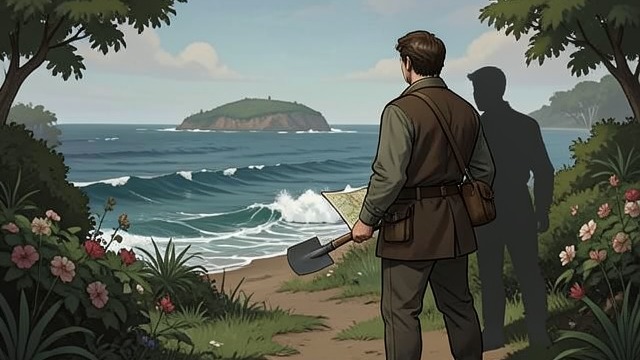
The Island Dream Collapses
Ambition exposed
Poirot concludes that Garfield’s vision of an island garden helped drive his pursuit of money and his readiness to eliminate perceived obstacles. What began as creative aspiration became a justification through which he could treat other people as expendable.
Creation without redemption
Garfield’s imagined Eden is never built. The garden he has made in England remains beautiful, but it cannot redeem the murders or his attempt to sacrifice Miranda; his creative achievement and his moral failure stand side by side, irreconcilable.
Several years before the Hallowe’en party
During Poirot’s first visit to Quarry Garden
During Garfield’s later conversation with Poirot in Quarry Wood
Shortly before Poirot’s final confrontation with the conspirators
At the close of the investigation
