Apple motif
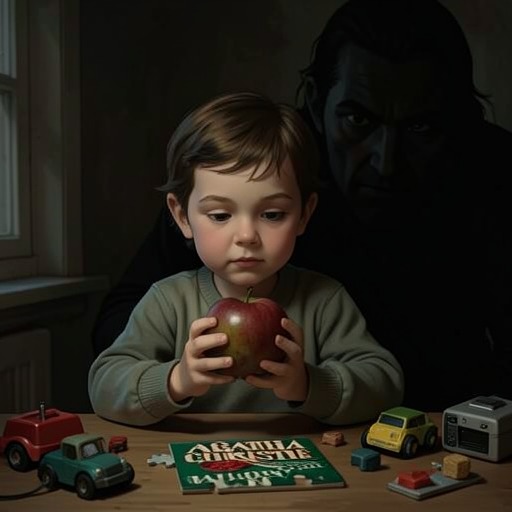
Hallowe'en PartyThe apple motif begins as a familiar pleasure and a party decoration, then becomes the material center of a child’s murder and a recurring measure of memory. At the Halloween gathering, apples pass from a bowl into a game, from the game into the story of Joyce Reynolds’s death, and from there into the investigation of a crime rooted in the past. Their changing significance gives an ordinary fruit an unsettling double life: an emblem of seasonal festivity that cannot be separated from violence once the party’s hidden history is exposed.
At the Halloween Party
The motif first takes shape amid the party’s seasonal props. Ariadne Oliver, considering a large yellow pumpkin, recalls seeing hundreds of pumpkins in the United States, where they were displayed for Thanksgiving rather than Halloween. Her uncertainty about the distinction between a pumpkin and a vegetable marrow, and her reflections on the calendar of autumn observances, set a conversational, almost comic tone. Against that background of pumpkins, witches, and party preparations, apples arrive as another ordinary feature of the celebration. The contrast matters: the fruit is not introduced as a warning, but as something familiar and appealing.
Ariadne Oliver immediately expresses a fondness for the apples when someone brings in a large bowl. Rowena Drake explains that they are soft and have been chosen for bobbing because the children will be able to get their teeth into them more easily. The game is to take place in the library; water will slop onto its old carpet, but the mess is treated as unimportant. These practical details give the apples a specific, physical role in the party. They are not merely a decorative sign of autumn: their softness, the water, and the room selected for the game will all be recalled after the gathering has ended.
As the bowl is carried away, two apples roll out and stop at Ariadne Oliver’s feet. Joyce Reynolds, a sturdy thirteen-year-old, asks whether Oliver likes apples and recognizes her as a writer of murder stories. Oliver picks up the fallen fruit and, almost without noticing, bites into one. Rowena Drake takes the other from her and returns it to the basket. The exchange briefly places apples, appetite, and the child who will die together in an unremarkable social scene. In retrospect, the innocent movement of fruit across the floor becomes a quiet preparation for the game’s fatal setting.
From Game to Crime Scene
The apples acquire their darkest meaning when Ariadne Oliver reconstructs the party for Hercule Poirot. She first identifies them as the beginning of her recollection. The party concluded with Snapdragon, in which raisins were burned in a dish, and after it everyone went home. Only then did the guests discover that Joyce was missing. The remembered sequence turns party entertainment into a chronology of absence: the games and festivities end, the gathering disperses, and the failure to find Joyce marks the point at which the celebration becomes a murder case.
Joyce is eventually found in the library, where the bobbing-for-apples bucket had been left. It is a large galvanized iron bucket, nearly full of water. Ariadne Oliver explains that someone forced Joyce’s head down among the apples and held her there until she drowned. The details that had made the game seem manageable now take on a terrible practical significance: a child kneeling to reach an apple, water in a heavy metal container, and a party activity whose mess had seemed of no consequence. Oliver wonders whether a plastic bucket might have tipped over, but this is her speculation, not an established alternative outcome. What is certain in her account is that the water, apples, and bucket formed the setting in which Joyce was killed.
The fruit’s transformation is registered in Oliver’s own response. At the party she had admired the red apples, admitted her fondness for them, and eaten one. Recalling Joyce’s death, she says she never wants to see an apple again. Her revulsion gives the motif a personal consequence: an object previously associated with appetite and pleasure has become inseparable from the image of a child being drowned. The change does not erase the party scene; it makes that earlier scene painful to remember.
Credibility, Memory, and the Past
Apples also sit within a larger pattern of disputed testimony. Elspeth McKay compares Joyce’s habitual untruthfulness to the story of the boy who cried wolf: repeated false alarms can make a true warning seem incredible. She allows that Joyce might have seen something, though perhaps less than she claimed, and Superintendent Spence stresses the consequence of that possibility: Joyce was killed. The apple game supplies the physical circumstances of the child’s death, while the discussion of her reputation frames the danger surrounding what she may have witnessed. The motif therefore connects a visible object at the scene with a less tangible question—whether anyone believed the child’s words.
The investigation’s temporal logic further enlarges the meaning of the apples. Hercule Poirot tells Ariadne Oliver that the recent event has to be understood through a past that has become part of the present. A murder committed perhaps one, two, or three years earlier was seen by a child; because of what that child saw on a particular date, another child has died four days ago. Oliver accepts the broad connection but remains unsure, allowing that Joyce’s death might instead have been an act by a mentally disturbed killer. Poirot rejects that possibility as the reason Oliver came to him: she had sensed that the circumstances did not feel right. In this structure, the apple-filled bucket is not an isolated horror. It is the present scene through which an older crime and its consequences return.
A Recurring Image in the Investigation
The motif persists beyond the party because Hercule Poirot associates apples with Ariadne Oliver herself. He remembers her as a large woman getting out of a small car on a hill while a bag breaks and apples roll down the slope. When he later meets her outside Apple Trees, even the house’s name seems uncannily apt. He reflects that it is difficult to escape apples: they belong both to ordinary enjoyment and, in this case, to witches, brooms, old folklore, and a murdered child. The recollection of the spilled bag provides a harmless counterpart to the apples at the bottom of the bucket, while Poirot’s repeated notice of the fruit makes it a thread connecting different moments in the investigation.
The apple image also enters language as a test of character. When Hercule Poirot asks Miss Emlyn whether Nicholas Ransom and Desmond Holland are trustworthy, she describes them as fundamentally sound, like an apple without maggots. Poirot remarks that the conversation has returned to apples once again. Here the fruit offers a compact figure for judging what is sound beneath the surface, an especially pointed echo in a story where the party’s pleasant exterior concealed a killing and where an apparently unreliable child may have perceived a truth others missed.
By the time Ariadne Oliver says she dislikes the associations of apples, the motif has gathered more than one kind of meaning. It holds the sensory memory of eating, the children’s game, Joyce’s drowning, uncertainty about testimony, and Poirot’s insistence that the present is rooted in what came before. Its force comes from that accumulation rather than from a single symbolic meaning: each return brings the ordinary fruit back into contact with the crime, while making the past harder to leave behind.