Children's Secrets and Witnessing
Hallowe'en PartyChildren's Secrets and Witnessing is the novel's account of how a child can see what adults miss, keep the sighting private, and only later understand what it means. Miranda Butler's observation of a body being carried away becomes decisive not because she immediately recognizes a crime, but because an experience she has put aside returns with new meaning. The same pattern also complicates testimony: Joyce Reynolds repeats Miranda's account as though it were her own, while Leopold Reynolds's appetite for other people's secrets makes his knowledge dangerous.
Watching Before Understanding
Miranda's observation begins as part of a familiar private routine. She says that she often walks where nobody knows where she is, sits in trees, and watches what happens. Her attention is directed chiefly toward birds and squirrels; she notices, for instance, that birds are quarrelsome rather than living in the harmony suggested by a familiar line of poetry. This is not presented as formal investigation. It is a child's chosen way of being alone and attentive, a habit that places her where adults do not expect her to be.
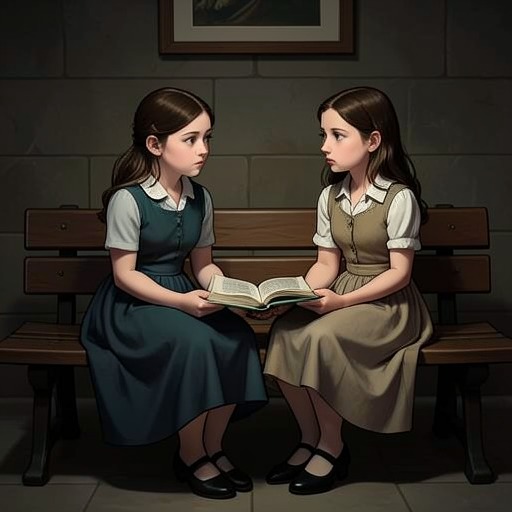
Her friendship with Joyce gives secrets a social life as well as a private one. Miranda remembers Joyce as a great friend who told her interesting things about elephants and rajahs and about having been to India. They used to tell each other secrets, though Miranda felt she had less to share than her mother, Judith Butler, who had travelled to Greece and met Ariadne Oliver there. The details establish Miranda as a listener and participant in an exchange of confidences, not merely a passive child discussed by adults. But the friendship also allows an observation to travel from one child to another—and, in Joyce's hands, to change its apparent source.
An Unnoticed Witness
Before Miranda's account is disclosed, Hercule Poirot proposes that a child might have witnessed a killing near the Green Swan: a child coming home by a footpath or watching from behind a hedge, present precisely because nobody expected her there. Mr Fullerton finds the possibility implausible. Poirot's counterargument is that children may not know what they have seen; a frightening or ambiguous event may not be reported at home. A child might keep the memory privately, even taking possession of it as a secret.
Miranda's later testimony gives that hypothesis its concrete shape. Hidden in the branches of a tree in the hollow of the Quarry Garden, where the fountain used to be, she is watching a squirrel when she sees a man and a woman carrying a woman up the path. At first she thinks the person has fallen from somewhere above and assumes the pair are taking her to a hospital or Quarry House. The woman suddenly says that someone is watching them and looks toward Miranda's tree. The man dismisses the possibility. Miranda stays still, frightened without knowing why. What she sees is therefore both vivid and incomplete: she registers the people, their burden, and the woman's alertness, but initially lacks the knowledge to identify the scene as murder.
Silence and the Return of Memory
Miranda does not tell Judith what she saw. She thinks she should not have been watching, and when nobody mentions an accident the next day, she forgets the incident—or believes she has. Her silence is not evidence that the observation was insignificant. It follows from her uncertainty about what happened, her fear, and her sense that her own watching may have been improper. Those motives give substance to Poirot's earlier claim: a child can retain an experience without presenting it to an adult as a report.
The memory returns during a second moment of watching. Miranda is still and hidden behind bushes, this time observing a green woodpecker, when the same man and woman speak about a Greek island and taking things slowly. The woman again warns that someone is watching. Her manner recalls the earlier scene so precisely that Miranda becomes frightened and remembers what she had seen. Now she can interpret the blood, knife, and limp body as signs that the people had been carrying a dead woman away to hide her. The change is not in the first sighting but in Miranda's capacity to read it: the earlier image acquires its meaning through repetition and her later knowledge.
Secrets Passed On—and Distorted
Joyce had claimed, on the afternoon before the Halloween party, that she had seen a murder. When Miranda is asked whether this was true, she explains that Joyce was repeating Miranda's story while pretending it had happened to her. The distinction matters to the investigation: Joyce's statement was not an independent eyewitness account, but neither was it invented from nothing. It was a transformed version of a real observation that Miranda had confided to a friend. Their intimacy enabled the information to circulate, while Joyce's false attribution obscured its origin.
Another child, Leopold, illustrates the more perilous consequences of possessing hidden knowledge. Miranda says he listened at doors and liked knowing people's secrets. Mrs Drake later acknowledges that he may have seen the murderer or something that could identify the killer, and says she had hoped he would receive treatment rather than be left to the police. Hercule Poirot adds that Leopold had recently been flush with money and concludes that someone must have paid him to keep silent. The novel thus makes secrecy more than a child's private habit: information can be withheld, relayed, misrepresented, or bought, and a young person's knowledge can carry risks the child may not be equipped to judge.
Narrative Significance
The motif binds together different forms of incomplete knowledge. Miranda sees before she understands; Joyce tells what she has heard but claims it as her own experience; Leopold listens deliberately and appears to have been paid for silence. Adults, meanwhile, initially debate the child witness as an unlikely possibility. The investigation depends on taking seriously what children notice and on distinguishing the original observation from the story that later forms around it.
Miranda's remembered scene also gives the narrative a delayed structure: an apparently ordinary childhood memory becomes evidence only when a repeated warning and a second act of watching make the past legible. Her account does not present childhood as either perfect understanding or simple innocence. It shows a child capable of sustained attention and meaningful judgment, but also vulnerable to fear, uncertainty, and adult assumptions. The secret survives because Miranda cannot initially name what she has witnessed; it becomes useful when she can finally do so.