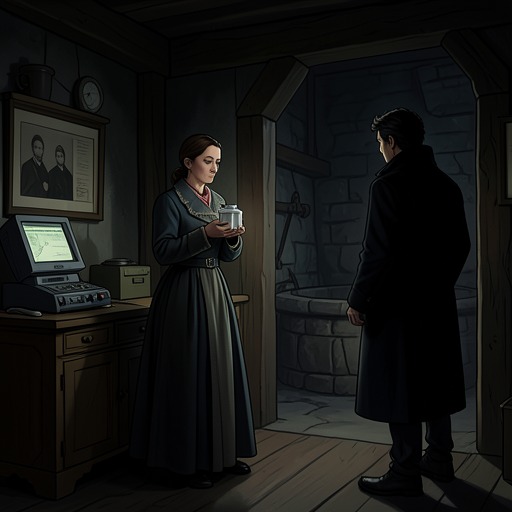
Discovery of Olga Seminoff's Body in the Well
Hallowe'en PartyThe discovery of Olga Seminoff’s body in the well reaches Elspeth McKay not through a description of the search, but through a telephone call that moves from guarded confirmation to bluntly stated murder. The exchange transforms the uncertain fate of the missing au pair girl into a death confirmed as violent, while the circulating news makes clear that the revelation can no longer be kept private.
The call and its guarded news
Sergeant Goodwin opens by asking for Mrs McKay and whether her brother is there. Elspeth says that he is in London that day. Goodwin has already tried to reach him there and reports that he has left; when he returns, she is to tell him that the police have had a positive result. The phrase conveys the significance of the development without yet naming it. It is a report passed through Elspeth to an absent brother, not a full account of what the police have found.
Elspeth immediately supplies the possibility concealed in that official-sounding phrase: she asks whether the positive result means that a body has been found in the well. Goodwin confirms the discovery indirectly, remarking that there is little use in keeping quiet about it because word has already got around. The call therefore carries two kinds of news at once: the body has been found, and information about the discovery is already spreading beyond the person who is being formally informed.
Identification of the victim
Elspeth’s next question is whether the body is that of the au pair girl. Goodwin’s answer is qualified: it seems to be. The exchange identifies the likely victim through her role rather than through a detailed description or an immediate, unequivocal naming. That qualification matters: the dialogue conveys the force of the identification while preserving a trace of uncertainty in the report as spoken.
The event is consequently presented as a sequence of recognition. First comes the euphemistic announcement of a positive result; then the fact of a body in the well; then the possibility that it is the missing au pair girl. The conversation narrows the uncertainty in stages instead of opening with a complete explanation. It gives the reader the same compact progression of news that Elspeth receives, without showing the discovery itself or supplying details about how the body was located.
From suspected death to murder
Elspeth responds with pity for the girl and asks whether she threw herself into the well, or what happened. Her question introduces suicide as a possible explanation, but Goodwin rejects it directly: the girl was knifed, and it was murder. That statement changes the meaning of the discovery. The well is not merely where a dead girl has been found; the reported knife wound makes clear that her death was violent and not self-inflicted.
The dialogue gives no account of the stabbing, the weapon’s recovery, or the circumstances in which the body entered the well. Its decisive revelation is narrower and firmer: the death is murder. The contrast between Elspeth’s tentative question and Goodwin’s categorical answer marks the turn in the call. Before the answer, the manner of death remains open; afterward, suicide is no longer the explanation under consideration.
Disclosure and narrative effect
The scene is structured around what can be said and what has already escaped control. Goodwin first offers an abbreviated official phrase, but Elspeth understands enough to ask about the well. His reference to the news getting around acknowledges that silence is no longer realistic. The call still serves to pass information to Elspeth and, through her, to her absent brother, yet it occurs after the discovery has begun to circulate.
The revelation is consequential precisely because it is delivered in stages and through ordinary conversation rather than through a narrated search scene. A positive result becomes a body; the body is likely the au pair girl; the suspected death is confirmed as murder by stabbing. Elspeth’s sympathy keeps the victim present as a person in the exchange, while the police report establishes the fact that changes the case’s meaning. The call confirms a killing, but leaves its perpetrator and circumstances undisclosed.