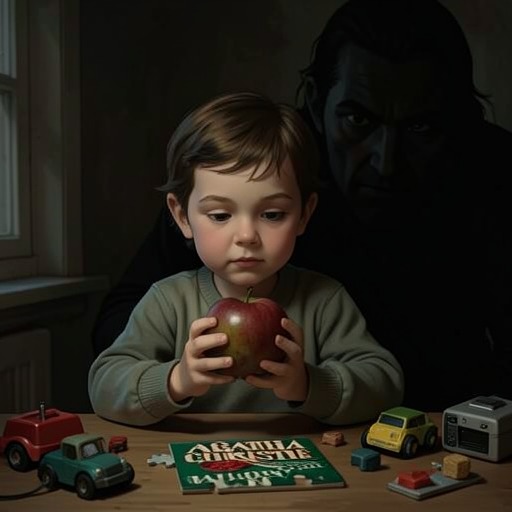
Dr Ferguson
Hallowe'en PartyDr Ferguson is a local physician whose medical authority shapes two crucial judgments: Mrs Llewellyn-Smythe’s death was certified as natural, and Joyce Reynolds was regarded as a compulsive boaster rather than a credible witness. He is careful to insist that conclusions require evidence, yet his ready confidence in Joyce’s character shows how readily a reputation can become a filter through which evidence is heard—or dismissed.
Identity and Medical Practice
About sixty and of Scottish extraction, Dr Ferguson has a brusque manner and a shrewd, direct presence. When Hercule Poirot visits him, Ferguson sizes him up and immediately warns him to mind a chair with a loose castor. The exchange establishes a practical, unsentimental manner: he does not begin with deference or ceremony, and he makes his position plain.
Ferguson is one of two doctors serving the locality and is the Reynolds family doctor. He had treated Joyce, whom he remembered as a generally healthy child with no unusual medical history. Her childhood illnesses included mumps and chickenpox, and she sometimes suffered what was then called a bilious attack after eating too much. In Ferguson’s account, her tendency to talk excessively had caused her no physical harm. This clinical familiarity gives weight to his description of Joyce, while also marking the limits of what his medical knowledge can establish about the truth of her claims.
The Death of Mrs Llewellyn-Smythe
Mrs Llewellyn-Smythe had heart trouble and received regular medical attention. Her death was sudden, though not wholly unexpected; the account of the case suggests that Ferguson was at least somewhat surprised, having expected her to live longer. He was identified as the local doctor who certified her death as natural. That certification gave the death an official medical explanation, even as its suddenness and the circumstances surrounding it prompted later questions.
The context offered for her decline was consistent with a natural-cause account. She had been advised not to overexert herself, but was described as disregarding such recommendations and continuing to garden energetically. Gardening was a longstanding passion, and she had invested heavily in transforming the disused quarry at Quarry House into a designed garden. The physician’s expectation that she might live longer did not itself amount to suspicion of murder; it was a discrepancy between expectation and outcome, not proof of foul play. Ferguson’s certification therefore represents a consequential professional judgment, but the evidence does not show him alleging that her death was criminal.
Evidence, Diagnosis, and Murder
When questioned about Joyce’s murder at the Hallowe’en party, Ferguson refuses to identify a killer by guesswork. He argues that a doctor’s tentative diagnosis follows questions and comparison of possibilities, rather than an instant hunch; a responsible opinion requires evidence and care. The analogy distinguishes a provisional assessment from certainty, and expresses his insistence that a serious conclusion should not be reached in haste.
At the same time, Ferguson offers a bleak general account of violence. He says he has been called to examine too many murdered children in recent years and attributes some such crimes to people who ought to be under mental restraint but are at liberty because institutions lack room. He imagines a killer who appears ordinary in manner and appearance, and invokes an example from Medchester of a thirteen-year-old who murdered a younger child and later seemed to lead a blameless life. Ferguson presents this as a warning about the possible hidden persistence of violent impulses, not as evidence identifying Joyce’s killer. He also acknowledges that he is not a psychiatrist and treats psychological diagnosis as a matter requiring expertise rather than casual certainty.
His refusal to name a suspect is thus not a refusal to reason: Ferguson accepts that Joyce’s murderer must have been present at the party, among the guests or helpers, or have entered the house. But he will not turn that broad inference into an accusation without evidence. The distinction between what can be inferred about the circumstances and what can responsibly be claimed about a person defines his stated approach to the investigation.
Joyce Reynolds and the Problem of Credibility
Ferguson describes Joyce as neither especially stupid nor particularly intellectual, and calls her a compulsive liar. He distinguishes this habit from deceit intended to escape punishment: Joyce, in his view, boasted about events that had not happened because the stories would impress the friends listening to her. He therefore considers it likely that her claim to have seen a murder was another attempt to make herself important, perhaps directed at Ariadne Oliver, who was associated with writing murder stories.
That explanation fits the response Joyce received. Earlier in the day, she insisted that she had seen someone commit a murder, but her listeners dismissed the claim as fabrication and laughed; Joyce became angry. She later explained that she had not understood at the time that what she had witnessed was murder, recognizing its meaning only afterward. After her death, Ariadne Oliver reconsidered the boast: finding Joyce dead made her wonder whether the girl might have been telling the truth after all. Ferguson’s assessment helps account for why the original testimony was not taken seriously, but it cannot establish that this particular claim was false.
The later revelation that Miranda Butler had told Joyce alone about witnessing a murder, and that Miranda eventually recovered the memory of seeing a body being carried away, sharpens the irony of Ferguson’s judgment. Joyce’s reputation for invention helped conceal the significance of what she had said, while Miranda’s true observation had remained undisclosed. Ferguson is not present for that revelation, and the evidence does not show him learning of it. His narrative significance lies instead in the tension between his sound caution against unsupported diagnosis and the confidence with which he interprets a child whose reputation has already made disbelief easy.