Floral vase on the staircase platform
Hallowe'en PartyThe vase of mixed autumn leaves and flowers is both a broken household object and the instrument of Rowena Drake’s deception. Its water supplies an innocent-looking explanation for the wetness that could otherwise connect her to Joyce Reynolds’s drowning, while its staged fall gives Elizabeth Whittaker a misleading impression about activity by the library. What first appears to be an awkward accident becomes, in Hercule Poirot’s reconstruction, a calculated performance that turns a conspicuous mess into cover for murder.
The Vase on the Staircase
During the party’s final event, the Snapdragon, the burning dish of raisins and brandy made the room hot enough that Elizabeth Whittaker left it and went into the hall. There she saw Rowena Drake emerge from the first-floor lavatory carrying a large vase of mixed autumn leaves and flowers. The vase was awkward to carry and, as Whittaker understood it, heavy because it was full of water. Rowena paused at the angle of the staircase, above the hall.
The position made the object unusually visible. Rowena adjusted the vase so that she could hold it against herself with one arm and reach for the stair rail with the other. She looked down toward the hall and the library door, which stood across from the dining-room door, rather than at the vase she was carrying. Whittaker saw her shift her grip, pause, and then make a sudden movement that she interpreted as a start of surprise. The vase slipped, reversed as it fell, sent water over Rowena, and smashed on the hall floor. Its weight, contents, and fall are not incidental details: together they make the resulting wet clothes look like the consequence of an accident.
The Fall and Its Aftermath
Rowena came down the stairs with an exclamation of vexation and complained about the mess. She kicked broken glass aside. Whittaker helped sweep the fragments into a pile in a corner, although the glass could not all be cleared at once as the children were beginning to leave the Snapdragon room. Whittaker fetched a glass cloth and dabbed at Rowena’s wet clothes. The flowers and broken pieces were also picked up as the party wound down.
The practical work of dealing with the accident reinforced its ordinary appearance. Whittaker had no immediate reason, as a guest, to challenge a hostess who had dropped one of her best glass vases. She regarded clumsiness as unlike Rowena, but treated the breakage as misfortune rather than asking what had made her let go. Rowena said nothing about having been startled, and made no reference to anyone coming out of the library. The broken vase therefore left a mundane record of the scene—water, wet clothing, scattered flowers and glass—while the crucial explanation for its fall remained unspoken.
From Accident to Evidence
Only after Joyce’s body was found behind the library door did Whittaker reconsider the moment on the staircase. She had not seen anyone emerge into the hall; whoever might have been there could, she thought, have withdrawn into the room. Hercule Poirot’s questioning drew out the distinction between what she had actually observed and what she had inferred: Rowena’s sudden movement was visible, but the supposed cause of her start was not. Whittaker had also not initially treated the incident as important enough to investigate.
Poirot had previously seen Rowena only briefly, when he visited her house with Ariadne Oliver, and had not thought her a woman easily startled. Whittaker agreed that this made the apparent start worth remembering. In his reconstruction, the vase’s fall manufactured a witnessable reason for Rowena to be wet. Joyce had been vigorous, and holding a child’s head under water in a full bucket would involve struggling and splashing. The killer, Poirot reasoned, would necessarily get wet and therefore need an explanation for it.
The Vase as a Staged Alibi
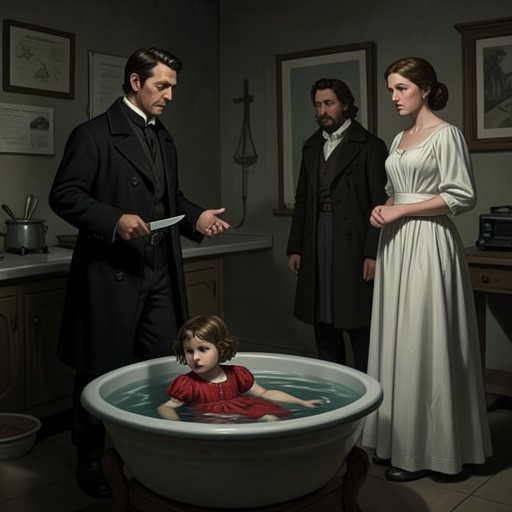
While the partygoers crowded into the dining-room for the Snapdragon, Rowena took Joyce with her into the library. Joyce trusted her and had no suspicion of her. Poirot concluded that Rowena killed Joyce there, then used the water-filled vase to create an alibi for the wetness the killing had caused. She waited on the landing until Whittaker, driven out by the heat, came into the hall; then she pretended to start and let the vase fall so that its water soaked her as it crashed below.
The performance did more than account for wet clothes. By making Whittaker think that Rowena had reacted to someone or something near the library, it planted a false impression that a person might have been about to leave the room where Joyce had been killed. The witness accepted the moment at face value, but later mentioned it to Miss Emlyn, who recognized its significance and urged her to tell Poirot. A private, unexplained gesture thus became a clue through retelling and reconsideration.
Material Clue and Earlier Crime
The vase’s importance rests on a chain of concrete details rather than on its appearance alone: water on the floor and clothes, Rowena’s position above the hall, her apparent start, and the fragments that Whittaker helped clear. Poirot connected those observations to the physical consequences of drowning a struggling child. The vase made Rowena’s wetness seem accidental, but precisely because it was such a visible explanation, its staged failure could later be examined as evidence.
Poirot further explained that Rowena had suspected someone might have been present in Quarry Wood when she and Michael Garfield killed Olga Seminoff. She did not know that Joyce had never witnessed a murder. That mistaken suspicion links the vase’s false suggestion of a person at the library with the earlier crime: Rowena used an apparent start to make Whittaker imagine a presence, while the supposed eyewitness whose possible discovery haunted Rowena had not seen what she feared. Once Poirot recognized water as the vital clue and Whittaker’s account as a constructed scene, he knew who had murdered Joyce. The vase’s breakage had concealed the truth briefly, but its conspicuous mess preserved the details that exposed the deception.