Joyce Reynolds
Hallowe'en PartyJoyce Reynolds is the young girl whose claim to have witnessed a murder is dismissed by those around her, yet helps bring about her own death. The claim is not a revelation of what Joyce has actually seen: she has never witnessed a murder. Its force lies in what Rowena Drake believes it means. The murderer treats Joyce’s boast as a possible sign that she witnessed an earlier crime, and kills her to silence a witness who does not exist.
The claim no one believes
While preparations for the Hallowe’en party are under way, Joyce announces, “I saw a murder once.” The adults and older girls around her reject the statement at once. Elizabeth Whittaker, the schoolteacher, tells her not to be silly; Rowena Drake also dismisses it as nonsense. When Joyce persists—“I did. I did. I did.”—the attention shifts from the claim to her insistence. The others regard her as making something up, and Joyce becomes angry at being disbelieved.
Her words stand out partly because they are repeated so emphatically and partly because the listeners have an easy explanation for them: Joyce is lying. At the time, even Miranda Butler, who later recalls the exchange, does not believe her. Nothing in the exchange proves that Joyce has seen a killing, and Poirot ultimately establishes that she has not. But the listeners’ dismissal does not make the claim harmless. It enters the story as a false statement that another person interprets as a real threat.
The party and the killing
The murder takes place during the Hallowe’en party at Woodleigh Common. After the Snapdragon, a burning dish of raisins and brandy that draws the guests together in a final burst of festive activity, Joyce cannot be found. Her absence is first explained away in ordinary terms: perhaps she felt tired or ill and went home alone. Her mother is said to be annoyed that Joyce has apparently left without telling anyone. That explanation fails when the searchers find her in the library.
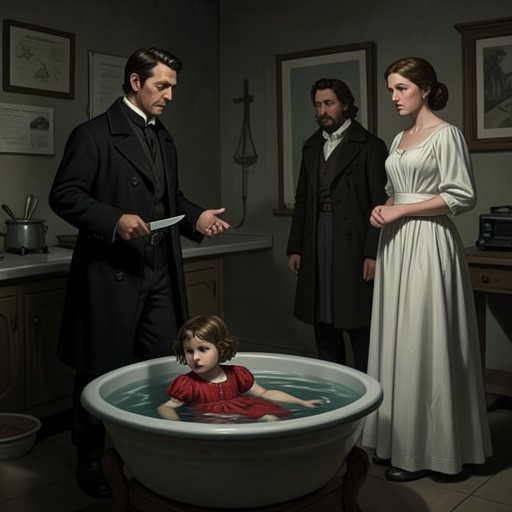
Joyce has been drowned in the large galvanized bucket used for bobbing for apples. The bucket is nearly full of water; her head has been forced beneath the surface and held there. The detail that the container is a heavy galvanized iron bucket, rather than a plastic one, gives the party game a grim physical consequence: the killer has used the actual vessel at hand to make drowning possible. Ariadne Oliver, recounting the scene, dwells on the water, the apples and the bucket, and says that she never wants to see an apple again. A playful party custom is thus bound to the fact and memory of Joyce’s death.
The water clue and Rowena Drake’s cover
The water also gives Poirot a way to reason backward from the killing. Someone who held a vigorous child beneath water in a full bucket would be splashed and would have wet clothing. The murderer would therefore need an innocent explanation for being wet. This makes the water on a sheet and the question of how much water was present more than incidental details: the physical aftermath of the drowning becomes a clue to the murderer’s attempt to disguise what happened.
During the Snapdragon, Rowena takes Joyce away to the library, where Joyce has no reason to suspect her hostess. Rowena then creates an apparent accident on the staircase. She waits with a large vase filled with water and, when Elizabeth Whittaker comes out of the hot Snapdragon room, pretends to be startled and lets the vase fall. It crashes onto the hall floor, spilling water over Rowena. Whittaker helps collect the broken pieces and flowers, and Rowena complains about losing her beautiful vase. The episode supplies a witness who can account for Rowena’s wet clothes, while also encouraging the impression that Rowena reacted to someone or something emerging from the library.
Whittaker initially accepts the incident at face value. When she later tells Miss Emlyn about it, however, Miss Emlyn recognizes its significance and urges her to tell Poirot. A vase broken in the hall, water on Rowena’s clothes, and Joyce drowned in a water-filled bucket form a chain of circumstances that turns an apparently accidental mishap into evidence of deliberate concealment. Joyce’s murder is solved not by accepting her boast as true, but by reconstructing what the killer had to do after the drowning.
The mistaken witness and narrative significance
Poirot’s explanation separates Joyce’s actual knowledge from Rowena’s fear. Rowena did not know that Joyce had never seen a murder. She had long suspected that someone might have been present in Quarry Wood when she and Michael Garfield killed Olga Seminoff and might have witnessed that crime. Joyce’s boast seemed to Rowena to confirm the danger she already feared. In fact, the words were not evidence that Joyce had seen the killing in Quarry Wood; they were enough to make Rowena believe she might be able to identify it.
Joyce therefore occupies a tragic double position in the mystery: she is treated by her community as an unreliable teller of stories, but becomes, in her killer’s imagination, a credible witness to a past murder. The discrepancy between those judgments drives the plot. Her reputation for making things up offers no protection when Rowena chooses to believe the most dangerous possible interpretation of her words. The false claim does not disclose a secret; it creates the mistaken belief that a secret has been exposed. Joyce’s death, the bucket, and Rowena’s staged vase accident reveal how that misreading becomes a murder and how the effort to conceal it supplies the clue that identifies her killer.