Kilterbury Ring
Hallowe'en PartyKilterbury Ring is a local beauty spot whose scattered megalithic stones become the setting for Michael Garfield’s attempt to make Miranda a ritual sacrifice. Its contrast between weathered remnants and carefully staged violence gives the place a decisive role: the past is not merely recalled there but manipulated into a script for a present-day crime.
Setting and Remains
The Ring’s stones are remnants of a structure dismantled many hundreds of years earlier; despite their age, the site is not particularly famous. A few tall megaliths still stand upright, bearing witness to a past associated in the scene with ritual worship. Others lie fallen or lean down the slope, their differing positions making the site feel fragmentary rather than intact.
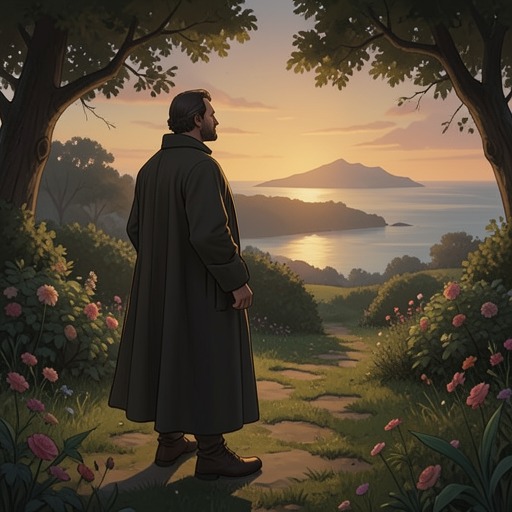
Kilterbury Ring lies at the top of Kilterbury Down. In November, the approach is described as cold, with the blackberries already over. At the hour Miranda visits, the sun is dipping toward the horizon, and her companion stresses that nobody comes up then. The relative isolation and fading light are not incidental: they help him present the stones as a private ceremonial space beyond ordinary company.
Miranda’s Visit
Miranda responds to the site first as a place of beauty. She asks why the stones were set there, and her companion answers in terms of ritual worship and sacrifice. He then directs her attention to a double axe carved into one of the stones, saying it was carved when people came from Mycenae or Crete. The account belongs to the companion’s explanation of the mark; the scene does not establish its historical accuracy independently.
As the sun nears the horizon, he asks Miranda to put her hand on the carved symbol and proposes a drink to the past, the future, and beauty. He places a golden cup in her hand and pours golden liquid from a flask. The sequence joins the site’s ancient associations to a present, deliberately arranged performance: stone, symbol, sunset, and goblet give the planned violence the appearance of a rite.
The Planned Sacrifice and Its Interruption
Poirot later explains that Michael Garfield had chosen Kilterbury Ring for Miranda’s death. He intended her to be found beside the double-axe sign, with a golden goblet at her side, and had carefully prepared the scene as a ritual sacrifice. Poirot says that Garfield had indoctrinated Miranda with the idea, and that he was willing to sacrifice her to save himself, despite loving her in his own way.
The plan is interrupted before it can be completed. Nicholas Ransom knocks a knife from a slowly rising hand, catches Miranda, and drags her away while the other two struggle. Miranda then says that she had thought she was to be a sacrifice, partly because she believed Joyce’s death was her fault. Her willingness to accept that role shows how effectively Garfield’s staging has shaped her understanding of what is happening; the site’s ritual language has turned her guilt into apparent consent.
Narrative Significance
Kilterbury Ring brings beauty and danger into the same scene. Miranda’s admiration is genuine, but Garfield uses that response—and the site’s stones and carved emblem—to make an attempted murder appear to belong to a larger, solemn order. The place’s ancient remains lend his invention an authority they cannot themselves confirm.
The episode also resonates with the book’s Halloween party, where children take part in apple-bobbing and reach for flaming raisins during a communal seasonal celebration. At Kilterbury Ring, by contrast, ritual forms are isolated from the group and appropriated by a murderer to control one child. The contrast makes the Ring more than a picturesque backdrop: it is where play and ceremony are stripped of their communal safeguards and recast as a threat.