Leopold Reynolds
Hallowe'en PartyLeopold Reynolds is the precocious younger brother of Joyce Reynolds, remembered for his scientific interests, quick fingers, eavesdropping, and unexplained money. His body is found in a brook after he has apparently been held underwater. The killing echoes Joyce Reynolds’s death and gives a grim consequence to the possibility that Leopold possessed a secret someone was paying him to keep.
Family and Characterization
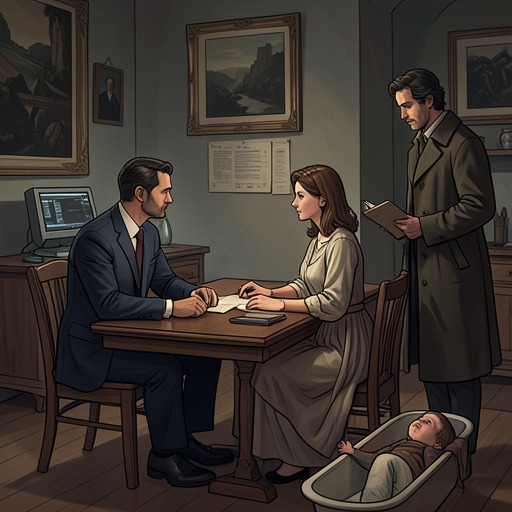
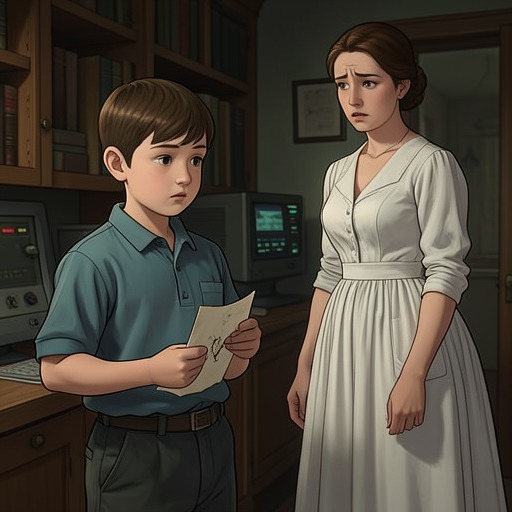
Mrs Goodbody portrays Leopold as markedly clever, especially with his hands and with mathematics. Although she estimates that he is only nine or ten, she expects him to pursue science and says that his school has been surprised by his mathematical ability. She also distinguishes him from Joyce Reynolds: Joyce was not as academically capable as Leopold, but was driven to outdo others and attract attention. This family portrait makes Leopold’s intelligence both a talent and a source of unease.
His cleverness has a covert side. Mrs Goodbody says that he plays tricks and listens in on other people, discovering their secrets. She cannot explain how he has acquired so much pocket money, since his parents cannot afford to give him much. He keeps the money in a drawer under his socks and spends it on expensive gadgets. Mrs Goodbody suspects that he learns private information and accepts money in return for silence; her account is gossip and conjecture, but later evidence gives the suspicion a more serious basis.
Death and the Withheld Suspicion
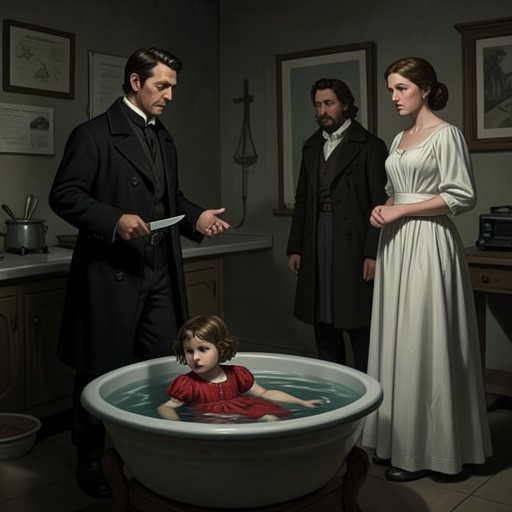
Rowena Drake tells Hercule Poirot that Leopold’s body has been found on a field path. He was apparently returning from school, but had gone out of his way to play by a brook. Someone held him down and kept his head underwater. Rowena immediately recognizes the resemblance to the way Joyce Reynolds was killed: in both cases, a child is drowned by another person.
The manner of Leopold’s death becomes entangled with Rowena’s earlier reluctance to speak. She explains that she had not wanted to accuse a child who was so young; she thought he might not have understood what he was doing and might need psychological treatment rather than police intervention. After his death, she reasons that his startled reaction may have meant he had seen the murderer, or something that could identify the murderer. In her account, someone then waited until Leopold was alone and drowned him to prevent him from telling what he knew. This is Rowena’s explanation of the danger he faced, not a confirmed identification of his killer in the evidence presented here.
Money, Secrets, and the Investigation
The unexplained money Mrs Goodbody had noticed takes on new significance when Hercule Poirot says he has just been told that Leopold had recently been unusually flush with money. Poirot concludes that somebody must have been paying him to keep silent. The payment connects the boy’s habit of uncovering secrets to the investigation, but the evidence does not establish who paid him or exactly what information he possessed.
Leopold’s death therefore sharpens a distinction between suspicion and proof. Rowena believes that he may have seen the murderer or encountered a clue, while Poirot’s remark supports the idea that someone had a reason to buy his silence. Neither statement, on its own, establishes what Leopold witnessed. His reputation as an eavesdropper makes concealed knowledge plausible, but the precise secret remains unresolved in these scenes.
Narrative Role and the Water Motif
Water links Leopold’s death to Joyce Reynolds’s murder while keeping their circumstances distinct. Joyce was held underwater in a bucket; Leopold was drowned in a brook after leaving his route home from school. The repeated method makes the later death feel like an escalation: the investigation is no longer dealing only with Joyce’s killing, but with another child apparently silenced by drowning.
The water clue also matters to Hercule Poirot’s solution to Joyce’s murder. He reasons that the killer of a struggling child would have become wet and needed an innocent explanation for being so. Rowena Drake’s staged vase accident supplied that explanation: she arranged for a witness to see water soak her when the vase crashed on the hall floor. In the same final account, Poirot explains that Rowena had suspected someone might have witnessed her and Michael Garfield killing Olga Seminoff in Quarry Wood. That disclosure gives context to the fear of a witness and to the theme of secrets bought or enforced through silence, but it does not prove that Leopold witnessed that earlier killing or identify his own murderer.