Louise Llewellyn-Smythe
Hallowe'en PartyLouise Llewellyn-Smythe, usually referred to as Mrs Llewellyn-Smythe, was a wealthy woman whose final arrangements for her estate overturned a testamentary pattern that had stood for years. Her choice of Olga Seminoff as beneficiary, and the conflicting evidence about the codicil behind that choice, makes Louise’s household and her intentions a crucial part of the inheritance mystery.
Identity and Household
Louise was the aunt of Rowena Drake and the employer of Olga, who served as her companion or nurse attendant. Olga was not the first foreign girl Louise had hired for such a position: one had quarrelled with her almost immediately, while another was described as pleasant but painfully stupid. Louise was said not to suffer fools gladly, but Olga, her last such appointment, appears to have suited her well.
A Longstanding Will and a Sudden Change
For many years, Louise’s fundamental testamentary arrangement had remained stable. Her fortune was left jointly to her nephew, Hugo Drake, and his wife, Rowena, who was also Louise’s niece; if either spouse died before Louise, the survivor would inherit. The will also included charitable bequests and legacies for old servants. Changes over the years had been limited to adding charities or revising gifts made void by a beneficiary’s death.
The apparent final codicil departed sharply from that pattern. Made about three weeks before Louise died, it was said to be in her own handwriting. It included fewer charities than the earlier arrangements, omitted legacies for the old servants, and left the residue of her considerable fortune to Olga in gratitude for her devoted service and affection. To those familiar with Louise’s established habits, the disposition seemed astonishing.
The Witnesses and the Document
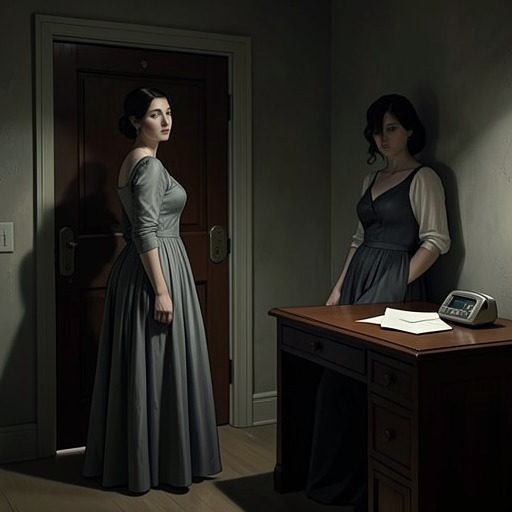
Harriet Leaman later recalled being summoned to Louise’s room with Jim, a young helper who worked in the garden and brought in sticks and coal. Louise had not been feeling well that day. Papers were on her desk, and she asked Olga to leave, saying that Olga must not be involved in that part of the business. Louise then told Leaman and Jim that she was writing her will and wanted them to witness both what she wrote and her signature.
A piece of blotting paper covered the upper part of the document, though its lower portion was visible. Louise wrote two or three lines with the scratchy pen she habitually used, signed her name, and directed each witness to write a name and address. She explained that they had seen her write and sign the document and had added their names to attest to it. As Leaman left, she had to pull the door shut because it did not always latch properly; she began to describe turning her head at that moment, but the account recorded here does not establish what she saw.
The Inheritance Mystery
The codicil eventually produced was judged by Hercule Poirot to be so obviously forged that a lawyer would detect the fraud. He expected it to be contested and set aside, leaving the original will in force. Because Hugo had recently died, that arrangement would make Rowena the heir. The distinction between the witnessed document and the forged codicil that surfaced later is therefore essential: evidence that Louise wrote and signed a document did not, by itself, authenticate the instrument presented as her final will.
Poirot offered a possible explanation for Louise’s change of heart, while presenting it as a surmise rather than a confirmed account. He thought Louise might have discovered that Michael Garfield and Rowena were having an affair, probably before Rowena’s husband died, and made a codicil leaving everything to her au pair girl in anger. Olga may then have told Michael about the inheritance, hoping to marry him. Michael’s alternative story blamed the affair on Lesley Ferrier, but Poirot noted that this version had no confirmation. Louise’s legacy thus turns on a gap between her apparent act of deliberate bequest and the uncertain, potentially self-serving accounts of why she made it.