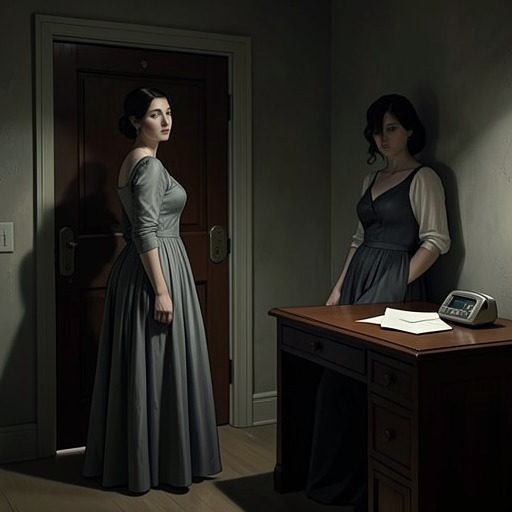
Louise Llewellyn-Smythe's arthritis
Hallowe'en PartyLouise Llewellyn-Smythe’s arthritis was a progressive physical limitation that affected her walking and, especially, her right hand. Her resistance to appearing incapacitated shaped her everyday self-presentation and had an unexpected bearing on the forgery that came to light after her death: a practice adopted to conceal her difficulty writing also gave Olga Seminoff experience imitating her handwriting.
Condition and daily limitations
The account of Louise’s condition emphasizes its practical effects. Her wrist was becoming increasingly difficult to use, and her right hand in particular could no longer perform certain actions as it once had. She was also unable to walk far or climb hills quickly. The narrative thus presents the illness through specific losses of mobility and dexterity rather than through a detailed medical history.
These limitations mattered to Louise because she resented being unable to do what she had formerly managed. She wanted to present herself as perfectly well and capable of doing anything she set her mind to. That insistence did not remove the effects of arthritis; it influenced how she chose to manage and disclose them.
Handwriting and independence
Louise disliked having personal letters typed. She regarded typewritten correspondence to friends and personal acquaintances as discourteous, and wanted her letters to appear to have been written by her despite the worsening rheumatism in her wrist. She therefore instructed Olga to write letters in a hand that closely resembled her own, paying attention to the formation of individual letters, including a, b, and f, and to sign Louise’s name.
The arrangement reflected both a social preference and Louise’s effort to conceal a bodily limitation. Rather than identify the writer as a secretary or allow the illness to make her reduced ability visible, she wanted recipients to believe that she had written the letters herself. That established practice later complicated judgments about the authenticity of writing attributed to her.
The codicil and handwriting evidence
After Louise’s death, a purported handwritten codicil, made about three weeks before she died, left the residue of her fortune to Olga Seminoff. This departed sharply from Louise’s established testamentary arrangements: for years, the main inheritance had gone to her nephew and his wife, alongside charitable and servant bequests. The new document was initially accepted without suspicion in part because Olga had repeatedly practiced copying Louise’s handwriting for personal letters.
The resemblance did not withstand expert examination. Lawyers familiar with Louise’s writing noticed discrepancies, and handwriting experts concluded that the codicil was not hers. The contrast is significant: Louise’s arthritis had made her handwriting practice necessary for the correspondence she wished to send, while Olga’s resulting familiarity with that handwriting supplied an opportunity to imitate it. The evidence does not make the illness itself proof of the forgery; the decisive finding came from comparing the codicil with known examples of Louise’s writing.
Witnesses and the limits of the evidence
A separate recollection further shows why the paperwork required careful scrutiny. Harriet Leaman recalled being summoned, with a young garden worker, when Louise said she was writing something and asked them to witness her writing and signature. Harriet saw Louise use her characteristic scratchy pen, write several lines, and sign the page. This account concerned a document Harriet had witnessed; it did not establish that she had witnessed the forged codicil later produced for probate.
Poirot subsequently learned from the solicitor that the forged codicil had instead been witnessed by Mary Doherty, who had died, and James Jenkins, who had left for Australia. He and Ariadne Oliver also recognized the possibility that a real codicil existed as well. The distinction between Louise’s genuine act of writing, the witnesses to a document, and the forged document submitted for probate keeps her arthritis in its proper evidentiary place: it explains the circumstances in which handwriting could be imitated, but does not by itself settle which document was genuine.