Murder Case of Leopold Reynolds
Hallowe'en PartyThe Murder Case of Leopold Reynolds reveals that Leopold’s death was neither an accident nor an isolated tragedy: someone drowned him to prevent him from speaking about a clue to an earlier murder. The case turns on a withheld witness account, the money Leopold had recently received, and Poirot’s insistence that compassion for the killer cannot replace justice for those still at risk.
Death in the brook and withheld testimony
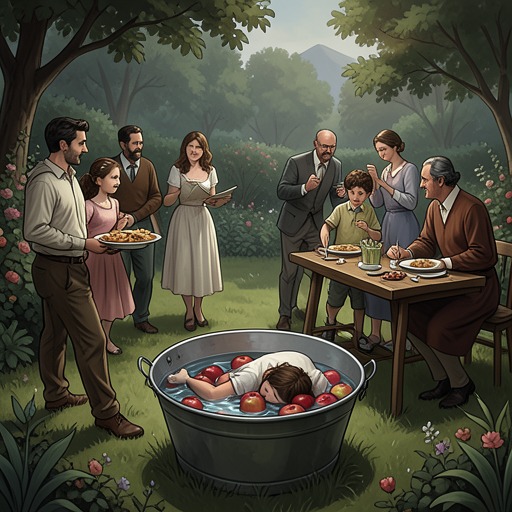
Leopold was found dead on a field path after apparently going out of his way, on his return from school, to play in a nearby brook. The account of his death is stark: someone held him down and kept his head under water. Its method recalled the drowning of Joyce Reynolds, making the two children’s deaths feel like repetitions rather than unrelated misfortunes.
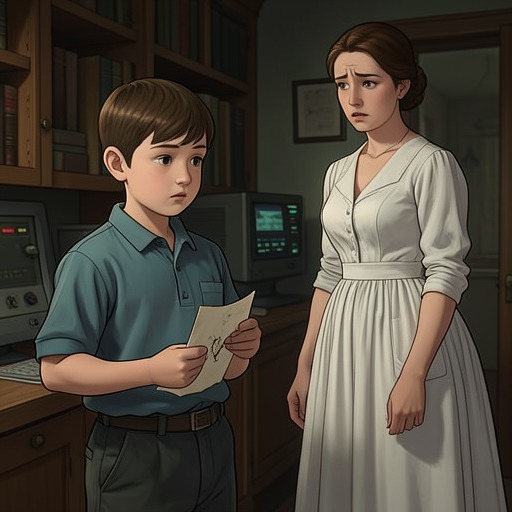
Mrs Drake had seen something connected to the crime but did not tell the police, even after Leopold’s death. She explained that the person she had seen was very young—ten, perhaps eleven—and that she had thought he could not fully understand what he was doing. She hoped he might receive special psychological treatment instead of being sent to the police or to an institution. Her silence was meant, in her view, to protect a child; it also left the person who could identify or expose a murderer unable to speak safely.
Mrs Drake later understood the danger her silence had helped create. She reasoned that Leopold must have seen either the murderer or something that could identify him, and that the murderer had waited until the boy was alone before drowning him. She regretted not speaking to Poirot, the police, or anyone else, recognizing that her confidence in knowing what was best had instead allowed the threat to continue.
Payment, risk, and the pursuit of justice
Poirot learned that Leopold had recently been unusually flush with money. He treated the payment as evidence that the boy had been bought off: Leopold wanted money, received it, and was then drowned when the opportunity arose. The money changed the significance of the death. It suggested not a random attack but an effort to keep a child silent, and it made the boy’s danger part of a wider pattern in which killing had become a means of security for the killer.
That interpretation sharpened the contrast between compassion for Leopold and responsibility toward the living. Rowena Drake had been overwhelmed by pity for the very young person she believed connected to the earlier crime, and had hoped that treatment might be possible instead of police involvement. Poirot did not dismiss that compassion, but argued that it could do nothing for Leopold after his death. Pursuing justice, he told Miss Emlyn, might instead help keep another child alive by stopping a killer who had struck more than once. He was travelling to London to persuade others to accept his certainty and discuss how to proceed.
The case’s later solution also shows how the effort to suppress a possible witness grew out of a mistaken belief about what had been seen. Poirot traced Joyce’s murder through water: whoever had forced her head into a full bucket would have been soaked, so the killer needed an innocent explanation for being wet. Rowena had carried a water-filled vase onto the landing and staged its fall in front of Elizabeth Whittaker, giving the witness an apparent reason for her wet clothes while directing suspicion toward someone supposedly leaving the scene. Rowena believed that someone might have witnessed her and Michael Garfield killing Olga Seminoff in Quarry Wood; in fact, Joyce had not seen that murder. The staged accident thus concealed one killing while the fear of exposure helped drive the violence that followed.
From physical trace to planted alibi
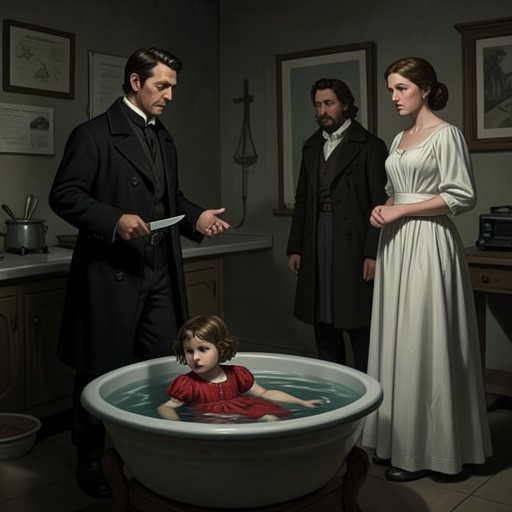
The case’s decisive clue is not simply that water was present, but that the drowning made wet clothing unavoidable. Hercule Poirot’s question about the water turns an apparently ordinary detail into a test of the killer’s account: someone who held a child’s head beneath the surface of a full bucket would be splashed. The water on the sheet and around the bucket therefore has a double significance, recording the violence while also explaining why its perpetrator needed a separate reason to appear wet.
Elizabeth Whittaker’s account supplies the circumstances that make Rowena Drake’s explanation persuasive at first and incriminating in retrospect. During the Snapdragon, the burning dish of raisins and brandy made the room hot; Whittaker stepped into the hall and saw Rowena pause on the shaped turn of the staircase with a heavy vase of autumn leaves and flowers. Rowena looked across the hall toward the library, shifted the awkward vase, and then appeared to start, releasing it. The vase overturned, water spilled over her, and it smashed on the hall floor. The broken vessel thus gave her wetness a visible, seemingly accidental cause, while her gaze and sudden reaction suggested that she had noticed someone near the library. Poirot’s reconstruction makes the staged mishap legible as an alibi built for a witness: Whittaker’s observation was real, but the meaning Rowena encouraged her to assign to it was false.
How the case becomes legible
The investigation depends on keeping observation separate from interpretation. Elizabeth Whittaker saw Rowena Drake release the vase, soak her clothes, and break the vessel; that account established what happened on the landing, but not why. Poirot’s reconstruction supplies a test for the explanation: the person who drowned Joyce would have been wet, so the vase’s fall had to account for more than a mishap. Mrs Drake’s silence and Leopold’s recent money then add a further link, suggesting why the boy might have been killed. No single detail carries the whole case. Its force comes from the way a physical trace, a witness’s account, and an undisclosed payment converge, changing the meaning of scenes that first appeared unrelated.