Murder of Joyce Reynolds
Hallowe'en PartyThe Murder of Joyce Reynolds takes place during the Snapdragon at the Woodleigh Common Hallowe’en party, when Rowena Drake lures Joyce into the library and drowns her in a bucket of water. Its decisive significance lies in the connection between two supposed acts of witnessing: Rowena kills Joyce to prevent her revealing a murder, but Poirot establishes that Joyce had never witnessed one. The water that made the killing physically unavoidable also becomes the clue to Rowena’s staged explanation for her wet clothes.
Background and Disappearance
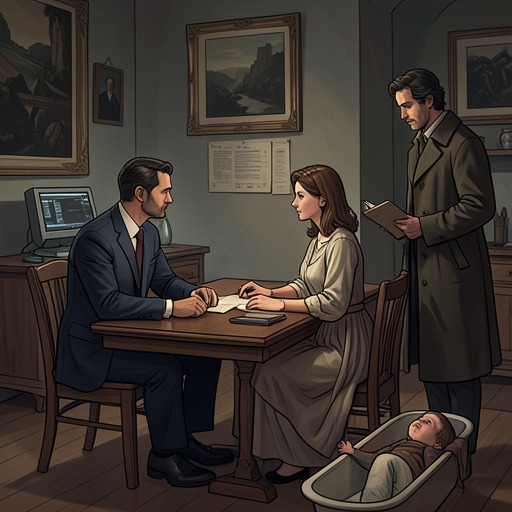
Ariadne Oliver recalls that the party’s final activity was Snapdragon, a Christmas-associated game in which guests snatched raisins from a dish of burning brandy. Afterward, people went home, and Joyce could not be found. The search initially produced the ordinary explanations of a tired or unwell child leaving by herself, but her mother was annoyed that Joyce had not left word. The uncertainty ended when they found her in the library.
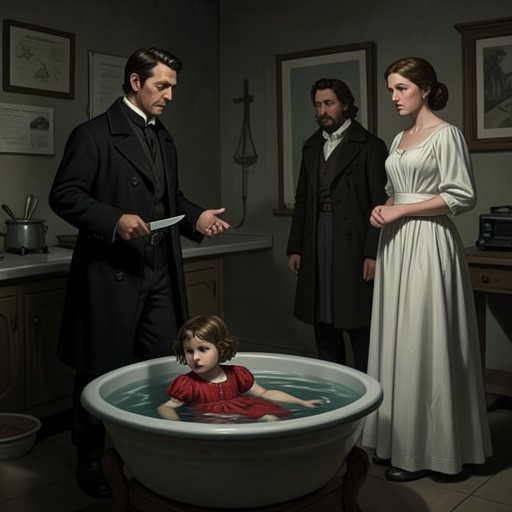
The murder was bound to the game’s setting and its equipment. Joyce had been bobbing for apples in a large galvanized bucket nearly full of water. Someone forced her head beneath the surface and held her there until she drowned. Oliver dwells on the weight of the bucket, contrasting it with the plastic one that might have tipped over; the heavy vessel stays put while the child struggles. The scene is not a death by some distant or elaborate method, but a killing carried out at close quarters, in the very apparatus of a party game.
The Killing and Its Immediate Stakes
Oliver’s account places the murder at the point when the party breaks up. Poirot asks whether Joyce really saw a murder earlier or merely believed she had seen one. Oliver now thinks the claim was true, recalling that Joyce had insisted vehemently that she had seen it happen. At the time, however, Oliver had dismissed the girl as someone dressing up a vague memory to make it sound exciting. Joyce’s insistence changes the meaning of her death: Oliver comes to believe that the killing makes sense only if Joyce was a witness to another murder.
That inference gives the case its urgent causal logic. As Poirot observes, the killer must have been among the people at the party and must also have been present earlier that day, when Joyce spoke about what she had seen. He describes the drowning as an ugly, hurried murder: whoever felt threatened struck as soon as it was possible. Oliver argues that Joyce would not have made her claim if the murderer had been in the room with her when she spoke. Poirot agrees that she saw a murder but not the murderer’s face, leaving the identity of the earlier crime and the person who feared discovery to be worked out.
Water as Clue and Cover
The reconstruction turns on a physical consequence of the drowning. Anyone holding a vigorous child’s head down in a full bucket would be splashed and soaked. Therefore, the murderer would need an innocent-looking reason to be wet. Poirot connects that necessity to the vase Elizabeth Whittaker saw Rowena carrying on the staircase: it was large, awkward, and, as Elizabeth supposed, heavy with water.
Elizabeth’s recollection supplies the apparently accidental scene. The Snapdragon room had become hot, so she came into the hall. Rowena emerged from the first-floor lavatory with a vase of autumn leaves and flowers, paused at the staircase, and looked across the hall toward the library door. As she negotiated the turn in the stairs, the vase fell, spilling water over her and smashing on the hall floor. Rowena and Elizabeth gathered the broken pieces and flowers, while Rowena lamented the loss of the vase. What looked like an unfortunate mishap gave Elizabeth a witnessable explanation for Rowena’s wetness—and the impression that Rowena had seen someone coming from the library.
Poirot’s solution recasts the fall as deliberate staging. Rowena had taken Joyce away from the crowded dining room and into the library, where Joyce would have no reason to suspect her hostess. After drowning the girl, Rowena needed someone to see her drenched and accept an innocent cause. She waited on the landing with the water-filled vase, then pretended to start, releasing it so that it flooded her as it crashed below. Elizabeth took the incident at face value; when she later told Miss Emlyn, Miss Emlyn recognized its importance and urged her to tell Poirot. The vase’s shattered remains thus serve two purposes in the explanation: they disguise the source of Rowena’s wet clothes and make the disguise memorable to a witness.
Revelation and Significance
Poirot identifies Rowena as Joyce’s murderer through the contrast between the necessary wetness of the killer and the contrived accident that accounts for it. The chain of reasoning joins the bucket, the water on the staircase, Elizabeth’s observation, and Rowena’s attention toward the library. The vase is not merely a decorative object involved in an accident; its water provides the cover the killer needs, while its fall helps establish the false story of what Rowena saw.
The final reversal is that Joyce’s alleged knowledge was not what Rowena believed it to be. Rowena had long suspected that someone was present in Quarry Wood when she and Michael Garfield killed Olga Seminoff. Joyce’s claim to have seen a murder seemed to confirm the danger of a witness, and Rowena acted on that fear. But Poirot concludes that Joyce had never seen any murder committed at all. Joyce is killed because Rowena mistakes a claim for proof; the lie, or apparent lie, becomes lethal not through the truth it contains but through the fear it awakens. In retrospect, the Snapdragon’s playful apple-bobbing has become a mechanism of death, and the water that drowned Joyce also exposes the murderer.