Olga Seminoff
Hallowe'en PartyOlga Seminoff is a foreign au pair whose apparent inheritance from Mrs Llewellyn-Smythe makes her disappearance look like an escape from exposure as a forger. The investigation overturns that impression: Olga’s practiced imitation of her employer’s handwriting made her a useful suspect, but the forged codicil and her disappearance belonged to a plan that used her as a scapegoat and ended in her murder.
Identity and Place in the Household
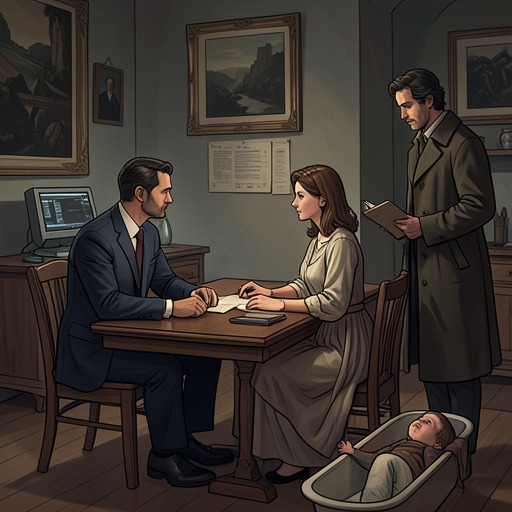
Accounts describe Olga as a foreign girl, an au pair, and, in one recollection, an opera girl; the servants called her Miss Olga. The available accounts offer little of her own perspective. Instead, they define her through her position in Mrs Llewellyn-Smythe’s household and through what others say she might have done. Her apparent closeness to her employer is central to the case: the codicil’s stated explanation for leaving her the fortune was gratitude for her devoted service and affection.
Olga’s supposed inheritance represented a dramatic break with Mrs Llewellyn-Smythe’s established arrangements. For years, the bulk of the estate had been left to her nephew, Hugo Drake, and his wife, alongside charitable and household bequests. The earlier arrangements also provided for the bungalow to go to the landscape designer and for the Quarry Garden to be maintained and opened to the public. The newly alleged codicil instead left the residue of the considerable fortune to Olga, removed the old servants’ legacies, and included fewer charitable gifts. Its unfamiliar distribution made Olga’s apparent benefit look suspicious as well as astonishing.
The Codicil and the Suspicion of Forgery
Olga had been given repeated opportunities to imitate her employer’s handwriting. Mrs Llewellyn-Smythe disliked using a typewriter and had Olga write personal letters in a hand modeled on her own; at times Olga even signed the employer’s name. When handwriting experts examined the codicil submitted for probate, however, they found only a faint resemblance to Mrs Llewellyn-Smythe’s writing and identified the document as a complete forgery. Her practice made her an immediately plausible author in other people’s eyes, but it did not prove she had forged the document in question.
A witness’s recollection further complicates the apparent evidence. Harriet Leaman remembered Mrs Llewellyn-Smythe asking Olga to leave the room, then summoning Leaman and a young garden helper to watch her write and sign a document. She recalled the employer covering the top of the paper with blotting paper, writing several lines with her usual scratchy pen, and asking both witnesses to add their names and addresses. Leaman noticed the incident as she left, when she turned to pull the door shut. This account supports the existence of a separately witnessed document; it does not, by itself, establish what that document contained.
Hercule Poirot later established that the forged codicil presented for probate had not been witnessed by Harriet Leaman. Its named witnesses were Mary Doherty, a former servant who had died, and James Jenkins, who had gone to Australia. Poirot consequently distinguished the forged document from a real codicil, rather than treating every account of Mrs Llewellyn-Smythe signing a document as evidence that the probate paper was genuine. The contrast between a remembered act of signing and the demonstrably forged document is crucial to understanding how the false inheritance story could be constructed.
Disappearance and Relationships
Once the forgery was detected, legal proceedings to contest the codicil were expected, although there would be a delay before the matter came to court. Olga disappeared during that interval. Her absence could be read as an admission of guilt, especially because the forged document appeared to benefit her and she had previously copied her employer’s handwriting. The apparent flight helped turn suspicion into a persuasive story: she could be imagined as both the forger and someone implicated in Mrs Llewellyn-Smythe’s death. Poirot’s reconstruction shows why that interpretation was useful to the actual plotters, not that it was true.
Olga was also connected to Lesley Ferrier. When Hercule Poirot asked whether Lesley had been her friend, Superintendent Spence confirmed the friendship. Spence had heard Olga speak gravely of someone she hoped to marry in her own country, but he could not tell whether that account was true or invented. He also recalled that Lesley was attractive and that his other girlfriends were displeased. These details establish a connection and a possible source of jealousy around Lesley, but they do not establish that Olga and Lesley were lovers or had agreed to marry. Poirot later rejects the supposed love affair as a story introduced by Michael Garfield.
Scapegoat and Victim
In Poirot’s account, Michael Garfield and Rowena Drake needed Olga to be suspected, not necessarily prosecuted or convicted. Her history of imitating Mrs Llewellyn-Smythe’s handwriting supplied an easy explanation for the forged codicil, while the apparent benefit to Olga made that explanation seem self-evident. If she vanished, suspicion could harden into the assumption that she was a forger who might also have helped bring about her employer’s sudden death. The scheme depended on an accusation that would continue to work even without Olga present to answer it.
Poirot’s reconstruction is that Mrs Llewellyn-Smythe had hidden the original document and that Lesley was paid to produce a similar forged one. The conspicuous weakness of the forgery was part of its effect: it would draw suspicion and allow Olga to be branded as its maker. Poirot concludes that Michael, who had been courting Olga and suggesting possible marriage, was involved in the plan with Rowena Drake, and that Olga was killed when the scheme required her removal. The account does not describe the circumstances of her killing in detail, but it makes clear that her disappearance was not simply a voluntary flight from legal trouble.
Narrative Significance
Olga’s role turns handwriting from a domestic convenience into a source of criminal suspicion. The personal letters she wrote for her employer had given her the skill that made the forged codicil plausible, but the same history was exploited to conceal who stood to gain from the forgery. Her supposed inheritance is therefore both the apparent motive assigned to her and the instrument used to frame her.
The investigation also exposes how little the case’s early stories allow Olga to speak for herself. Other people characterize her as devoted, unreliable, romantically involved, or capable of forgery; the plotters rely on those ready-made accounts to make her disappearance seem like confirmation. By separating the real witnessed document from the forged codicil, and the friendship with Lesley from the alleged affair, Poirot dismantles the narrative built around her. Olga is not revealed as the author of the scheme but as the person whose reputation and absence were made to serve it.