Rowena Drake
Hallowe'en PartyRowena Drake is the host whose polished organization gives the children’s Halloween gathering at Apple Trees its orderly shape, until Joyce Reynolds’s murder turns that carefully managed occasion into a crime scene. Tall, handsome, and conspicuously capable, she presents herself as a woman accustomed to making events run smoothly. That image becomes central to her role: after the murder, the party’s failure to remain safe seems to her not merely tragic but a reflection on her own competence, while a later witness’s account places her at a significant moment in the house.
Identity and Public Role
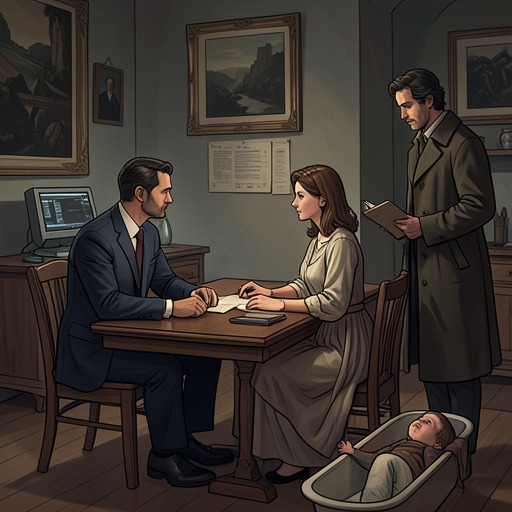
Rowena Drake is a prominent member of the Woodleigh Common community and the woman giving the party. Hercule Poirot sees her as a tall, handsome woman in her forties, with golden hair lightly touched with grey and brilliantly blue eyes. Her competence, in his impression, seems to extend from her fingertips downwards: he considers any party arranged by her likely to succeed. The house itself reinforces an image of controlled respectability. Apple Trees is well furnished, carefully polished and cleaned, and conventional in its décor, with few conspicuous objects to distract from its orderliness.
That public capability has a more complicated side. When Poirot visits after the murder, he suspects that Rowena is suppressing annoyance at having to act as hostess at a social occasion violated by murder. He also imagines that, as a prominent local figure, she feels the tragedy reflects some inadequacy in her own performance. These are Poirot’s readings of her manner, not facts Rowena confesses; they nevertheless frame the tension between her reputation for command and the event she could not control.
The Party and Its Organization
Rowena defines the gathering by its age group as well as its season. Although it is in effect a Halloween party, she prefers to call it the Eleven Plus party: most of the children are leaving The Elms for other schools. Her choice gives the evening a practical social identity, centering the children’s transition rather than the calendar’s associations with All Souls’ Day and All Saints’ Day.
The party begins at half past seven, and the arrivals are punctual. The house is decorated with red and blue lights on the stairs and abundant yellow pumpkins. Children bring decorated broomsticks for a competition, and Rowena announces a tightly sequenced programme: judging the brooms, cutting the flour cake in the small conservatory, bobbing for apples with assigned partners, dancing with partner changes whenever the lights go out, a visit by the girls to the small study to receive their mirrors, supper, Snapdragon, and prize-giving. The evening’s activities shift between contests, food, and social play, but their order is set in advance.
Her management also includes a deliberate accommodation of children who might otherwise lose out. The broomsticks are miniature and, on the whole, not very skilfully decorated. Rowena treats that low standard as an opportunity: she remarks privately to a friend that it makes the contest easier to manipulate, so that children unlikely to win prizes in other activities can be rewarded here. The gesture reveals a hostess attentive not only to the programme but to how its outcomes affect the children. Her fairness is informal and knowingly adjusted, rather than a strict enforcement of merit.
Murder and the Failure of Control
In her later conversation with Poirot, Rowena recalls that the party had been going well and that the guests seemed to be enjoying themselves until the “terrible thing” happened. She says it is painful to remember and that the only course is to try to forget. She also singles out Joyce Reynolds’s foolish remark about seeing a murder. Her phrasing places the remark beside the tragedy as something unfortunate, but the account does not establish what Rowena knew about the murder or how she understood Joyce’s words at the time.
Poirot’s questions expose the gap between Rowena’s confidence as an organizer and the helplessness imposed by the crime. She had imagined and run an evening that, in Ariadne Oliver’s assessment, proceeded like clockwork; afterward, Rowena appears to Poirot to be searching irritably for some failure on the part of a helper. The contrast is sharp: her programme could govern the children’s movements, but it could not prevent violence from entering the gathering. Her account of the party’s success therefore carries an undertone of personal failure, even as she insists that the event had been enjoyable before it was broken by murder.
Elizabeth Whittaker’s Account
Elizabeth Whittaker describes seeing Rowena at the staircase during the final, unusually Christmas-like activity, Snapdragon. The room had become hot around the burning dish of raisins and brandy, and Whittaker stepped out into the hall. There she saw Rowena emerge from the lavatory on the first-floor landing carrying a large vase of mixed autumn leaves and flowers.
Rowena paused at the angle of the staircase and looked down toward the far end of the hall, where the library door stood across from the dining-room door. The vase was awkward and, Whittaker presumed, heavy with water. Rowena adjusted it so she could hold it against herself with one arm and reach for the stair rail with the other. She remained focused on the hall below rather than on the vase. Then, Whittaker said, Rowena made a sudden movement as if startled, released the vase, and let it fall. It reversed as it dropped, sending water over Rowena before smashing on the hall floor.
The account is specific about the vase, the water, the staircase, and Rowena’s apparent start of surprise, but it does not identify what startled her or establish whether the fall was deliberate. Its importance lies in the circumstances it preserves: Rowena was carrying a heavy, water-filled arrangement, and its breaking left her soaked. In a house where a murder has occurred, that witnessed episode becomes more than a household mishap, while remaining open to interpretation on the evidence presented here.
Narrative Significance
Rowena’s role is built around the contrast between order and disruption. She assigns partners, schedules activities, provides prizes, and manages a gathering designed for children at a point of transition. When murder interrupts that design, she is described not as openly losing control but as maintaining a public manner while Poirot suspects irritation and self-reproach beneath it. The account of the broken vase extends that contrast into a concrete image: the competent hostess, carefully negotiating a staircase with an unwieldy object, suddenly loses her hold and is drenched by the spill.
These details make Rowena a figure to be assessed through both her visible competence and other people’s observations of her. Poirot’s impressions are explicitly interpretations; Whittaker’s testimony is a witnessed sequence whose cause remains unstated. Together, they establish the circumstances that make Rowena significant to the investigation without, by themselves, resolving what lay behind the murder or the vase’s fall.