Woodleigh Common
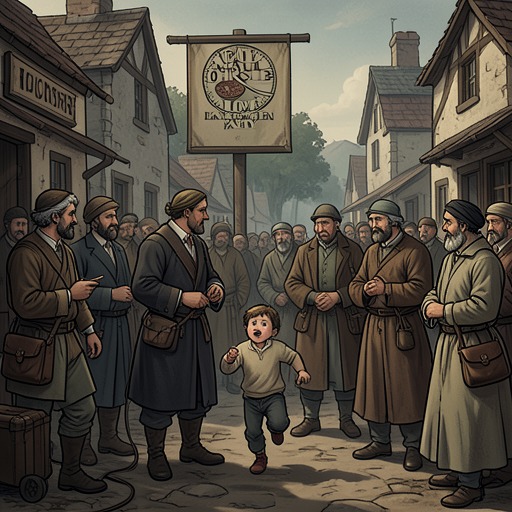
Hallowe'en PartyWoodleigh Common is a residential community near Medchester and within commuting distance of London, but its everyday appearance conceals the violence at the centre of the novel’s investigation. Ariadne Oliver arrives as a guest of Judith Butler and attends a children’s Halloween party there; afterward, Hercule Poirot and Superintendent Spence examine the people and institutions of the town in connection with Joyce Reynolds’s murder. The setting’s ordinary houses, shifting population, and organized village life make it a place where visitors and newcomers can blend into familiar routines—and where familiarity does not guarantee that anyone is truly known.
Setting and Access
Woodleigh Common is presented not as an isolated village but as a modest residential settlement within reach of two larger centres. Ariadne Oliver estimates that it lies roughly thirty to forty miles from London and near Medchester. A good school serves the area, and residents can commute either to London or into Medchester. Its houses include older, established homes alongside newer residential building, and Oliver describes its inhabitants as people with ordinary, reasonable incomes. The place is thus defined by routine mobility: employment elsewhere can bring a family to Woodleigh Common, while a change of job can take it away again.
Oliver’s own arrival gives this geography a personal route into the story. She has been staying with Judith Butler, whom she met earlier in the year on a Hellenic cruise. Judith, a widow with a twelve- or thirteen-year-old daughter, Miranda, invites Oliver to visit and tells her that friends are holding a children’s Halloween party; Oliver’s ideas might be useful. The party is therefore not an event that draws Oliver to an unfamiliar destination by chance alone. It is an extension of a friendship made while travelling, carried into Judith’s home and local circle.
The town also becomes a place Poirot recognizes, or at least seems to recognize. When Oliver names Woodleigh Common, he repeats the name thoughtfully and begins to refer to something that happened there before breaking off. The conversation does not complete that thought, leaving the place’s previous associations unstated at this point. Its name nonetheless changes the tone of the exchange: a description of an ordinary residential community has touched a memory for the detective.
A Community in Motion
Superintendent Spence has lived in Woodleigh Common for about a year when Poirot asks him to discuss the people connected with the party. Spence moved there to join his widowed sister, Elspeth McKay; her children are married and live abroad, one in Australia and the other in South Africa. Their pensions do not go far, he explains, but sharing a home makes them comfortable. His account makes settlement in the town partly practical: family circumstances and finances, not only attachment to a place, determine where people live.
Spence describes the community as neither large nor particularly settled. Many residents arrive because a husband has work in Medchester, Great Canning, or another nearby place; when his employment changes, the family may move on. Some residents, however, have been there for a long time. Miss Emlyn, the schoolmistress, and Dr Ferguson are named as examples of that more established presence. The contrast matters to the inquiry: local knowledge exists, but it is unevenly distributed in a population where some people are rooted and others are passing through.
This fluctuating population also shapes the way the investigation is framed. Poirot asks Spence for information not only about the partygoers but about the children’s parents, the school, teachers, lawyers, and doctors. Spence agrees that the murder is a nasty business and considers who in the community might be capable of it, while also discussing the possibility of a disturbed adolescent and the release of patients from overcrowded mental institutions. These are lines of inquiry, not conclusions about any particular resident. The town’s small scale makes its inhabitants available for scrutiny, but movement in and out complicates the assumption that a community’s most visible members are its only relevant ones.
The Party and the Investigation
The Halloween party brings the private world of children into the centre of the town’s public inquiry. Spence reconstructs how a person could have induced a girl to kneel, ostensibly to show her how to catch an apple with her teeth, then put a hand on her head. In his account, the act could have caused little struggle or noise. The familiar party activity provides cover for an assault precisely because it can look like play. Woodleigh Common’s ordinary social setting is therefore not incidental to the murder: the crime can be approached through the habits and explanations that make an apparently harmless gathering possible.
Poirot’s request to hear about the people around the party broadens the investigation beyond the immediate scene. The relevant network includes families, school staff, and local professionals, while Spence’s account of who stays and who leaves supplies a guide to how that network is assembled. The town is small enough for Poirot to ask for a collective portrait, yet fluid enough that its social map cannot be treated as fixed. In this respect, Woodleigh Common functions both as a physical setting and as an investigative problem: knowledge of a place depends on distinguishing enduring local ties from temporary residence.
Civic Life and the Cemetery
The town’s newer cemetery gives Poirot a different view of local life. He reaches it by a turning off the main road marked Helpsly Cemetery Road, then follows a footpath across two fields. The cemetery appears to have been established within roughly the previous decade as Woodleigh grew in residential importance. The older church, dating back two or three centuries, has only a small enclosure around it, already full; the newer burial ground answers the needs the old churchyard can no longer meet. Neat, businesslike, and arranged with urns, flowers, and suitable inscriptions, it offers little to an antiquarian, but it records a modern community in the process of expanding.
There Poirot reads the grave of Hugo Drake, Rowena Drake’s husband, whose memorial gives his date of death as March 20, with the year left incomplete in the inscription. An alabaster urn at the grave contains the remains of flowers. An elderly gardener tells Poirot that Hugo was struck by a car while crossing the road near twilight: the car did not stop, and, according to the account repeated locally, it was later abandoned in a car park twenty miles away after having been stolen. The gardener says Rowena took her husband’s death very hard and brings flowers nearly every week. His talk joins a specific grief to the broader everyday work of maintaining the cemetery and remembering the dead.
The gardener also describes Rowena’s public presence. She takes part in and runs local activities, including women’s institutes, teas, societies, tours, and outings; the vicar relies on her, although some people consider her bossy and interfering. The account holds two views of the same local influence together: her work sustains communal activity, while it can also make her unwelcome to those who dislike being directed. The gardener thinks she may eventually leave Woodleigh Common to live abroad, recalling that she and her husband liked foreign holidays. The town’s social life is consequently shown through both organized public service and private judgment, neither of which entirely settles how its residents feel about one another.
Narrative Role
Woodleigh Common is first introduced through Oliver’s conversational explanation of how she came to be at the party, then gradually disclosed through Spence’s local knowledge and Poirot’s walks and questions. That movement from broad description to particular people and places mirrors the detective’s task: an ordinary commuter settlement must be read closely before its hidden relations become legible. The cemetery extends that reading from the living community to the stories attached to its graves, especially the death of Hugo Drake and Rowena’s recurring visits.
In a later scene, Oliver announces that she and Miranda are going to London, and Miranda comes toward them slowly. The brief departure points beyond the town without making Woodleigh Common cease to matter: it is the place where Oliver’s visit, Miranda’s local life, and the inquiry into Joyce Reynolds’s death have converged. The setting’s decisive force lies in that convergence. Its apparent ordinariness is not proof of safety or transparency; it is the surface beneath which the investigation searches for concealed actions and relationships.