Woodleigh Common Hallowe’en party
Hallowe'en PartyThe Woodleigh Common Hallowe’en party, also called the Eleven Plus party, is Rowena Drake’s well-orchestrated gathering at Apple Trees for children around the age of eleven. Its cheerful programme gives a murderer cover for taking Joyce Reynolds away from the other guests, while a staged vase accident later supplies an innocent-looking explanation for the water on the killer’s clothes. The party’s orderly surface and its lethal interruption become inseparable in Hercule Poirot’s reconstruction of Joyce’s death.
Occasion and setting
Rowena Drake describes the gathering as an Eleven Plus party rather than a Hallowe’en party, though she acknowledges that it is one in spirit. The label fits the intended age group: most of the children are leaving The Elms to attend other schools. Elizabeth Whittaker, a local schoolteacher who is particular about accuracy, immediately challenges Rowena’s wording, a small exchange that sets the party’s managed informality against her insistence on precise terms.
The event begins at half past seven. Ariadne Oliver has initially felt that she does not want to attend, but she admits that the party is a success once it is underway. Arrivals are punctual, and the evening is described as running smoothly. Red and blue lights line the stairs, yellow pumpkins are displayed in profusion, and the children arrive carrying decorated broomsticks for a competition. The festive details are not incidental decoration: they help make a crowded, moving gathering in which guests shift from room to room and attention repeatedly turns toward the next activity.
Programme and party games
Rowena announces a sequence of entertainments: judging the broomsticks, cutting a flour cake in the small conservatory, bobbing for apples with partners listed on a notice, dancing, a visit by the girls to the small study to receive mirrors, supper, Snapdragon, and prize-giving. During the dancing, the lights go out at intervals and the children change partners. The programme makes movement and temporary separation part of the evening’s ordinary rhythm.
The broomsticks are miniature, and their decoration is generally of modest quality. Rowena jokes privately that this makes the competition easier to judge, since she can arrange for children unlikely to win elsewhere to receive a prize. The evening’s planned generosity is therefore slightly managed, but the party otherwise proceeds according to its schedule. Supper includes iced cakes, savouries, prawns, cheese, and nut confections, which the children eat enthusiastically.
The final entertainment is Snapdragon. The children are called across from the pantry after the prizes have been presented. In the dining room, a green baize cloth covers the table, and a large dish of raisins is brought out flaming after brandy has been poured over them. The children crowd forward to snatch the burning fruit, shrieking and laughing when their fingers are burned. The flames gradually die, the lights come up, and the party ends. Elizabeth Whittaker later describes the dish as more associated with Christmas festivity than with Hallowe’en; within the party, however, it is the climactic spectacle.
Joyce Reynolds’s disappearance
After Snapdragon, the guests go home. Only then do the adults realize that Joyce Reynolds cannot be found. They call her name and search, while her mother becomes annoyed and supposes that Joyce has gone off alone because she felt tired or ill. The ordinary explanations offered in the first confusion of a child’s absence briefly obscure the more serious possibility: Joyce has been murdered.
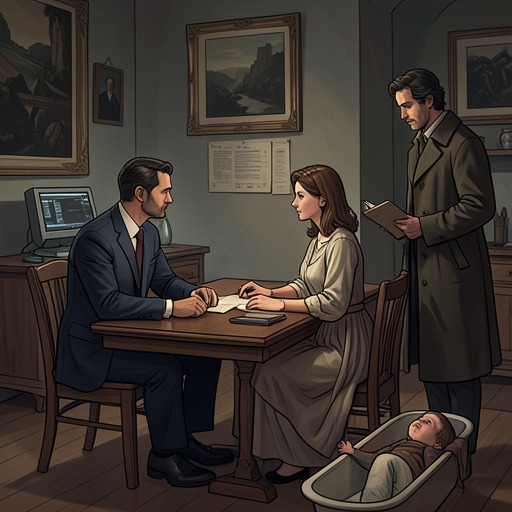
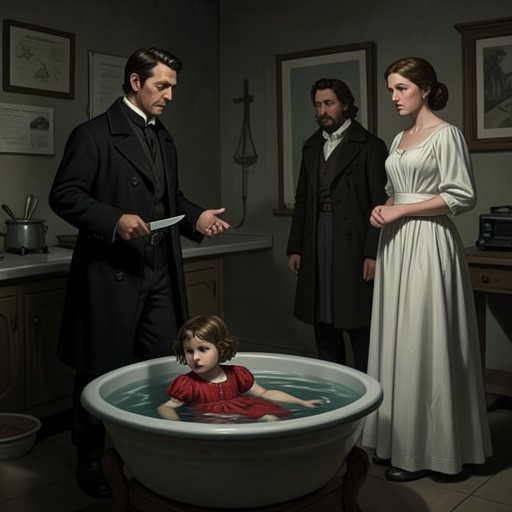
Ariadne Oliver later identifies the end of Snapdragon as the likely time of the crime. Hercule Poirot’s account makes the timing more precise. While the guests are gathered in the dining room for the flaming raisins, Rowena takes Joyce to the library. As hostess, she can invite a child to accompany her without provoking suspicion; Joyce, for her part, has no reason to distrust her. Rowena then holds Joyce’s head under water in a full bucket. The child’s struggle splashes water onto the murderer, creating a practical problem that will shape the deception surrounding the killing.
The wet-clothes alibi
Hercule Poirot treats water as the decisive clue. Anyone who had held a vigorous child under water would be likely to get wet, so the murderer needed a plausible explanation for wet clothes. Rowena supplies one with a large vase of mixed autumn leaves and flowers, filled with water, which she carries onto the first-floor landing. She waits there until Elizabeth Whittaker leaves the hot Snapdragon room and comes into the hall.
Whittaker’s account preserves the details that make the accident credible. Rowena pauses at the angled turn of the staircase, holding the awkward, apparently water-filled vase against herself while reaching for the rail. She looks down toward the hall and the library end rather than at the vase. Then she starts as though startled, lets it go, and the vessel overturns as it falls. Water streams over her; the vase smashes on the hall floor. Rowena and Whittaker pick up the flowers and pieces while Rowena laments the loss of the vase. The staged mishap both wets Rowena in public and gives Whittaker the impression that she has seen someone emerging from the room in which a murder has taken place.
What the party conceals
Whittaker accepts the apparent explanation at face value, but when she tells Miss Emlyn about the incident, Miss Emlyn recognizes the significance of the water and urges her to report it to Hercule Poirot. The vase episode thus changes meaning: what appeared to be an accidental interruption becomes evidence of deliberate preparation. Poirot connects it to the bucket, the likely splashing, the library, and Rowena’s need for a witness to her supposed accident, identifying Rowena as Joyce’s murderer.
The party’s final image—the children reaching eagerly for burning raisins—stands beside the concealed killing that takes place under cover of the same gathering. Its games, room changes, and crowded climax provide the opportunity; its hostess’s visible, apparently unfortunate accident supplies the alibi. Joyce had never actually seen a murder, although Rowena believed someone might have witnessed her and Michael Garfield killing Olga Seminoff in Quarry Wood. That mistaken belief explains why Joyce was targeted and makes the party’s apparent success a cover for violence rooted in an earlier crime.