Attempted Ritual-Sacrifice Murder at Kilterbury Ring
Hallowe'en PartyThe Attempted Ritual-Sacrifice Murder at Kilterbury Ring is Michael Garfield's carefully staged attempt to kill Miranda Butler. He turns an ancient stone circle, a golden cup, and Miranda's guilt into instruments of control, presenting murder as ritual; Nicholas Ransom's intervention saves her and exposes the connection between the attempted sacrifice and the crimes surrounding Joyce Reynolds and the missing au pair.
Setting and Background
Kilterbury Ring is a local beauty spot whose ancient remains are not especially famous. Though the stones had been dismantled many centuries earlier, several tall megaliths still stood as traces of past ritual worship. Miranda admired the place and asked why the stones had been set there. Her companion answered by invoking ritual and sacrifice, introducing the idea that would transform a visit to a historic site into a threat against her life.
The meeting took place in November, when, as Miranda's companion observed, the blackberries were over and the weather kept other visitors away. He waited for the sun to fall directly on a stone and described the moment as wonderful because no one else was likely to be at the Ring. The isolation was not incidental: it left Miranda alone with the man who had brought her there and gave his staged ceremony the appearance of a private, timeless rite.
The Staged Sacrifice
Michael directed Miranda to a carved double axe on one of the stones, describing it as a sign made by people who had come from Mycenae or Crete hundreds of years earlier. He asked her to put her hand on it and proposed a toast to the past, the future, and beauty. A golden cup was placed in Miranda's hand, and Michael poured a golden liquid from a flask. He told her it tasted of peaches and urged her to drink, then turned her toward the setting sun and instructed her to raise the cup.
Miranda obeyed. One hand remained on the megalith and its partly erased mark; Michael stood behind her. Two figures crept up the slope from below the leaning stone, but those at the summit had their backs to them and did not notice their approach. As Miranda was told to drink to beauty, the attempted killing was interrupted by a voice: “Like hell she does!” A rose velvet coat was thrown over a head, and a knife was knocked from the hand that was rising. Nicholas caught Miranda and dragged her away while the other two struggled.
Miranda's Understanding of the Threat
Once pulled clear, Miranda did not describe herself as an unsuspecting victim. She said she had understood, in a way, that she was to be sacrificed. She believed Joyce had been killed because of her and asked whether it was therefore right that she should become the victim of a ritual killing. Her response shows how Michael's staging had worked: he had given Miranda's remorse a murderous form, making self-punishment seem to her like a kind of justice.
Nicholas rejected that interpretation and told her that the missing au pair girl had not run away, as people had believed after the forged will. Her body had been found in the well. When Miranda asked whether it was the wishing well she had wanted so badly to find, Nicholas answered that the person who had brought her to Kilterbury Ring was the same person who had put the girl there. The rescue thus brought a concealed crime into the open at the very moment Miranda's own life was saved.
The Plan and Its Earlier Crimes
Poirot later explained that Michael had planned the scene around Miranda's attachment to ritual and beauty. He had instructed her to tell him if she was leaving Woodleigh Common and to meet him at the inn where Ariadne Oliver and Judith Butler had lunched. His intended discovery scene was the Ring, with Miranda beside the double-axe sign and a golden goblet at her side: an apparent ritual sacrifice that would disguise a deliberate murder.
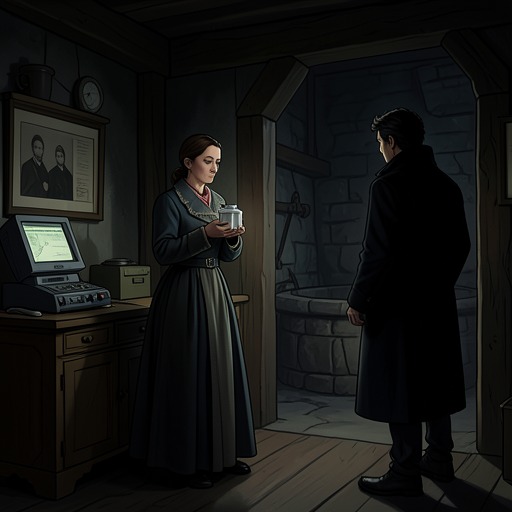
The plan also belongs to the wider chain of violence. Michael had killed Olga Seminoff with Rowena Drake, and Rowena feared that someone might have witnessed the killing in Quarry Wood. Joyce had not, in fact, seen a murder, but Michael's guilt about the earlier crime helped make Miranda's mistaken belief dangerous. Poirot's account of Joyce's death supplied a separate link: the murderer had needed an innocent explanation for getting wet after holding a struggling child beneath water. Rowena created one by dropping a water-filled vase and letting Elizabeth Whittaker witness the resulting accident. These earlier crimes explain why Miranda's supposed knowledge and Michael's attempt to silence or frame her could be folded into the artificial sacrifice at the Ring.
Aftermath and Significance
Michael's ritual construction was undone by the arrival of the rescuers, and Miranda survived. Poirot later pictured Michael dead beside the megalith marked with the double axe, still clutching the golden goblet he had seized and drained when retribution came. The image returns the objects of the staged ceremony to the scene, but reverses their meaning: the would-be director of a sacrifice becomes its dead figure, while his intended victim lives.
The episode contrasts the children's Hallowe'en party, with its arranged games and flaming raisins, against Michael's private imitation of ancient ritual. At the party, ritual-like customs belong to communal play; at Kilterbury Ring, Michael uses old symbols to isolate Miranda, teach her to accept a false account of justice, and make a murder appear ceremonial. The double axe, the cup, and the language of beauty are not proof of a supernatural or sacred order. They are props in a plan to turn murder into spectacle and to bend Miranda's guilt toward her own death.